


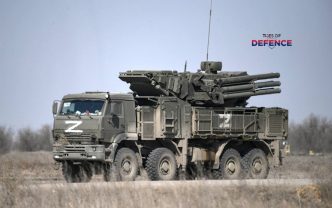
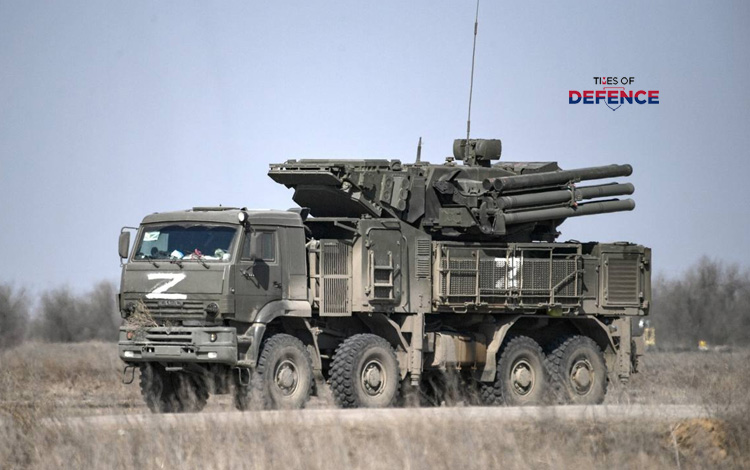
Dmitry Shugaev, Director of Russia’s Federal Service for Military-Technical Cooperation (FSMTC), announced on November 1, 2026, that Moscow expects to execute a sales contract for the Pantsir-S1 (SA-22 Greyhound) self-propelled anti-aircraft gun/missile system with Azerbaijan.
The prospective transaction signals a potential recovery in bilateral defense trade following a diplomatic fallout triggered by the December 2024 downing of an Azerbaijan Airlines Embraer E190 over the Caspian region. Concurrently, Shugaev confirmed the signing of a comprehensive bilateral agreement under which Russian defense enterprises will assist Azerbaijan in constructing and modernizing maintenance, repair, and overhaul (MRO) facilities for its fleet of Russian-made armored fighting vehicles (including T-90S MBTs, BMP-3 IFVs, and BTR-80A APCs).
TECHNICAL SPECIFICATIONS: PANTSIR-S1 AIR DEFENSE ARCHITECTURE
System Classification, Chassis & Mobility Baseline
⚡ Developer & OEM: KBP Instrument Design Bureau (Tula, Russia / Rostec High Precision Systems)
⚡ System Classification: Self-Propelled Short-Range Air Defense (SHORAD) Missile and Anti-Aircraft Artillery (SPAAGM) System
⚡ Carrier Vehicle Options: KAMAZ-63501 8×8 heavy utility truck chassis (standard), MAN 8×8, or Belarus-built MZKT chassis variants
⚡ Operational Manning: 3-person crew (Commander, Operator, Driver) integrated inside an armored control cabin
⚡ Setup & Reaction Times: 5 minutes from stowed/transit to operational firing status; 4-to-6 second target reaction time 
Sensory Suite, Tracking Radars & Target Engagement Matrix
💥 Target Acquisition Radar (TAR): 1RS1-1E S-band phased-array radar providing 360° azimuth coverage out to 36–40 km for targets up to 15 km altitude
💥 Target Tracking Radar (TTR): 1RS2 / 1RS2-1E Dual-band (mm-wave and X-band) phased-array tracking radar capable of simultaneous multi-target engagement
💥 Electro-Optical/Infrared (EO/IR) Pod: Multi-channel optical tracker featuring thermal imaging, daylight TV camera, and laser rangefinder for passive engagement in high-jamming environments
💥 Target Engagement Capacity: Simultaneous engagement of up to 4 targets across radar and optical channels; intercept velocity envelope up to 1,000 m/s (Mach 3.0+)
Kinetic Ordnance: Surface-to-Air Missiles & Dual Autocannons
🚀 Surface-to-Air Missile (SAM) Suite: 12× ready-to-launch 57E6 / 57E6-E radio-command-guided two-stage solid-fuel missiles
• Slant Intercept Range: 1.2 km to 20 km (up to 30 km on upgraded Pantsir-SM baselines)
• Intercept Altitude Envelope: 15 meters to 15,000 meters (49,000 ft)
• Warhead: 20 kg continuous-rod / fragmentation warhead with contact and proximity fuzing
🚀 Dual Autocannon Suite: 2× 2A38M 30mm dual-barrel automatic anti-aircraft cannons
• Rate of Fire: Combined 4,800 to 5,000 rounds per minute
• Effective Engagement Range: 200 meters to 4,000 meters; Altitude: up to 3,000 meters
• Ammunition Types: HE-T (High-Explosive Tracer) and HE-I (High-Explosive Incendiary)
TIMES OF DEFENCE ASSESSMENT
Russia’s proposal to export the Pantsir-S1 to Azerbaijan reflects Moscow’s desire to re-engage Baku’s arms market, but it faces significant technical and geopolitical hurdles.
From an aerospace engineering and regional procurement perspective, the initiative presents three core dynamics:
1. **Rebuilding Russian Defense Export Footprint**: Following diplomatic resolution over the 2024 airliner incident and settlement on compensation, Russia is eager to resume defense sales to Azerbaijan. The signed MRO modernization program for Azerbaijan’s legacy T-90S and BMP-3 fleets provides Moscow with an operational foothold to maintain defense ties despite Baku’s increasing tilt toward Turkish and Israeli suppliers.
2. **Operational Performance vs. Drone Saturation**: While the Pantsir-S1 offers a combined gun/missile defense envelope, its operational record in high-density uncrewed combat environments—including Ukraine and Syria—has revealed vulnerabilities to multi-directional loitering munitions and electronic warfare. Azerbaijan’s extensive procurement of Turkish (Baykar Mızrak, Aselsan ALP-100) and Israeli (Elbit PULS, IAI systems) technology suggests Baku may prioritize NATO-compatible or indigenous counter-UAS systems over Russian SHORAD platforms.
3. **South Caucasus Defense Diversification**: Azerbaijan has maintained a multi-vector procurement strategy, signing over $500 million in Turkish defense agreements (Hürkuş-II, Barbaros, Aselsan radars) alongside Israeli precision artillery (Elbit PULS/EXTRA). Relying on Russian armored vehicle MRO while acquiring Western, Turkish, and Israeli sensors forces Azerbaijan’s defense forces to manage complex, multi-tiered C4ISR integration across competing industrial baselines.

