


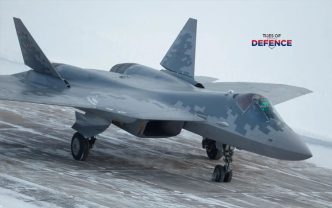
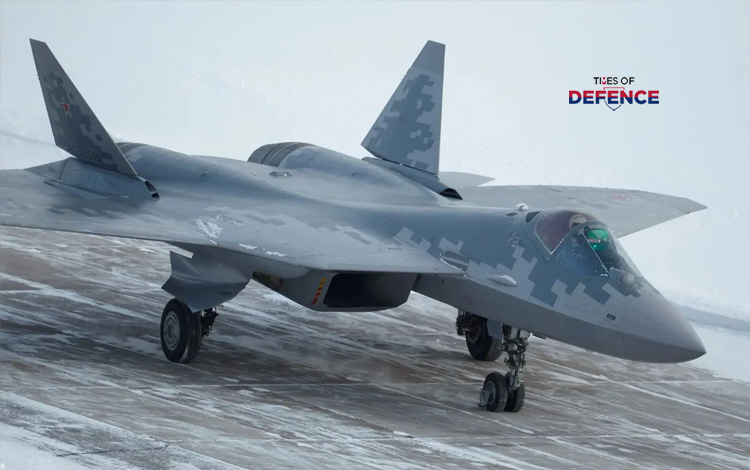
Prominent pro-Kremlin military aviation blogger Ilya Tumanov, operating the Fighterbomber Telegram channel, pushed back on November 24, 2026, against statements by United Aircraft Corporation (UAC) CEO Vadim Badekha characterizing the Sukhoi Su-57 Felon as Russia’s “main” combat aircraft in the war against Ukraine, arguing that if the Su-57 stopped flying tomorrow, neither Russian forces nor Ukrainian defenders would notice.
Badekha’s remarks followed Rostec and UAC’s November 19, 2026 announcement handing over a third batch of upgraded Su-57 fighters—equipped with updated onboard systems and weapons—to the Russian Aerospace Forces (VKS) from the Komsomolsk-on-Amur Aircraft Plant (KnAAZ), where Moscow does not disclose exact batch sizes under a 2019 contract for 76 aircraft through 2028. While acknowledging the Su-57’s combat exposure relative to rival fifth-generation designs, Tumanov contended that low fleet numbers limit its operational impact compared to high-volume workhorses—singling out the Soviet-era Mi-8 transport/utility helicopter as irreplaceable to daily logistics, medical evacuation, and rocket support, while noting that losing Su-35 fighters would be “sad” and losing Su-34 strike aircraft would be a “disaster.”
TECHNICAL SPECIFICATIONS: SUKHOI SU-57 FELON & OPERATIONAL FLEET CONTEXT
1. Airframe, Propulsion, Avionics & Weapons Envelope
⚡ Prime OEM & Production Site: Sukhoi / United Aircraft Corporation (UAC, part of Rostec), assembled at the Komsomolsk-on-Amur Aircraft Plant (KnAAZ); third 2026 batch delivered November 19, 2026 (following earlier batches in February and September 2026) with undisclosed unit counts
⚡ Airframe & Stealth Architecture: Twin-engine low-observable multirole fighter featuring blended wing-body aerodynamics, all-moving tail surfaces, thrust-vectoring nozzles, and two internal weapons bays plus external hardpoints (with a two-seat Su-57D prototype also entering flight testing in May 2026)
⚡ Propulsion & Kinematic Envelope: Currently fielded with AL-41F1 (izdeliye 117) turbofans delivering supercruise capability, Mach 2-class maximum speed, and a combat ceiling near 20,000 meters, while higher-thrust izdeliye 30 / izdeliye 177 propulsion upgrades remain in development/transition
⚡ Sensors & Munitions Suite: Equipped with N036 Byelka AESA radar array and electro-optical/infrared (EO/IR) sensors, supporting internal carriage of R-77M (izdeliye 180) and R-74M2 air-to-air missiles alongside standoff strike munitions such as Kh-69 cruise missiles and Kh-38M tactical missiles 
2. Fleet Scale, Employment Profile & Comparative Utility
💥 Fleet Scale & Delivery Constraints: Built under a June 2019 contract for 76 aircraft by 2028 alongside export Su-57E commitments, with small annual/batch handovers and low active frontline numbers compared to legacy tactical fleets and thousands of Mi-8 airframes
💥 Battlefield Employment Pattern: Primarily employed in standoff strike and air-patrol missions from Russian-controlled airspace rather than deep penetration over heavily contested air defenses, with Russian aircraft also exposed to long-range strikes such as the April 2026 strike reported at Shagol airfield
💥 Comparative Force Relevance: Contrasted by Fighterbomber against the ubiquitous Mi-8 helicopter—essential for troop movement, cargo, casualty evacuation, and unguided rocket fire—as well as higher-density Su-34 and Su-35 fleets
TIMES OF DEFENCE ASSESSMENT
The public exchange between UAC leadership and Fighterbomber following the third 2026 Su-57 batch delivery highlights three critical realities of modern airpower economics, fleet scale, and wartime aviation discourse:
1. Fleet Mass and Sortie Volume Outweigh Flagship Status in High-Attrition Wars: Even technologically capable or high-profile platforms have limited day-to-day operational weight if fielded in small numbers, whereas high-volume platforms like the Mi-8, Su-34, and Su-35 drive continuous logistics, strike, and air-defense sorties.
2. Standoff Employment Limits Direct Tactical Impact in Contested Airspace: Operating stealthier or high-value jets primarily from standoff envelopes to preserve airframes reduces direct frontline visibility compared to tactical strike and rotary-wing assets operating closer to the line of contact.
3. Industrial Bottlenecks and Export Competition Strain Low-Rate Production: With KnAAZ balancing domestic deliveries under a 76-jet contract, export Su-57E commitments, and propulsion/system upgrades, undisclosed batch sizes reinforce outside assessments that production scaling remains measured.

