

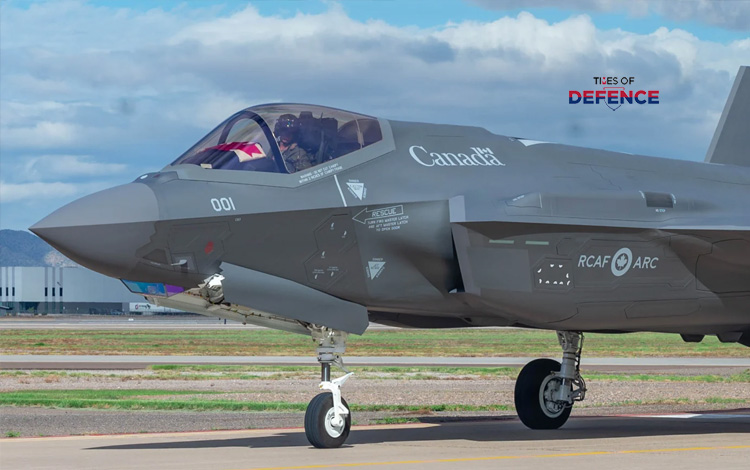
A Royal Canadian Air Force (RCAF) capability-development discussion paper titled “Project Arrow”—reported on November 24, 2026 and authenticated by Canada’s Department of National Defence (DND)—outlines a future combat-air architecture anchored on the Lockheed Martin F-35A Lightning II and domestically developed Collaborative Combat Aircraft (CCAs), omitting any mention of Saab’s Gripen fighter while Ottawa continues reviewing its broader fighter procurement options.
While DND officials emphasized that Project Arrow originates from the RCAF’s autonomous collaborative platform office as an internal discussion concept rather than formal government policy or a binding procurement decision, the paper arrives weeks after Canada’s first F-35A maiden flight in September 2026 and the October 22, 2026 delivery of the first two RCAF F-35A jets to Luke Air Force Base, Arizona. Structured around three pillars—continuing F-35 entry into service, building Canadian-owned collaborative drones to fly alongside crewed fighters, and expanding Canada’s role in the Global Combat Air Programme (GCAP) after becoming its first observer nation in July 2026—the document highlights ongoing friction between operational air-force preferences, industrial-offset proposals tied to Saab’s Gripen assembly offer, and strategic sovereignty debates over U.S. dependency.
TECHNICAL SPECIFICATIONS: RCAF “PROJECT ARROW” & F-35A / CCA ARCHITECTURE
1. Strategic Concept, Programme Status & Fleet Mix Debate
⚡ Document Origin & Governance Status: Capability-development concept paper (“Project Arrow”) authored within an RCAF autonomous collaborative platform branch and confirmed authentic by DND as a discussion paper rather than formal policy or an active procurement program
⚡ F-35A Fielding & Review Posture: First two RCAF F-35A aircraft arrived at Luke Air Force Base, Arizona on October 22, 2026 (following a September 2026 maiden flight in Texas); Ottawa maintains its commitment to at least 16 F-35As and has begun funding 14 additional units while reviewing the remainder of its planned 88-jet acquisition and studying a potential mixed fleet with Saab Gripen
⚡ Sixth-Generation & Allied Linkages: Canada joined the trilateral UK–Italy–Japan Global Combat Air Programme (GCAP) as its first observer nation in July 2026, while BAE Systems and Bombardier signed a memorandum in October 2026 to explore next-generation combat aircraft collaboration, including mission systems and digital engineering 
2. Collaborative Combat Aircraft (CCA) & F-35A Operational Envelope
💥 Sovereign IP & Manned-Unmanned Teaming (MUM-T): Prioritizes domestic Canadian development and sovereign intellectual property (IP) retention for collaborative drones operating in formation with F-35As—with potential domestic contributors including Bombardier and Ottawa-based Dominion Dynamics (developing the Dominion Scout Arctic UAV concept with Pratt & Whitney Canada engine engagement)
💥 F-35A Fifth-Generation Baseline: Single-engine, stealthy multirole fighter powered by a Pratt & Whitney F135 turbofan with sensor fusion, low-observable airframe shaping, and networked battle-management connectivity to act as a forward command and sensor node for uncrewed wingmen
💥 Strategic Sovereignty & Industrial Trade-Offs: Weighs operational fifth-generation stealth and network integration against concerns over U.S. political/supply-chain leverage raised by former air force leadership and competing industrial offset pitches—such as Saab’s proposal for Canadian Gripen final assembly and GE Aerospace / Magellan Aerospace engine maintenance
TIMES OF DEFENCE ASSESSMENT
The emergence of the RCAF’s “Project Arrow” discussion paper amid initial F-35A deliveries highlights three core tensions in Canadian airpower planning, sovereign defense industrial policy, and manned-unmanned combat teaming:
1. Operational Pull Toward Fifth-Generation Stealth and Uncrewed Wingmen: From a tactical standpoint, air-force planners favor pairing stealthy fifth-generation sensors and data links with collaborative drones to expand coverage across vast Arctic and NORAD airspace while keeping crews out of high-threat zones.
2. Friction Between Industrial Offsets and Operational Requirements: While Saab’s Gripen offer and domestic maintenance/assembly proposals attract attention for local jobs and industrial return, defense analysts warn that treating fighter selection primarily as an economic job-creation exercise risks sidelining long-term operational needs against Russian and Chinese activity in the Arctic.
3. Navigating Strategic Autonomy Within Deep North American Integration: Even if Canada retains domestic IP on future collaborative drones, operating an F-35A fleet and NORAD defense architecture closely tied to U.S. supply chains and approvals underscores the ongoing debate over how much operational autonomy Ottawa can exercise over its future combat air force.