


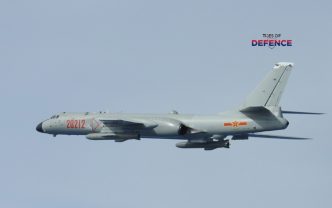
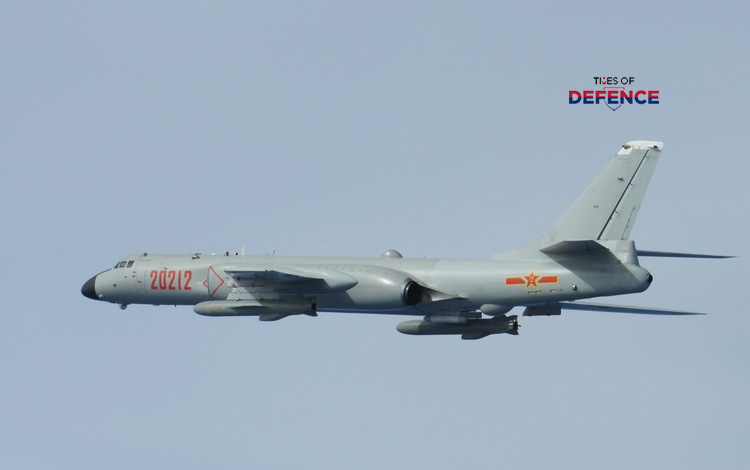
Imagery has surfaced indicating that a People’s Liberation Army Air Force (PLAAF) Xi’an H-6KG cruise missile bomber has been equipped with a new, heavy underwing electronic warfare (EW) pod.
The observed pod closely matches the design language of the RKZ930 series electronic countermeasure (ECM) family—the primary wideband tactical jamming suite fielded on the Shenyang J-16D dedicated electronic attack aircraft. Mounting high-power jamming hardware directly onto the H-6KG airframe represents a capability evolution for the PLAAF’s standoff missile carrier fleet. If operationalized, onboard wideband jamming would allow H-6KG strike packages to conduct organic radar suppression during launch approaches without mandatory escort by dedicated electronic warfare aircraft.
TECHNICAL SPECIFICATIONS: H-6KG EW POD INTEGRATION & SUITE ARCHITECTURE
System Developer, Airframe Integration & Pod Designation
⚡ Platform Integrator: Xi’an Aircraft Industrial Corporation (XAC) / PLAAF Air Intelligence
⚡ Host Airframe: Xi’an H-6KG (PLAAF land-attack cruise missile / standoff strike variant)
⚡ Pod Classification & Lineage: Suspected derivative of the RKZ930-series high-power tactical EW suite (developed by CETC for the J-16D and J-15DT Flanker-derived EW aircraft)
⚡ Pylon Mounting Configuration: Heavy underwing hardpoints (previously dedicated to KD-20/CJ-10K cruise missiles or YJ-12 anti-ship missiles)
⚡ Operational Status: Flight-test / integration phase; operational deployment and full electromagnetic compatibility (EMC) within active bomber units unconfirmed 
Electronic Attack (EA) & Jamming Capabilities
💥 Multi-Band Frequency Coverage: Modulated solid-state active electronically scanned array (AESA) jammer emitters designed to counter early warning, target acquisition, and fire-control radars (S-band, C-band, and X-band arrays)
💥 Organic Standoff Jamming: Generates high-ERP (Effective Radiated Power) noise, deceptive jamming, and digital radio frequency memory (DRFM) techniques directly from the bomber platform
💥 Dynamic Escort-Free Strike Concept: Reduces reliance on J-16D “Gray Wolf” escorts, allowing long-range H-6KG strike packages to operate with higher autonomous electronic survivability in contested airspace
💥 Payload Trade-off Metrics: Equipping underwing EW pods occupies hardpoints, trading 1 to 2 standoff missiles (e.g., KD-20/YJ-12) for enhanced electronic protection and survivability during ingress/egress
Tactical Airframe & Sensor Network Interoperability
🚀 Optronics & Targeting Suite: Integrated with the H-6KG’s chin-mounted electro-optical/infrared (EO/IR) targeting turret and ventral surface-search radar
🚀 Radar Warning & EW Integration: Interfaces with the airframe’s tail-mounted Radar Warning Receiver (RWR) and Missile Approach Warning System (MAWS) for automated threat prioritization
🚀 Data-Link & Cooperative Engagement: Open software architecture compatible with PLAAF Joint C4ISR networks (Link 16 equivalent), enabling real-time threat-frequency sharing with escort fighters and naval air assets
TIMES OF DEFENCE ASSESSMENT
The spotting of an RKZ930-class jamming pod on the H-6KG missile carrier points to strategic adaptations in how the PLAAF envisions standoff missile operations, particularly in a Taiwan Strait or Western Pacific anti-access/area-denial (A2/AD) scenario.
From an electronic warfare and air combat perspective, this integration introduces several key tactical dynamics:
1. **Enhanced Standoff Survivability**: The H-6K/KG is a non-stealthy airframe designed as a standoff launch vehicle rather than a deep-penetration bomber. Equipping the airframe with high-power jamming pods complicates the tracking loop for enemy ground-based air defenses (e.g., Patriot PAC-3, SAMP/T, or Taiwan’s Sky Bow III) and naval Aegis combat systems, increasing the survival probability of the platform prior to missile release.
2. **Autonomous Tactical Formation Flexibility**: Previously, H-6 strike groups required dedicated electronic warfare support—such as the J-16D or legacy HD-6/H-6G jamming variants—to blind enemy radars. Organic jamming capability gives PLAAF commanders greater flexibility to deploy independent bomber strike packages over longer ranges without exhausting the operational radius or endurance of escorting fighter-type EW assets.
3. **Payload Trade-off Considerations**: Mounting external EW pods displaces heavy ordnance pylons. Military planners must balance the tactical trade-off between carrying fewer cruise missiles (e.g., 4× KD-20s instead of 6×) versus securing higher platform survivability and target suppression through onboard electronic attack.

