


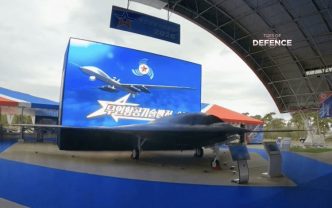
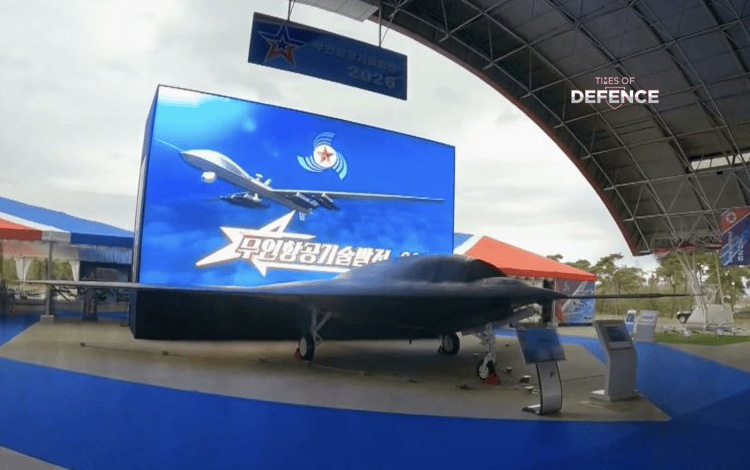
The Democratic People’s Republic of Korea (DPRK) has publicly unveiled a previously unseen, tailless flying-wing uncrewed aerial vehicle (UAV) during the “Unmanned Aeronautical Technology Development – 2026” exhibition in Pyongyang.
Inspected by North Korean General Secretary Kim Jong Un alongside senior Korean People’s Army (KPA) leadership, the static platform features aerodynamic shaping aligned with low-observable (stealth) design principles. Resembling global heavy UCAV technology demonstrators—such as the American Northrop Grumman X-47B, China’s CASC GJ-11 Sharp Sword, Dassault’s European nEUROn, and Russia’s Sukhoi S-70 Okhotnik—the platform signifies North Korea’s intent to develop deep-penetration, low-radar-cross-section (RCS) reconnaissance and strike platforms. However, key operational parameters, internal systems architecture, and actual flight status remain unverified by foreign defense intelligence agencies.
TECHNICAL SPECIFICATIONS: NORTH KOREAN FLYING-WING UAV DEMONSTRATOR
Program Governance, Exhibition Context & Development Footprint
⚡ Development Authority: KPA Air Force / Defense Development State Academy (Pyongyang, DPRK)
⚡ Exhibition Debut: Unmanned Aeronautical Technology Development – 2026 (Pyongyang)
⚡ Estimated Dimensions: Wingspan: ~17 to 20 meters (56–66 ft) | Fuselage Height: ~3.0 to 3.5 meters (10–11.5 ft)
⚡ Design Configuration: Tailless blended-wing-body (BWB) layout with a swept delta-wing silhouette, integrated dorsal air intake, and retractable tricycle landing gear
⚡ Operational Status: Ground technological demonstrator / mock-up phase; no verified flight telemetry or live operational deployments confirmed 
Aerodynamic Shaping & Signature Management Evaluation
💥 Planform Alignment: Edge-aligned swept wing leading edges and serrated rear trailing edges designed to reflect incident radar energy away from threat emitters
💥 Air Intake Architecture: Top-mounted (dorsal) flush air intake designed to mask the engine face (compressor blades) from frontal line-of-sight ground-based radars
💥 Vertical Surface Elimination: Complete omission of traditional vertical fins, tail planes, and rudders to eliminate major sources of side-aspect radar cross-section (RCS)
💥 Stealth Limitations & Unknowns: Low-observable performance requires precise composite radar-absorbing material (RAM) application, internal weapon bays, S-duct intake geometry, and engine thermal (IR) suppression—capabilities unconfirmed in North Korean manufacturing
Propulsion, Sensor & Payload Hypotheses
🚀 Suspected Propulsion: Internal single non-afterburning turbojet or turbofan engine (potentially derived from legacy Klimov RD-33 or Soloviev D-30 stocks, or small domestic turbojet series)
🚀 Tactical Mission Profiles: Designed for high-end Reconnaissance-Strike Complexes (RSC)—conducting deep intelligence, surveillance, and reconnaissance (ISR) and targeting for KN-25 / tactical ballistic missile units
🚀 Internal Bay Capacity: Estimated center fuselage volume suggests potential internal bay storage for satellite/laser-guided precision munitions or optical/radar sensor payloads
TIMES OF DEFENCE ASSESSMENT
The unveiling of a flying-wing stealth UAV design demonstrates Pyongyang’s strategy to match Western and regional unmanned force structures. Following previous displays of the Saetbyol-4 (RQ-4 Global Hawk clone) and Saetbyol-9 (MQ-9 Reaper clone), introducing a tailless flying-wing platform highlights rapid external design adoption by North Korean aerospace engineers.
From an aerospace engineering and air defense intelligence perspective, several technical factors govern this development:
1. **Geometric Stealth vs. Complete LO Integration**: Constructing a flying-wing shell is achievable through fiberglass, aluminum, or basic carbon composites. However, true low-observable (stealth) combat performance depends on advanced Radar-Absorbing Materials (RAM), complex flush S-duct engine intakes to conceal turbine blades, and precise seam tolerances. Without verified flight testing or thermal/RCS data, foreign intelligence agencies treat the platform as a design demonstrator rather than an operational stealth threat.
2. **Flight Control Software Challenges**: Tailless flying-wing aircraft are aerodynamically unstable along pitch and yaw axes, requiring complex, multi-redundant fly-by-wire (FBW) flight control software to maintain stable flight. Achieving this software autonomy without foreign technical assistance (such as technology transfers from Russia or China) represents a significant development hurdle for Pyongyang.
3. **Integration into Reconnaissance-Strike Complexes**: If North Korea transitions the design into a functional long-endurance UCAV, its primary operational role would be penetrating South Korean and Allied air defenses to perform target acquisition for heavy artillery and tactical ballistic missile batteries, strengthening DPRK strike capability across the Korean Peninsula.

