


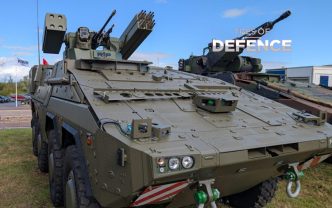
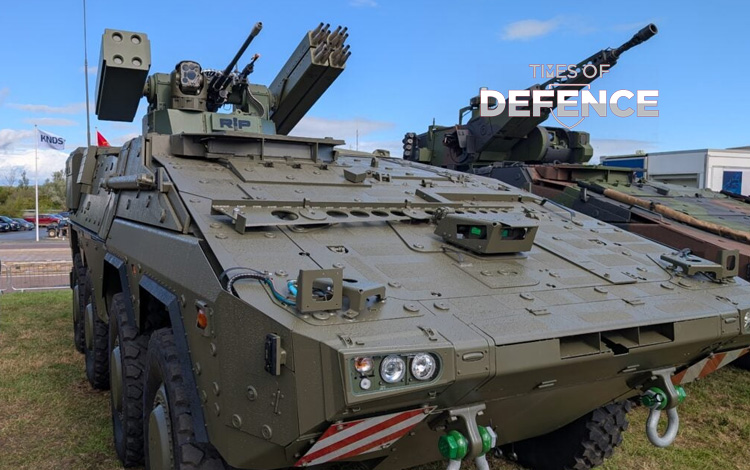
Moog has unveiled a new air-defense configuration of its Reconfigurable Integrated-weapons Platform (RIwP) mounted on a Boxer 8×8 at DVD 2026, combining a 30mm cannon, Stinger missiles and 70mm laser-guided rockets on a single armored platform.
The configuration represents the first time Moog’s RIwP has been integrated onto the Boxer, according to the company. The mission module was assembled in just a matter of weeks using engineers and facilities in the United Kingdom operated by Moog and KNDS. Moog has also committed to manufacturing RIwP in the UK through a local supply chain.
The vehicle displayed at DVD 2026 is not an announced British Army procurement. Instead, it demonstrates how the Boxer platform could be adapted for short-range air defense (SHORAD), counter-UAS and other close-combat missions.
Three Layers of Firepower
The most striking feature of the configuration is its combination of three different effectors:
- XM914 30×113mm automatic cannon
- FIM-92 Stinger surface-to-air missiles
- 70mm laser-guided rockets
The displayed launcher carries four Stinger missiles and a 16-round 70mm guided-rocket canister. Moog says the 70mm rocket capacity can also be expanded, depending on configuration.
A 7.62mm M240 machine gun is also integrated into the turret.
This creates a layered weapon architecture rather than relying on a single interceptor against every aerial threat.
A relatively inexpensive drone does not necessarily need to be engaged with a Stinger if the cannon or guided rocket can provide an effective response.
Conversely, Stinger provides a dedicated missile option for more demanding airborne targets.
RIwP — Designed Around Modularity
RIwP is fundamentally a modular remote weapon system.
Moog describes it as weapon-, sight- and platform-agnostic, allowing different guns, missiles, sensors and other effectors to be integrated onto the same basic architecture. The company says the Standard RIwP shares approximately 85% commonality of subcomponents across configurations.
Its published compatibility includes:
- 30mm XM914
- 30mm Mk44/XM813
- 7.62mm M240
- .50-caliber M2
- Stinger
- Coyote
- Hellfire
- Javelin
- APKWS 70mm rockets
- Starstreak
- LMM
- Other missile and counter-UAS effectors
That flexibility allows the same basic turret architecture to be configured for different missions rather than developing a completely new turret for each requirement.
Why Put It on Boxer?
The Boxer is already designed around a modular architecture.
Its common drive module can accept different mission modules, allowing operators to configure the same basic vehicle for troop transport, command, ambulance and other roles.
Adding RIwP creates another possible mission configuration:
Boxer 8×8 + RIwP = mobile air defense
That could be particularly useful for mechanized formations that need their air-defense assets to keep pace with armored and infantry units.
A wheeled Boxer-based system can move with the formation rather than relying on static air-defense positions.
The Drone-Swarm Problem
The configuration is particularly relevant to the rapid growth of small unmanned aircraft on modern battlefields.
A traditional air-defense model can become inefficient when an inexpensive drone forces the defender to use a much more expensive guided missile.
This is the central logic behind the mixed-effector RIwP concept.
A hypothetical engagement sequence could look like:
Small/slow UAV → 30mm cannon
More demanding UAV → 70mm guided rocket
Aircraft/helicopter or higher-value threat → Stinger
The actual engagement decision would depend on the sensors, fire-control architecture, target characteristics and rules of engagement adopted by an eventual user.
But the concept gives the operator a larger menu of responses and potentially preserves expensive missiles for targets that require them.
70mm Rockets Add Magazine Depth
The 70mm guided rockets are particularly interesting.
The displayed configuration carries 16 rockets, while Moog says the capacity can be increased to 32.
That gives the vehicle considerably more ready-to-fire effectors than a four-missile Stinger launcher alone.
Moog’s broader RIwP architecture already supports APKWS and other 70mm guided rockets. These weapons can provide a precision effect between conventional cannon fire and dedicated surface-to-air missiles.
For counter-UAS operations, magazine depth can be just as important as maximum interceptor performance.
A system that can defeat multiple targets before reloading has an obvious advantage during prolonged attacks or swarm engagements.
Under-Armor Reloading
Another important RIwP feature is its ammunition handling.
Moog says the turret allows direct-fire weapons to be reloaded from under armor, reducing the need for crew members to expose themselves during ammunition replenishment.
The turret also does not extend below the Boxer vehicle’s roofline.
This helps preserve internal vehicle space for personnel and mission equipment.
For a vehicle that may have to operate close to the forward edge of the battlefield, keeping the crew protected while rearming is a significant design consideration.
RIwP Has Already Been Used for M-SHORAD
The Boxer configuration is new, but the underlying RIwP architecture is not untested.
Moog identifies RIwP as the core turret architecture for the U.S. Army’s Maneuver Short-Range Air Defense Increment 1, also known as the SGT Stout program.
The U.S. configuration integrates RIwP with a Stryker chassis and combines:
- XM914 30mm cannon
- M240 7.62mm machine gun
- Stinger missiles
- Hellfire missiles
- Radar and electro-optical/infrared sensors
The U.S. system therefore provides a useful reference for the Boxer concept.
However, the two configurations should not be treated as identical.
The DVD 2026 Boxer demonstrator uses 70mm guided rockets instead of the Hellfire configuration used by M-SHORAD.
Sensors Will Determine the Real Capability
The weapons displayed on the Boxer attract most of the attention, but the effectiveness of an air-defense vehicle ultimately depends heavily on its sensor and command-and-control architecture.
A complete SHORAD system needs to:
Detect → classify → track → prioritize → engage → assess
Small drones can present difficult targets because of their low radar and infrared signatures and their ability to operate at low altitude.
The Boxer-RIwP demonstrator therefore should not be interpreted as a complete operational air-defense system simply because the weapons are mounted on the vehicle.
An operational configuration would require an appropriate combination of radar, electro-optical sensors, identification systems, fire control and communications/network integration.
Moog’s RIwP architecture is designed to support direct radar integration, stabilized sights and additional sensors, including counter-UAS and electronic-warfare payloads.
Starstreak and Martlet Are Also Possible
The displayed configuration is not the only possible British-oriented weapon fit.
Moog’s RIwP documentation lists Starstreak HVM and Starstreak LMM among compatible missile effectors.
That gives a potential UK configuration several options depending on the mission:
Stinger + cannon + 70mm rockets
or
Starstreak/LMM + cannon + 70mm rockets
or other combinations using the RIwP architecture.
The exact configuration would ultimately depend on the customer’s requirements and procurement decision.
A Possible Successor Concept for Stormer
The timing is significant for the British Army.
The UK is seeking to modernize its short-range air-defense capability, while the legacy Stormer HVM platform dates back to the CVR(T) family.
A Boxer-mounted RIwP would represent a substantial change in architecture:
Tracked Stormer → wheeled Boxer
Dedicated missile system → multi-effector turret
Limited ready-to-fire missile inventory → cannon + rockets + missiles
However, there is currently no announced UK decision to procure the Boxer-RIwP configuration as a Stormer replacement.
The system remains an industry demonstration at DVD 2026.
Beyond Air Defense
RIwP’s modularity means the same turret architecture can support missions beyond SHORAD.
Moog says configurations have been developed for:
- Specialist counter-UAS
- Short-range air defense
- Mounted Close Combat Overwatch
- Anti-armor
- Multi-mission direct fire
The company also markets RIwP for robotic and unmanned platforms.
This could allow an army to retain a common turret architecture while changing the weapons and sensors according to the operational role.
Why the Concept Matters
The significance of the Boxer demonstrator is therefore not simply that it carries more weapons.
It represents a broader shift in how short-range air defense is being designed.
Instead of asking:
“Which missile defeats this target?”
the system can potentially ask:
“Which available effector is the most appropriate and economical response?”
That distinction becomes increasingly important in a battlefield where a $10,000-class or similarly inexpensive drone can force the expenditure of a much more expensive interceptor.
A 30mm cannon, guided 70mm rockets and Stinger missiles give the operator several layers of response while maintaining the protection and mobility of an armored 8×8 vehicle.
Bottom Line
The Moog RIwP Boxer displayed at DVD 2026 is a demonstrator, not yet a British Army operational system.
But it combines several trends shaping modern ground-based air defense:
Boxer mobility + modular mission architecture + 30mm cannon + guided rockets + Stinger missiles + under-armor reload + future sensor integration.
The result is a potential multi-layer SHORAD/C-UAS platform designed to deal with a broader range of threats while reducing reliance on high-value missiles for every engagement.
The next question is no longer whether RIwP can be mounted on Boxer.
It is whether the British Army decides that this combination is the right answer for its next-generation mobile air-defense requirement.