

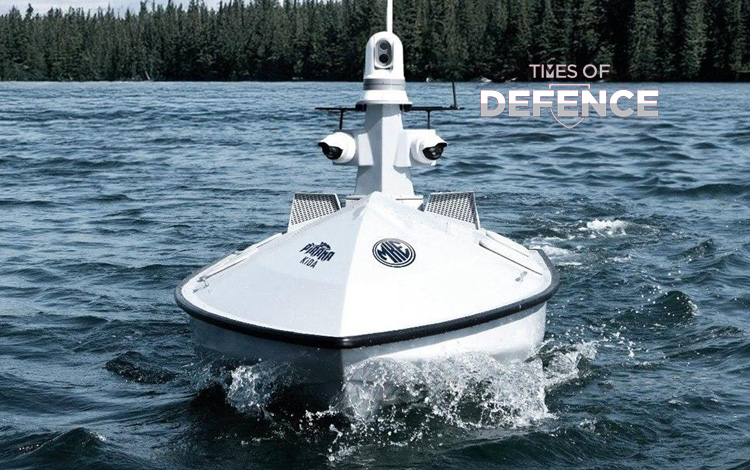
Türkiye’s MKE PİRANA kamikaze unmanned surface vessel has conducted its first publicly reported attack against a surface target, successfully destroying the target during the Denizkurdu-I/2026 exercise.
The strike took place on September 24 during the exercise’s distinguished observer day in the Eastern Mediterranean.
According to the Turkish Ministry of National Defence, PİRANA — developed by Makine ve Kimya Endüstrisi (MKE) — attacked a surface target using a warhead weighing approximately 100 kilograms. The system was operated through a command-and-control console installed aboard a Tuzla-class patrol vessel.
The successful strike marks an important transition for PİRANA: from controlled development and impact testing to a live-fire exercise demonstrating its ability to approach and destroy a surface target in a naval operational scenario.
A 200+ Nautical-Mile Kamikaze USV
MKE describes PİRANA as a low-cost, high-impact unmanned surface vessel designed for asymmetric warfare.
Its published product specifications list a range of more than 200 nautical miles, a top speed of more than 50 knots, and a displacement of approximately 1,200 kilograms.
The current MKE product page lists a 65-kg high-explosive warhead, consisting of a 50-kg warhead and a 15-kg precursor charge. However, the Ministry of National Defence specifically described the PİRANA used in the Denizkurdu-I demonstration as carrying an approximately 100-kg warhead.
This indicates that the configuration demonstrated during the exercise should not automatically be equated with every specification on MKE’s general product page.
PİRANA — Publicly Disclosed Specifications
| Feature | PİRANA |
|---|---|
| Type | Kamikaze unmanned surface vessel |
| Manufacturer | MKE |
| Maximum speed | 50+ knots |
| Published range | 200+ nautical miles |
| Displacement | ~1,200 kg |
| Propulsion | Diesel engine + waterjet |
| Warhead | 65 kg listed by MKE; ~100 kg cited for Denizkurdu-I configuration |
| Navigation | GNSS with CRPA anti-jamming support |
| Sensors | Electro-optical cameras |
| Control | Remote and autonomous modes |
| Sea-state capability | Level 4 |
| Employment | Single-vehicle or swarm concept |
MKE says PİRANA uses a diesel engine with waterjet propulsion and is designed for both remotely controlled and autonomous missions. Its navigation architecture includes CRPA-supported GNSS intended to improve resilience against interference.
From Remote Control to Autonomous Attack
PİRANA is not limited to conventional remote-control operation.
MKE describes the system as capable of operating in both operator-controlled and autonomous modes. The vessel can be directed toward a designated target and programmed to detonate upon impact.
The system is also being developed around a swarm concept.
Multiple PİRANA vessels could operate together, potentially forcing an adversary to divide its surveillance and defensive resources among several simultaneous contacts.
MKE says the vessel’s low radar cross-section and composite hull are intended to reduce the probability of detection, while its maneuverability allows it to conduct dynamic and asymmetric approaches toward targets.
The Communications Architecture
One of the more significant aspects of the system is its communications architecture.
MKE states that PİRANA can operate through RF and satellite communications, enabling remote control over long distances.
The system has also been demonstrated in an integrated configuration involving TCG Anadolu and Bayraktar TB3, with a data link and command-and-control connection between the platforms and PİRANA.
MKE says this demonstration was intended to show how the unmanned surface vessel could conduct operations at longer ranges by using an airborne or ship-based platform as part of the command-and-control architecture.
This points toward a broader concept in which the USV is not necessarily required to operate independently of the fleet.
Instead, it can become an expendable effect connected to a wider network of manned and unmanned platforms.
Why 50+ Knots Matters
PİRANA’s reported speed of more than 50 knots is significant for a vessel of this class.
At that speed, the system can rapidly close the final distance once a target has been designated.
The waterjet propulsion system also supports high maneuverability, which can be particularly important during the terminal phase of an attack.
The combination of:
high speed + low observability + autonomous/remote control + long range + large explosive payload
is intended to give PİRANA an asymmetric attack option against surface targets.
Denizkurdu-I Demonstration
The PİRANA strike was part of the broader Denizkurdu-I/2026 exercise, conducted from September 20–25 across the Black Sea, Marmara Sea, Aegean Sea and Eastern Mediterranean.
The exercise involves approximately 14,000 personnel, 100 ships and 50 aircraft, alongside unmanned naval systems and other forces.
The Ministry of National Defence said the exercise is designed to evaluate operational readiness, command-and-control effectiveness and joint operations in a multi-threat environment.
During the September 24 distinguished observer day, the Turkish Navy also conducted live-fire activities involving several platforms, while unmanned systems were demonstrated alongside conventional forces.
The successful PİRANA attack therefore took place within a larger exercise designed to integrate manned and unmanned capabilities.
A Different Kind of Naval Weapon
PİRANA is not intended to replace a conventional anti-ship missile.
Its concept is different.
A conventional missile provides high-speed engagement from a distant launch platform. A kamikaze USV instead physically travels toward the target, potentially remaining in the maritime environment for an extended period before conducting its terminal attack.
That creates different tactical possibilities, particularly for distributed maritime operations, harbor approaches, coastal targets and saturation attacks.
However, publicly available information does not establish PİRANA’s actual combat effectiveness against defended naval targets, nor does it disclose its complete seeker, electronic-warfare resistance, target-recognition architecture or terminal guidance performance.
The Bigger Picture
The Denizkurdu-I strike demonstrates that Türkiye is continuing to move beyond simply experimenting with unmanned maritime vehicles.
The emerging concept combines:
TB3 / UAVs → communications and targeting → unmanned surface vessels → autonomous or remotely controlled terminal attack
Such architectures could allow relatively small unmanned platforms to be deployed from greater distances while reducing the exposure of crewed ships.
PİRANA’s successful live attack does not by itself establish operational combat deployment.
But it does demonstrate a significant milestone: an MKE-developed kamikaze USV has now successfully executed a live attack against a surface target during a major Turkish naval exercise.
For naval warfare, the important question is no longer whether unmanned surface vessels can carry explosives.
It is how effectively they can be networked, distributed and coordinated as part of a larger fleet architecture.