


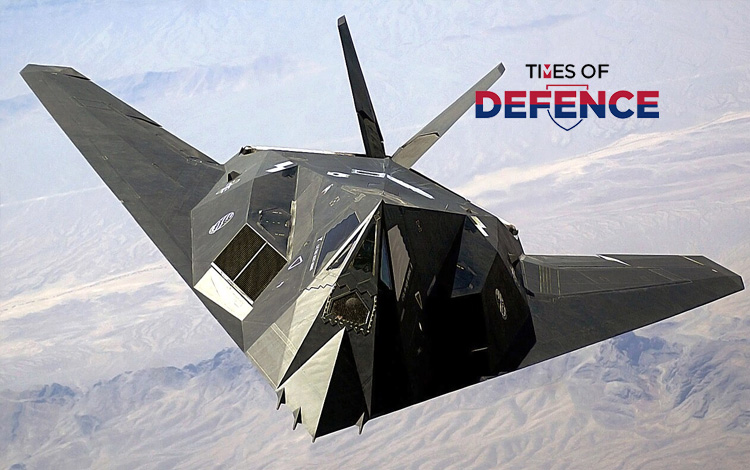
Lockheed Martin’s Skunk Works has completed the restoration of F-117A Nighthawk Aircraft 818, nicknamed “The Overachiever,” preparing the historic stealth attack aircraft for permanent display at the Smithsonian’s National Air and Space Museum.
The aircraft will join the museum’s collection and is scheduled to go on public display at the Steven F. Udvar-Hazy Center in Chantilly, Virginia, in late October 2026. The U.S. Air Force will transport the partially disassembled aircraft from the Skunk Works facility to Dulles International Airport aboard a C-5 Galaxy. Museum personnel will then reassemble it inside the Mary Baker Engen Restoration Hangar before moving it to the exhibition floor.
“The Overachiever”
Aircraft 85-0818, known as “The Overachiever,” has an unusually extensive combat history.
According to the Smithsonian, it is the only F-117 known to have flown combat missions in all four major conflicts in which the Nighthawk participated:
- Operation Just Cause — Panama, 1989
- Operation Desert Storm — Iraq, 1991
- Operation Allied Force — Yugoslavia, 1999
- Operation Enduring Freedom — Iraq, 2003
The aircraft first flew in 1986 and remained in operational service until 2007.
Its addition is particularly significant because the Smithsonian’s National Air and Space Museum had previously lacked an F-117 in its national collection. The museum describes the Nighthawk as the world’s first true operational stealth combat aircraft.
The Aircraft That Changed Stealth Warfare
Developed by Lockheed’s secretive Skunk Works division, the F-117 emerged from the highly classified Have Blue stealth demonstrator programme.
The aircraft’s angular appearance was not simply an aesthetic choice. Its faceted surfaces were designed to redirect radar energy away from enemy radar receivers, while specialized coatings and carefully controlled exhaust characteristics further reduced its detectability.
Lockheed Martin describes the F-117 as having been developed rapidly and in extreme secrecy to provide an aircraft capable of penetrating heavily defended airspace.
Although frequently called a “stealth fighter,” the F-117 was actually designed primarily as a single-seat stealth attack aircraft. It had no conventional air-to-air combat role comparable to later stealth fighters such as the F-22 or F-35.
F-117A Technical Characteristics
The F-117 was powered by two General Electric F404-F1D2 turbofan engines.
The U.S. Air Force’s published technical information lists:
- Crew: 1
- Engines: 2 × GE F404-F1D2
- Engine thrust: 10,600 lb each
- Maximum cruise speed: approximately 684 mph / 1,101 km/h
- Internal weapons capacity: up to 5,000 lb / 2,268 kg
- Primary role: stealth precision attack
The weapons were carried internally to preserve the aircraft’s low-observable characteristics.
The F-117’s weapons architecture could accommodate precision-guided munitions including GBU-10, GBU-12 and GBU-27 laser-guided bombs, depending on mission configuration.
Why It Was Subsonic
The Nighthawk was deliberately designed around stealth rather than speed.
Unlike later fighters, the F-117 did not use afterburners and remained subsonic.
Its mission depended on penetrating defended airspace while minimizing the probability of detection rather than outrunning enemy aircraft.
The aircraft’s distinctive shape, radar-absorbent materials, internal weapons carriage and infrared-signature reduction measures were therefore all part of a broader survivability architecture.
Combat Record
The F-117 became publicly famous during Operation Desert Storm in 1991, when it was used extensively against high-value targets and Iraqi air-defense infrastructure.
The aircraft had already seen combat during Operation Just Cause in Panama in 1989, but Desert Storm demonstrated the potential of operational stealth on a much larger scale.
F-117s subsequently participated in NATO’s Operation Allied Force over Yugoslavia in 1999 and later operations in Iraq.
The aircraft’s ability to attack targets in heavily defended environments helped establish stealth as a fundamental component of modern combat-aircraft design.
The F-117 and the Evolution of Stealth
The importance of the F-117 extends far beyond its relatively small production run.
Only 64 F-117-family aircraft were built, including five YF-117A development aircraft and 59 production F-117As.
The design demonstrated that survivability could be achieved by deliberately reducing an aircraft’s radar signature rather than relying primarily on speed, altitude or electronic countermeasures.
That concept subsequently influenced the development of aircraft such as the B-2 Spirit, F-22 Raptor and F-35 Lightning II.
The F-117 therefore represents an important technological bridge between experimental stealth technology and today’s low-observable combat-aircraft fleets.
Retirement Did Not Mean the End
The U.S. Air Force officially retired the F-117 fleet in 2008, but the aircraft did not immediately disappear from military aviation.
A small number of Nighthawks have continued to fly from Nevada for test, evaluation and training activities, including use as stealthy “red air” adversaries.
Their unusual radar and infrared characteristics make the aircraft useful for testing modern sensors and training crews against low-observable targets.
Aircraft 818 is now moving in the opposite direction: from an operational and test aircraft toward permanent preservation.
From Secret Weapon to Museum Artifact
The restoration gives the aircraft a new mission almost four decades after its first flight.
After reaching Dulles, Aircraft 818 will be partially reassembled in the Smithsonian’s Mary Baker Engen Restoration Hangar. Visitors will be able to observe the restoration process through the hangar’s glass viewing area before the aircraft moves onto the museum floor.
The transfer also creates an unusual historical connection between the aircraft’s original classified role and its future as a public exhibit.
The F-117 was once an aircraft whose very existence was hidden from the public. In late 2026, visitors will be able to stand beside the same aircraft and examine the design that helped redefine military aviation.
A Landmark Addition to the Smithsonian
The Smithsonian’s decision to preserve “The Overachiever” recognizes the F-117 not simply as a retired combat aircraft, but as a major milestone in aerospace engineering.
Its angular silhouette became one of the most recognizable shapes in military aviation, while its operational history demonstrated that stealth could fundamentally change how air campaigns were conducted.
Aircraft 818 will now preserve that story for future generations — from a highly classified Skunk Works programme to one of the most influential aircraft in the history of modern air warfare.
