


BETHESDA, Md. — Defense contractor Lockheed Martin has detailed its operational concept for Space-Based Interceptors (SBI), highlighting how orbital kinetic engagement platforms will extend the United States’ integrated air and missile defense (IAMD) architecture into Low Earth Orbit (LEO). Developed under U.S. Space Force Space Systems Command contracts, the SBI program is designed to establish an early-ascent interception layer capable of defeating adversary ballistic and hypersonic missile threats during their boost phase before payload separation and midcourse decoy deployment occur.
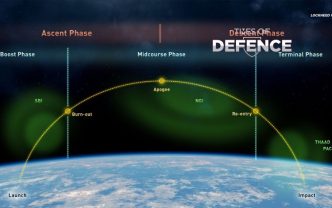
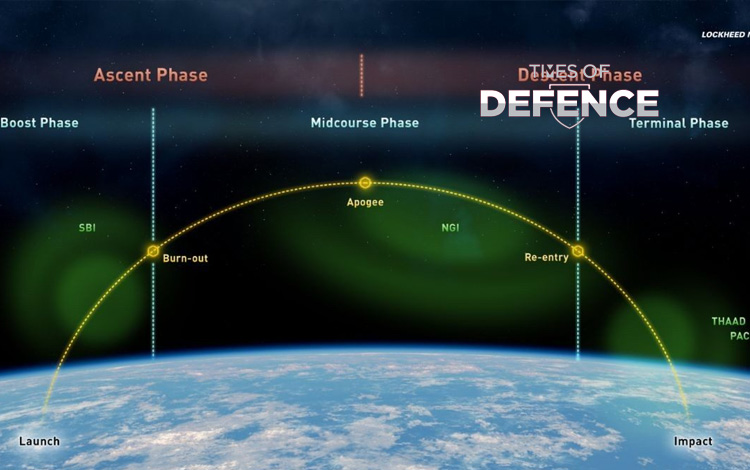
By positioning interceptors in orbit alongside space-based missile warning and tracking constellations (such as Next-Gen OPIR), the SBI layer detects the intense thermal signature of a rocket motor at ignition, enabling prompt engagement while the missile is still ascending. This boost-phase capability acts as the outer tier of a comprehensive, three-phase defense architecture: boost-phase engagement via SBI, midcourse interception via long-range ground assets like the Next Generation Interceptor (NGI) and Ground-Based Midcourse Defense (GMD), and terminal defense via Terminal High Altitude Area Defense (THAAD) and Patriot PAC-3 MSE. Coordinated via the Command and Control, Battle Management, and Communications (C2BMC) network and AI-driven data fusion, the space-based layer establishes a “denial of benefit” deterrence posture by compressing adversary attack windows and preventing midcourse sensor saturation.
TECHNICAL SPECIFICATIONS: LOCKHEED MARTIN SPACE-BASED INTERCEPTOR (SBI) & LAYERED IAMD ARCHITECTURE
* Program Architecture: U.S. Space Force Space-Based Interceptor (SBI) Initiative / Golden Dome Defense Framework
* Lead Systems Integrator: Lockheed Martin (Strike, Deterrence and Missile Defense Division)
* Primary Operational Domain: Low Earth Orbit (LEO) / Space-Based Boost-Phase Interception
* Integrated Demonstration Target: Scaled on-orbit operational demonstration projected for 2028
* Three-Tiered Interception Architecture:
* Boost Phase (Orbital SBI Layer): Early-ascent intercept utilizing space-based infrared sensors to engage rising boosters prior to stage separation and midcourse threat proliferation
* Midcourse Phase (Deep Space & Ground Layer): Vacuum-of-space interception utilizing Next Generation Interceptor (NGI) and Ground-Based Interceptors (GBI) guided by orbital tracking arrays
* Terminal Phase (Underlayer Defense): Point and area defense utilizing THAAD and PAC-3 MSE against surviving warheads entering atmospheric descent
* Primary Target Threat Profiles: Intercontinental Ballistic Missiles (ICBMs), Submarine-Launched Ballistic Missiles (SLBMs), Hypersonic Glide Vehicles (HGVs), and fractional orbit weapons
* Command, Control & Communications (C2):
* Battle Management: Unified command via C2BMC (Command and Control, Battle Management, and Communications) engine
* Data Processing: AI-enabled sensor fusion and automated threat-sorting algorithms to reduce operator latency
* Sensor Links: Optical inter-satellite laser communications paired with space-based AMTI, Over-The-Horizon (OTH) ground radar, and terrestrial sensors
* Strategic Deterrence Mechanism: Boost-phase interception negates MIRVs (Multiple Independently Targetable Reentry Vehicles) and penetration aids before deployment, forcing severe cost asymmetry on aggressor forces