


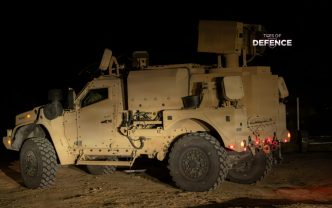
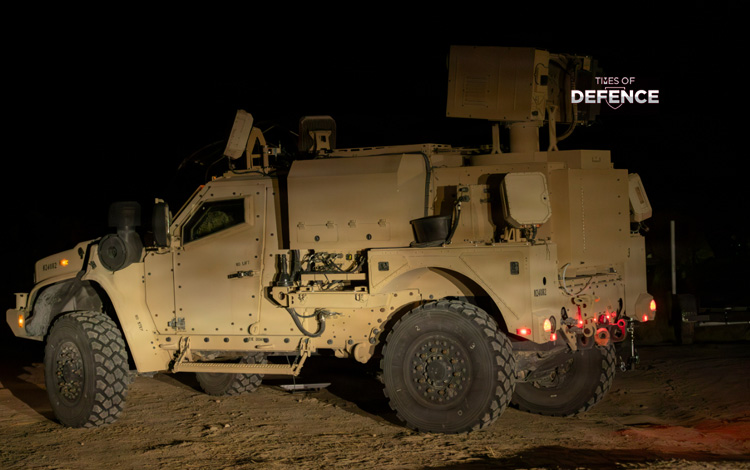
Defense technology contractor Leonardo DRS, Inc. announced on November 2, 2026, that it has been selected by prime contractor AeroVironment, Inc. to provide thermal management, power generation, and vehicle integration systems for the U.S. Army’s Enduring-High Energy Laser (E-HEL) production program.
The subcontract directly supports AeroVironment’s execution of its $464.8 million E-HEL contract awarded by the U.S. Army on September 2, 2026—the service’s first production-scale procurement of a directed-energy weapon system. Under the contract, AeroVironment will produce its 30-kilowatt LOCUST X3 high-energy laser to fulfill counter-uncrewed aerial systems (C-UAS) requirements across maneuver formations and point-defense nodes. Leonardo DRS will deliver specialized environmental control units (ECU), high-output power conversion systems, and rugged chassis integration suites across mobile vehicular baselines (e.g., Joint Light Tactical Vehicle / JLTV) and ground-palletized deployment options.
TECHNICAL SPECIFICATIONS: E-HEL / LOCUST X3 & DRS POWER/THERMAL ARCHITECTURE
Contractual Governance, Prime Architecture & Sub-System Lineage
⚡ Program Authority: U.S. Army Rapid Capabilities and Critical Technologies Office (RCCTO) / PEO Missiles and Space
⚡ Prime Integrator & OEM: AeroVironment, Inc. (Simi Valley, California — Space, Cyber and Directed Energy Segment / ex-BlueHalo)
⚡ Subcontractor Prime: Leonardo DRS, Inc. (Land Systems Division — Arlington, Virginia / St. Louis, Missouri)
⚡ Prime Contract Baseline: $464.8 Million E-HEL Production Award (September 2026); initial delivery schedule targets 26 operational units over five years
⚡ Core Directed Energy Effector: LOCUST X3 30-kW Class Solid-State Fiber Laser (3rd-generation evolution featuring AV_Halo AI targeting software)
⚡ Operational Purpose: Short-Range Air Defense (SHORAD) against Group 1–3 Uncrewed Aerial Systems (UAS), loitering munitions, and precision-guided air-to-ground threats 
Directed Energy Effector & Sensor Suite Kinematics
💥 Laser Power Output & Beam Quality: 30-kW continuous-wave (CW) solid-state fiber laser with adaptive optics targeting for thermal beam convergence
💥 Operational Cost Profile: Estimated engagement cost <$10 per shot (compared to traditional interceptor missiles costing $100K to $1M+ per engagement)
💥 Target Tracking & Fire Control: Integrated AV_Halo AI-driven autonomous target detection, classification, and precise optical beam-pointing suite
💥 Dynamic Platform Integration: Mounted via modular interfaces on Joint Light Tactical Vehicles (JLTV), Infantry Squad Vehicles (ISV), Heavy Tactical Vehicles, or autonomous ground pallets
DRS Power Management, Thermal Engineering & Vehicle Integration
🚀 High-Density Thermal Management System (TMS): Specialized liquid-to-air heat exchangers engineered to dissipate multi-kilowatt thermal loads during rapid-fire laser engagements
🚀 Power Generation & Energy Storage: High-voltage DC distribution architecture and energy storage modules (lithium-ion / supercapacitor buffer) delivering instantaneous surge power to the laser diode array
🚀 Environmental Hardening: Integrated shock isolation, MIL-STD-810H environmental sealing, and thermal regulation enabling operation in severe desert, arctic, and high-vibration tactical environments
TIMES OF DEFENCE ASSESSMENT
The formal integration of Leonardo DRS into AeroVironment’s E-HEL production program marks a key milestone in directed-energy transition: moving high-energy lasers from experimental prototypes into low-rate initial production (LRIP).
From an aerospace engineering and counter-UAS tactical perspective, the program delivers three main advantages:
1. **Resolving Thermal and Electrical Bottlenecks**: The primary constraint on mobile laser weapons has shifted from laser physics to heat dissipation and power density. Solid-state fiber lasers operate at roughly 30% to 40% wall-plug efficiency, meaning a 30-kW laser output generates over 60 kW of waste heat. Incorporating Leonardo DRS’s specialized cooling and high-density power architecture ensures the LOCUST X3 can sustain rapid engagement cycles without thermal throttling or engine power drain on light tactical platforms like the JLTV.
2. **Asymmetric Cost-per-Engagement Math**: Deploying low-cost loitering munitions and drone swarms creates an attrition dilemma when engaged with traditional kinetic interceptors (e.g., Stinger or AIM-9X). A 30-kW directed-energy system with an engagement cost under $10 per shot gives mobile ground forces a deep-magazine defense capability to neutralize small UAS swarms while conserving kinetic missiles for larger threat targets.
3. **Maneuver Integration & Platform Standardization**: Moving from fixed-base installations to mobile vehicle integration (JLTV/ISV) provides maneuver units with mobile C-UAS protection. Standardizing the power/thermal interface through Leonardo DRS allows the Army to mount or demount LOCUST X3 modules across multiple ground platforms without requiring complete vehicle redesigns.

