

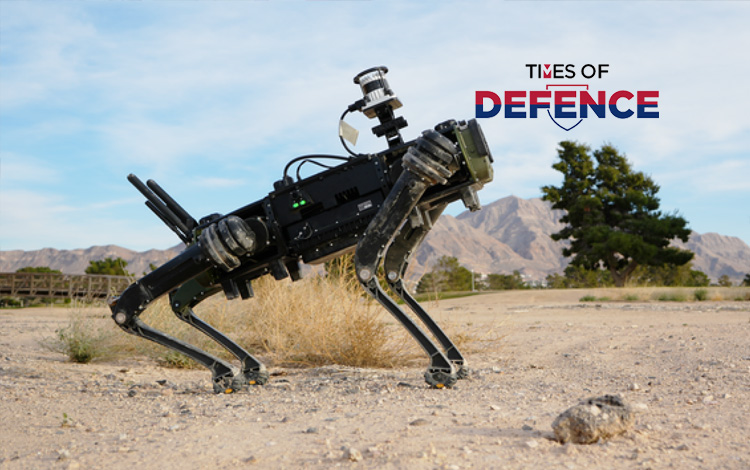
AULI, INDIA — An Indian Army robotic dog was demonstrated alongside U.S. and Indian troops during a counterterrorism building-clearance exercise at Auli, Uttarakhand, as part of Yudh Abhyas 2026, highlighting the growing role of unmanned ground systems in close-quarter and high-risk operations.
The demonstration took place on September 16 and involved U.S. Army and Indian Army personnel conducting a simulated building-clearing and room-intervention operation. Indian Army snipers, military working dogs and a robotic dog were integrated into the scenario, allowing U.S. soldiers to observe and interact with the technology.
The 2026 edition is the 22nd iteration of Yudh Abhyas, with approximately 600 personnel from each country participating. The exercise is being conducted at Auli and the Mahajan Field Firing Range in Rajasthan, with training covering mountain and cold-weather operations, counter-IED missions, counter-UAS operations, sniper tactics and other multidomain activities.
Indian Army’s MULE Robotic Platform
The robotic dog seen in the Indian Army’s activities is associated with the Multi-Utility Legged Equipment (MULE) program. Indian Army MULE systems have previously been demonstrated with cameras, radar and other modular payloads and are designed to operate in difficult terrain where conventional wheeled or tracked platforms can face mobility limitations.
Publicly reported specifications for the Indian MULE include a payload capacity of approximately 12 kg, remote operation through Wi-Fi or LTE, and the ability to accept mission-specific payloads such as thermal cameras and radar. Earlier demonstrations also showed the platform capable of climbing slopes of up to approximately 45 degrees and negotiating steps around 18 cm high.
Indian government-backed technology information also describes an Aero Arc MULE variant as an all-terrain robotic platform equipped with cameras and advanced sensors, with applications including reconnaissance, explosive detection, rescue and supply delivery. Reported environmental specifications include operation in temperatures from approximately -40°C to +55°C and an IP67 protection rating.
From Reconnaissance to Armed Missions
The MULE concept is not limited to carrying sensors. Earlier Indian Army demonstrations indicated that the platform can be configured with thermal imaging systems, radar and a weapon/firing platform. The Indian Army has described robotic dogs as potential tools for surveillance, reconnaissance and carrying light loads in difficult terrain, reducing the exposure of soldiers and military working dogs to dangerous areas.
This makes the technology particularly relevant to missions such as building reconnaissance, first-contact operations, perimeter surveillance, hazardous-area inspection and urban combat support. A robotic platform can potentially enter a suspected room or restricted area first, transmit imagery to an operator and provide situational awareness before personnel enter.
However, the specific robotic dog shown at Yudh Abhyas 2026 should not automatically be described as carrying an operational weapon during the exercise. Official U.S. Army material confirms the presence of the robotic dog but does not identify its exact sensor package, weapon configuration or firing system for this particular demonstration.
Why Auli Matters
The Auli portion of Yudh Abhyas 2026 is focused heavily on mountain and high-altitude operations. The Indian Ministry of Defence says the exercise is intended to improve the two armies’ ability to conduct infantry-dominated operations in mountainous and semi-mountainous terrain, while also emphasizing drones, autonomous systems and modern battlefield technologies.
Legged robotic systems are particularly relevant in such environments because their articulated legs can negotiate stairs, rocks, uneven ground and steep surfaces that can be difficult for conventional small UGVs.
The exercise therefore provides a practical environment for examining how human soldiers, conventional military working dogs, drones, robotic ground systems and precision weapons can operate together within the same tactical framework.
Technical Snapshot
| Feature | Publicly reported information |
|---|---|
| Platform | Multi-Utility Legged Equipment (MULE) |
| Configuration | Quadrupedal unmanned ground vehicle |
| Payload | Approx. 12 kg |
| Communications | Wi-Fi / LTE |
| Reported LTE control range | Up to approx. 10 km |
| Sensors | Cameras, thermal imaging and radar options |
| Mobility | All-terrain; snow and mountainous terrain |
| Slope capability | Up to approx. 45° reported |
| Step capability | Approx. 18 cm |
| Environmental protection | IP67 reported for Aero Arc MULE |
| Temperature | Approx. -40°C to +55°C reported |
| Mission options | ISR, reconnaissance, surveillance, logistics, hazardous-area inspection |
| Weapon integration | Firing/weapon platforms have been demonstrated as an option |
| Control | Remote control; pre-planned missions also reported |
The exact configuration, manufacturer and sensor/weapon package of the robotic dog photographed during Yudh Abhyas 2026 have not been publicly identified by the U.S. Army in its official exercise reporting. Therefore, the specifications above should be treated as publicly reported MULE-family information rather than a confirmed configuration of the exact vehicle shown at Auli.
The Bigger Picture
Yudh Abhyas 2026 demonstrates that robotic systems are increasingly being incorporated into conventional infantry training rather than being treated solely as experimental technology.
With counter-UAS, counter-IED, reconnaissance, mountain warfare and close-quarter operations forming part of the exercise, the robotic dog represents one element of a broader human-machine teaming approach in which unmanned systems can gather information or enter hazardous areas before exposing soldiers to the same risks.
The exercise is scheduled to continue through September 28, 2026.
