

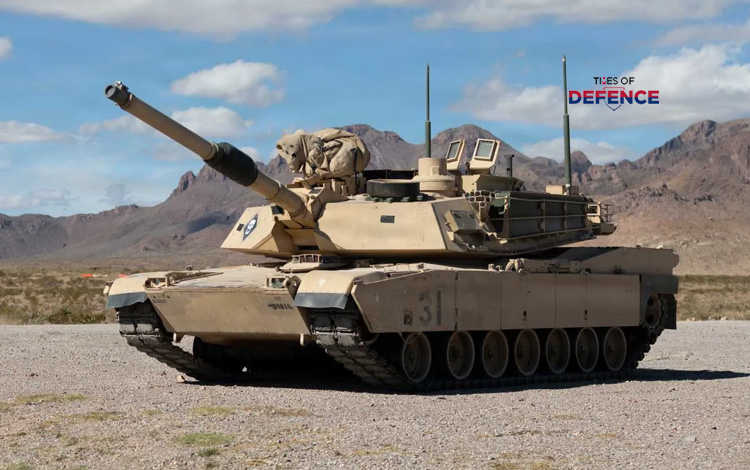
STERLING HEIGHTS, Mich. / WASHINGTON — General Dynamics Land Systems (GDLS) signed a master teaming agreement on October 6, 2026, with Primordial Labs to integrate the “Anura” Natural Language Command and Control (NLC2) software suite across GDLS’s portfolio of U.S. armored fighting vehicles.
Target platforms include the M1 Abrams (including the M1E3 variant), Stryker 8×8 armored vehicles, and the XM30 Infantry Fighting Vehicle (Optionally Manned Fighting Vehicle program). Anura is an edge-processed, intent-based natural language processing (NLP) engine designed to automate routine subsystem commands—such as radio frequency switching, sensor selection, tactical report generation, and offboard uncrewed aerial system (UAS) / uncrewed ground vehicle (UGV) tasking—via spoken voice commands.
The software operates locally without cloud reliance or generative AI models to avoid hallucination risks. Fire control and weapons release functions are explicitly excluded from the AI voice integration framework. 
TECHNICAL SPECIFICATIONS: ANURA NATURAL LANGUAGE COMMAND & CONTROL (NLC2)
* Lead Integrator / Software Developer: General Dynamics Land Systems (GDLS) & Primordial Labs
* System Classification: Edge-Processed Natural Language Command and Control (NLC2) AI Suite
* Target Vehicle Integration Portfolio:
* M1 Abrams Main Battle Tank (M1A2 SEPv3 / M1E3 pre-prototype series)
* XM30 Infantry Fighting Vehicle (GDLS “Wolf” XM30 candidate)
* Stryker 8×8 Armored Fighting Vehicle Family
* Core Architectural Features & Constraints:
* Local Edge Processing: Operates without cloud connectivity; optimized for low-latency onboard compute
* AI Model Framework: Non-generative, deterministic ML/NLP architecture (eliminates generative LLM hallucinations)
* Tactical Link Reliance: Offboard robotic/drone control utilizes tactical data links (e.g., ATAK plug-ins, WMI/RTK)
* Safety-Critical Exclusion: Kinetic engagement, target acquisition, and weapon firing functions excluded
* Primary Mission Functions & Capabilities:
* C4ISR Automation: Hands-free control of tactical radios, optical/thermal sensors, and internal/external displays
* Robotic & UAS Tasking: Natural-language command of reconnaissance drones (e.g., Teal 2, Black Hornet 3, Skydio)
* Operational Workload Reduction: Mitigates cognitive overload associated with reduced crew sizes (XM30 down to 2 crew; M1E3 targeting 3 crew)
* Proving History & R&D Milestones:
* U.S. Army SBIR Contracts: Developed under Army SBIR Phase II for Launched Effects ($1.9M) and UGV control via Warfighter Machine Interface ($250k)
* Field Evaluations: Demonstrated across 4 Army PEOs and tested with 8,000 trial licenses in 2025 across 10th Mountain and 3rd Infantry Divisions