



France has reportedly deployed newly delivered Saab Giraffe 1X X-band radars to the Middle East only months after ordering them, with the systems reportedly entering operational use before completing the normal qualification process in France.
The information was reported on September 17 by French defense analyst Florent de Saint Victor, who said the first Giraffe 1X systems ordered by France in late 2025 were delivered in the first quarter of 2026 and subsequently deployed to the Middle East. According to his account, the radars were used by French Army personnel, in coordination with the Army’s technical section (STAT), in several countries in the region.
The reported deployment highlights an increasingly important feature of European defense procurement: rapid acquisition and fielding of commercially available systems in response to urgent operational requirements.
From Contract to Operational Deployment in Months
France’s Directorate General of Armament (DGA) ordered its first batch of eight Giraffe 1X-equipped systems on December 29, 2025. A second order for another eight systems followed in April 2026, bringing the planned French fleet to 16 operational radar vehicles.
The DGA described the acquisition as an urgent interim capability. Rather than waiting for a domestically developed solution, France selected an existing Swedish system requiring relatively few modifications. The first eight systems are scheduled for delivery during 2026, with the remaining eight planned for the first half of 2027.
Saab’s May 2026 announcement adds an important detail: the broader French contract actually covers 17 Giraffe 1X radars. One radar is allocated to testing and evaluation, while 16 will eventually be integrated onto Scania V3P tactical vehicles.
The reported Middle East deployment therefore appears to concern early-delivered radars used as an urgent operational capability, rather than the final 16-vehicle VARDA configuration.
Why Were the Radars Put on Pick-Up Trucks?
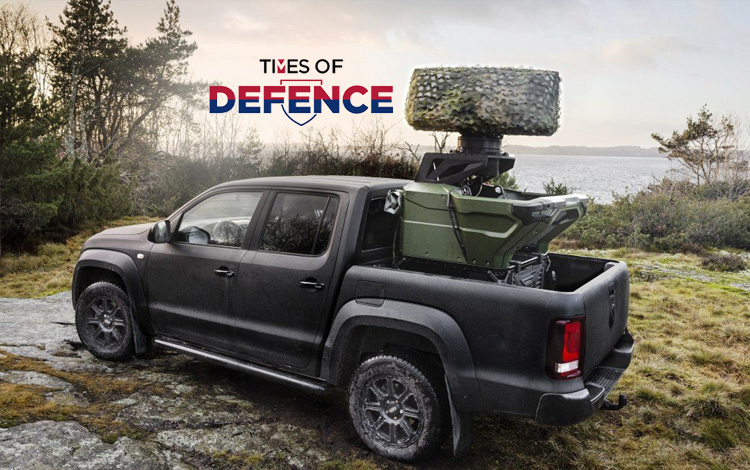
According to the French defense report, some of the early systems were not yet mounted on their planned Scania tactical vehicles. Instead, they were reportedly secured to the rear of pick-up trucks and deployed directly with French forces.
This is possible because the Giraffe 1X was deliberately designed as a highly mobile and platform-independent radar.
Saab says the complete system weighs less than 150 kg, with the radar topside weighing approximately 100 kg. It can be transported on a pickup-sized vehicle, helicopter or trailer and can be integrated onto different mobile or fixed platforms.
Saab has also demonstrated the Giraffe 1X in a Compact Radar Module (CRM) configuration specifically intended for rapid relocation and deployment. The company has stated that the module can be moved between platforms, including pickup trucks, buildings and other vehicles.
This modularity appears to have been particularly valuable for France’s urgent Middle East requirement.
What Does the Giraffe 1X Actually Do?
The Giraffe 1X is fundamentally a sensor, not a weapon system.
Its primary role is to detect, classify and track airborne objects and provide targeting-quality information to connected air-defense or counter-UAS systems.
The radar uses:
- X-band AESA technology
- Gallium-nitride (GaN) semiconductor technology
- Digital beamforming
- 360-degree surveillance
- Dedicated low-slow-small (LSS) drone detection algorithms
- Automatic target tracking and classification
- Counter-UAS functionality
- C-RAM sense-and-warn capability
- Electronic counter-countermeasures
Saab says the radar continuously updates its entire search volume every second. The company also states that the system can detect targets with radar cross sections below 0.01 m² at instrumented ranges of approximately 75 km, although actual detection range depends heavily on target size, altitude, radar horizon and environmental conditions.
Saab’s current product information says the radar can detect extremely small UAVs, including a drone lighter than a milk carton at ranges of up to approximately 4 km under stated conditions.
Technical Specifications
| Characteristic | Giraffe 1X |
|---|---|
| Radar type | 3D multi-mission AESA |
| Frequency | X-band |
| Technology | GaN AESA / digital beamforming |
| Search coverage | 360° |
| Search-volume update | Every second |
| Elevation coverage | Up to 70° in published baseline data |
| Instrumented range | ~75 km in current Saab C-UAS material |
| Older published instrumented range | 100 km |
| System weight | <150 kg |
| Topside weight | ~100 kg |
| Target types | Aircraft, helicopters, UAVs, missiles, RAM threats |
| C-UAS | Yes |
| C-RAM | Sense-and-warn |
| Deployment | Fixed, vehicle-mounted or rapidly deployable |
| Platform integration | Pickup-sized vehicles, tactical vehicles, trailers, buildings and other platforms |
Saab has progressively upgraded the Giraffe 1X family. Earlier technical documentation listed a 100 km instrumented range and 600 simultaneous tracks, while Saab’s 2026 material emphasizes approximately 75 km for small-target detection and the radar’s ability to detect objects with very small radar cross sections. These figures should therefore not be treated as contradictory combat-range guarantees; they refer to different performance parameters and configurations.
The Radar Is Designed for the Drone Threat
One of the Giraffe 1X’s most important features is its ability to deal with low, slow and small aerial targets.
Small commercial-style UAVs can be difficult for conventional air-defense radars because of their low radar cross section and ability to operate close to the ground amid buildings, terrain, vegetation and other clutter.
Giraffe 1X uses dedicated signal processing and drone-tracking algorithms to distinguish UAVs from background clutter and birds. Saab says the radar can simultaneously support detection, tracking and classification of these targets.
For French forces operating in the Middle East, the system can therefore serve as an early-warning sensor for counter-drone defenses, giving commanders more time to cue electronic warfare systems, guns, missiles or other interceptors.
The radar itself does not destroy the drone.
C-RAM Capability
The system also provides C-RAM — Counter-Rocket, Artillery and Mortar — sense-and-warn functionality.
France’s DGA specifically highlights the ability to detect and track incoming munitions from launch to impact. This expands the radar’s role beyond counter-UAS operations and allows it to contribute to protection against rockets, artillery rounds and mortars.
This multi-mission capability is important for deployed forces because the same radar can contribute to protection against several categories of aerial threats without requiring a dedicated sensor for each threat type.
Why Skip the Qualification Phase?
The reported decision to use the first radars operationally before completing France’s normal qualification process appears to reflect the urgency of the requirement.
France’s Force d’acquisition réactive (FAR) was created specifically to accelerate acquisition when conventional procurement timelines are considered too slow for an urgent military need.
The DGA explicitly said the Giraffe 1X/Scania acquisition was intended to provide an intermediate capability from 2026, while France waits for future air-defense and counter-drone versions of the Serval vehicle.
This makes the reported deployment particularly notable.
Instead of waiting for:
- final French vehicle integration,
- completion of the normal qualification process,
- delivery of the complete VARDA fleet,
France reportedly used already available radar hardware to fill an immediate operational requirement.
The Final French Configuration Will Be Different
The pick-up-mounted systems should not be confused with the final French VARDA — Véhicule Avancé de Détection Aérienne configuration.
The production system ordered by France will use the Scania V3P tactical vehicle.
The DGA says the vehicle will include:
- A dedicated energy pack for radar autonomy
- Additional seats and displays
- Capacity for a driver, vehicle commander and three operators
- French vehicle production and radar integration at Scania’s Angers facility
The completed system will eventually form part of France’s low-layer ground-based air-defense architecture.
France Is Not the Only User Exploiting Rapid Deployment
The Giraffe 1X has increasingly been used as a rapidly deployable sensor.
In Denmark, Saab said Giraffe 1X systems were delivered only three days after the initial request ahead of high-profile security requirements in Copenhagen. They operated for more than six months before Denmark placed a permanent order.
The United Kingdom also accelerated delivery of Giraffe 1X systems in 2026 for counter-drone operations. Saab said the radars have become part of the RAF’s wider counter-UAS architecture supporting UK and coalition forces, including operations in the Middle East.
These cases illustrate why the radar’s relatively low weight, modular architecture and rapid deployment characteristics have become important operational advantages.
What Is Confirmed and What Remains Reported?
Officially confirmed by France:
- France ordered eight Giraffe 1X systems in December 2025.
- A second order brought the total operational fleet to 16.
- A 17th radar is allocated for test and evaluation.
- The systems are intended for low-layer air defense and counter-UAS missions.
- The first eight are scheduled for delivery in 2026.
- The final systems will be mounted on Scania V3P vehicles.
Reported but not officially detailed by the DGA in its public announcement:
- Some early French Giraffe 1X radars were delivered in the first quarter of 2026.
- They were deployed to the Middle East before completing the normal French qualification phase.
- French Army personnel reportedly used them in several countries in the region.
- Some were reportedly mounted or secured on pickup trucks rather than their final Scania platforms.
The Middle East locations, exact number of deployed radars and precise operational configuration have not been publicly disclosed.
Bottom Line
The reported French deployment illustrates a different approach to military procurement: field the available sensor first, complete the final vehicle integration later.
The Giraffe 1X is particularly suited to this model because its sub-150 kg system weight, AESA architecture, 360-degree coverage, rapid deployment and dedicated counter-drone processing allow it to be integrated into improvised or temporary platforms.
For French forces in the Middle East, the immediate requirement appears to be straightforward: detect small drones early enough for other defensive systems to respond.
The reported use of the radar on pickup trucks — before completion of the normal qualification process — demonstrates how quickly a mature, modular sensor can be moved from procurement into an operational environment when the military requirement is considered urgent.
