


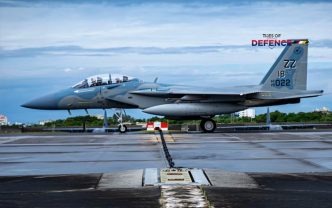
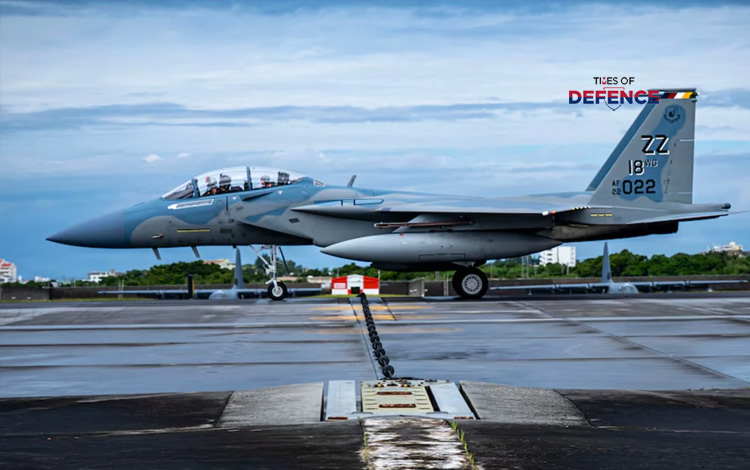
The U.S. Air Force’s 18th Wing officially welcomed its first two permanently stationed **F-15EX Eagle II** multirole fighters on November 15, 2026, marking the platform’s inaugural deployment to an overseas front-line combat installation.
Assigned to the 67th Fighter Squadron (“Fighting Cocks”), the aircraft—bearing the 18th Wing’s iconic “ZZ” tail code—touch down at Okinawa following extensive pilot and maintainer qualification training at Eglin Air Force Base, Florida, and Portland Air National Guard Base, Oregon. The arrival initiates the phased permanent replacement of 48 legacy F-15C/D Eagles (withdrawn between November 2022 and January 2025) with a modern fleet of **36 F-15EX Eagle IIs** split across the 44th and 67th Fighter Squadrons, bridging a critical Indo-Pacific deterrence gap roughly 724 km (450 miles) from Taiwan.
TECHNICAL SPECIFICATIONS: BOEING F-15EX EAGLE II ARCHITECTURE
Airframe, Propulsion & Flight Performance
⚡ Prime Contractor & Developer: Boeing Defense, Space & Security (St. Louis, Missouri)
⚡ Powerplant & Thrust: Dual General Electric F110-GE-129 afterburning turbofan engines, each generating 29,500 lbf (131 kN) of thrust
⚡ Performance Envelope: Maximum speed of Mach 2.5 (1,650 mph / 2,655 km/h) at high altitude; service ceiling of 60,000 ft (18,300 m); ferry range of 2,100 nautical miles (2,420 miles / 3,900 km) with conformal fuel tanks (CFTs) and external drop tanks
⚡ Structural Service Life & Flight Controls: Reinforced airframe rated for 20,000+ flight hours, featuring full digital fly-by-wire flight controls, a large-area display (LAD) glass cockpit, and open-mission-systems (OMS) architecture powered by the ADCP II mission computer 
Sensors, Electronic Warfare & Weapons Payload
💥 Radar & Targeting Suite: Raytheon AN/APG-82(V)1 Active Electronically Scanned Array (AESA) radar paired with the Lockheed Martin Legion Pod (AN/ASG-34(V)1 IRST21) for passive long-range infrared search and track
💥 Survivability & Electronic Attack: BAE Systems AN/ALQ-250 Eagle Passive Active Warning Survivability System (EPAWSS) providing full-spectrum radar warning, threat geolocation, and digital electronic countermeasures
💥 Maximum Weapons Capacity: Industry-leading external payload capacity of 29,500 lbs (13,380 kg) across up to 23–25 hardpoints, enabling carriage of up to 12 air-to-air missiles (AIM-120 AMRAAM, AIM-9X Sidewinder, AIM-260 JATM) or outsized standoff and hypersonic munitions alongside an internal 20mm M61A1 Vulcan cannon
TIMES OF DEFENCE ASSESSMENT
The permanent arrival of the F-15EX Eagle II at Kadena Air Base signals three major strategic and operational developments in the Indo-Pacific theater:
1. **Ending Rotational Reliance with Permanent Forward Airpower**: Since the phased retirement of Kadena’s legacy F-15C/D fleet concluded in early 2025, the U.S. Air Force relied on costly six-month rotational deployments of F-22s, F-35s, and F-16s. Permanently stationing combat-coded F-15EXs restores dedicated, persistent air superiority capacity at the closest U.S. air base to the Taiwan Strait.
2. **Offsetting Fleet Size Reductions Through Massive Magazine Depth**: Although 36 F-15EXs replace 48 legacy Eagles (a 25% hull reduction), each Eagle II carries up to 12 air-to-air missiles—a 50% increase in missile capacity per sortie—backed by AESA radar and EPAWSS survivability, preserving total combat mass.
3. **Establishing a High-Low Teaming Backbone with Fifth-Generation Stealth**: Operating as a high-speed, heavy-payload “arsenal plane” alongside allied Japanese F-35s and rotational U.S. fifth-generation fighters, the F-15EX provides deep standoff magazine capacity and future Collaborative Combat Aircraft (CCA) command-and-control scalability.

