

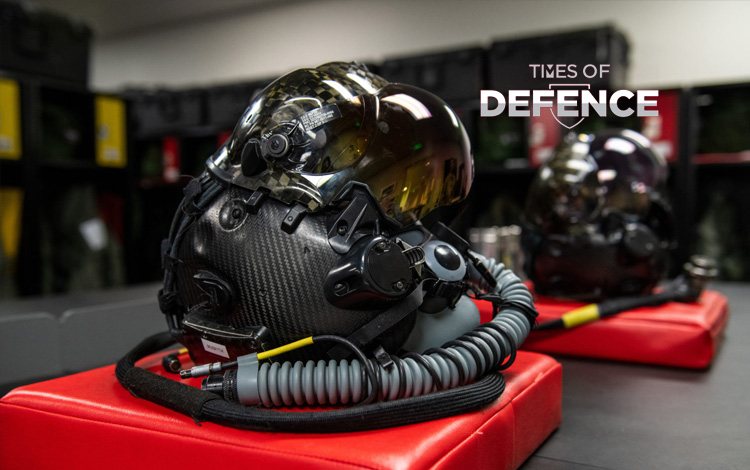
The F-35 Lightning II does not rely on a conventional head-up display to give its pilot access to critical flight and targeting information.
Instead, the aircraft uses its Gen III Helmet-Mounted Display System (HMDS) as the primary interface between the pilot and the aircraft’s sensor-fusion architecture.
The result is an aircraft in which targeting cues, flight information and sensor data can be presented directly in the pilot’s field of view.
A 360-Degree View Around the Aircraft
One of the technologies behind this capability is the F-35’s AN/AAQ-37 Distributed Aperture System (DAS).
DAS uses six infrared cameras distributed around the aircraft to provide continuous coverage of the surrounding battlespace. Their overlapping fields of view create a spherical, 360-degree infrared picture that can be presented through the pilot’s helmet.
This means the pilot does not have to rely exclusively on physically pointing the aircraft toward a sensor’s field of view.
The system can provide imagery from around the aircraft, including areas that would normally be obscured by the airframe.
The Helmet Becomes the Display
The F-35’s Gen III HMDS, supplied by Collins Aerospace, replaces much of the functionality traditionally associated with a conventional HUD.
The helmet provides flight-reference information, targeting data and sensor information directly in the pilot’s line of sight. Its virtual display can also present DAS imagery, allowing the pilot to look toward a target or through portions of the aircraft’s structure without physically aligning the aircraft with the target.
The important distinction is that the helmet itself is not the sensor.
Instead:
Sensors → Sensor Fusion → Helmet Display → Pilot
The helmet acts as the pilot’s interface to the aircraft’s wider information architecture.
Multiple Sensors, One Tactical Picture
The F-35’s advantage comes from combining several sensors rather than relying on a single system.
AN/APG-81 AESA Radar
The AN/APG-81 Active Electronically Scanned Array radar provides air-to-air and air-to-ground sensing.
It can operate in both active and passive modes and contributes data to the aircraft’s overall sensor-fusion system.
Distributed Aperture System
The DAS uses six infrared sensors positioned around the aircraft.
Its functions include missile warning, infrared tracking and continuous situational awareness. The system’s overlapping fields of view provide spherical coverage around the aircraft.
Electro-Optical Targeting System
The EOTS is integrated into the aircraft’s fuselage and provides electro-optical/infrared sensing for target detection and precision engagement, particularly against ground targets. It also contributes to detection of air targets.
Electronic Warfare Systems
The F-35 also incorporates advanced electronic-warfare capabilities that help detect and characterize electromagnetic threats.
Data from these systems can contribute to the aircraft’s overall tactical picture.
Sensor Fusion Is the Key
The individual sensors are important, but the real capability comes from sensor fusion.
Instead of requiring the pilot to interpret separate radar, infrared, electronic-warfare and targeting displays, the F-35 processes information from multiple sources and presents a more integrated picture.
Lockheed Martin describes this as giving the pilot a single integrated view of the battlespace.
The concept can be simplified as:
RADAR + DAS + EOTS + EW + OFFBOARD DATA
⬇
SENSOR FUSION
⬇
INTEGRATED TACTICAL PICTURE
⬇
HELMET-MOUNTED DISPLAY
⬇
PILOT
This architecture is particularly important in contested airspace, where the pilot may have to make decisions while dealing with multiple sensors, emitters and threats simultaneously.
Looking Through the Aircraft
One of the most distinctive aspects of the F-35 helmet is its ability to display information that effectively allows the pilot to “see through” the aircraft.
DAS imagery can be presented through the helmet, providing a synthetic view of the environment rather than restricting the pilot to the physical view available through the canopy.
This can be particularly useful during:
- Air-to-air engagements
- Low-altitude operations
- Threat avoidance
- Missile-warning situations
- Night operations
- Close-range maneuvering
The pilot’s head movement can also be used to cue sensors and weapons toward a selected area or target.
Beyond the Cockpit
The F-35 is also designed to share information beyond the aircraft itself.
Its architecture allows the fighter to act as a node in a wider network connecting airborne, maritime, ground and other forces.
Lockheed Martin describes the F-35 as a network-centric platform capable of sharing information across air, land, sea, space and cyber domains.
That means the aircraft is not simply collecting information for its own pilot.
It can also contribute information to the wider force.
The basic concept is:
Detect → Fuse → Understand → Share → Engage
This is why the F-35 is increasingly described not only as a stealth fighter but also as a sensor and information node.
Technical Capability at a Glance
| System | Primary function |
|---|---|
| Gen III HMDS | Displays flight, sensor and targeting information |
| AN/AAQ-37 DAS | 360° infrared sensing and missile warning |
| AN/APG-81 AESA | Air-to-air and air-to-ground radar sensing |
| EOTS | Electro-optical/IR detection and precision targeting |
| EW suite | Detects and characterizes electromagnetic threats |
| Sensor fusion | Combines information into an integrated tactical picture |
| Data links | Shares information with other platforms and forces |
Why the Helmet Matters
The significance of the F-35’s helmet is not simply that it is a sophisticated display.
It changes the relationship between the pilot and the aircraft’s sensors.
On a conventional aircraft, the pilot generally looks at separate displays to understand what individual sensors are seeing.
On the F-35, much of that information can be presented directly where the pilot is looking.
The result is an interface designed around information rather than individual instruments.
The pilot does not simply fly the aircraft and operate its sensors.
The pilot becomes the decision-maker at the center of a network of sensors, computers and connected platforms.
That is the core of the F-35’s sensor-fusion concept.
And the helmet is the interface that puts that information directly in front of the pilot.