


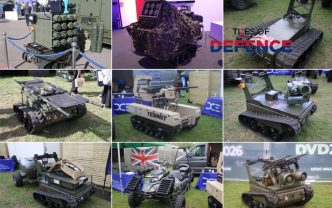
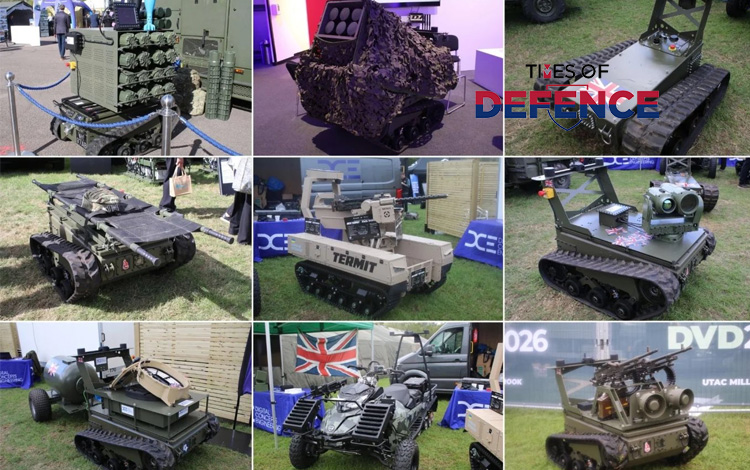
British company Digital Concepts Engineering (DCE) is showcasing 20 X-Series uncrewed ground vehicles across eight industry stands at DVD 2026, highlighting how its modular UGV family is moving from experimentation toward operational integration with the British Army.
The exhibition follows the British Army’s competitive procurement of 15 X-Series Universal Carrier UGVs, which DCE describes as the UK’s first operational deployment of this type of capability and the Ministry of Defence’s largest UGV order to date. The first vehicles were already being used on Exercise Rhino Storm in Germany earlier this year.
One UGV, Multiple Battlefield Roles
A key feature of the X-Series presentation at DVD 2026 is the use of a common carrier architecture for substantially different missions.
Displayed configurations include:
- Logistics and resupply
- CASEVAC / casualty evacuation
- ISTAR
- Fire support
- Breaching and engineering
- Counter-UAS-related payloads
- Anti-tank operations
The approach allows the same basic vehicle architecture to be configured around different payloads rather than requiring a dedicated robotic vehicle for every mission.
DCE’s X-Series is described as a mid-sized, highly mobile UGV capable of carrying approximately 150–500 kg of payload and towing up to 3 tonnes, depending on configuration.
The X3 Wide Universal Carrier is the variant currently associated with the British Army procurement.
New MBDA Anti-Tank Configuration
One of the most significant developments at DVD 2026 is the first public appearance of an anti-tank X-Series configuration developed with MBDA.
The installation turns the UGV from a logistics or reconnaissance platform into a potential remote weapons carrier.
However, important details remain undisclosed.
The specific MBDA missile, launcher configuration, targeting architecture and firing authority have not been publicly identified. It is therefore not possible to establish from the available information whether the system is intended for fully autonomous engagement, human-authorised firing or another human-machine control arrangement.
The MBDA display is nevertheless consistent with the company’s wider emphasis at DVD 2026 on integrating complex weapons with uncrewed platforms. MBDA has explicitly highlighted the integration of weapons and scalable effects onto unmanned systems as part of its exhibition programme.
X-Series Technical Architecture
The X-Series is built around DCE’s Marionette Universal Control System, which provides the vehicle-control architecture required to operate the platform remotely or autonomously.
Marionette uses a modular collection of control modules and interfaces that can manage functions including:
- Engine
- Transmission
- Steering
- Braking
- Vehicle diagnostics
- Sensors
- Mission payloads
- Hydraulic equipment
DCE says Marionette can support manual, remote and autonomous control, depending on the configuration and controller connected to the system. It has also been integrated into tracked and wheeled military vehicles, including the FV510 Warrior, HMMWV and MAN HX60 tactical truck.
The architecture is intended to be scalable rather than tied exclusively to the X-Series chassis.
That means DCE can use the same underlying control technology to turn an existing crewed military vehicle into an optionally unmanned platform.
Marionette: Turning Existing Vehicles Into UGVs
One of DCE’s more significant propositions is therefore not the X-Series itself, but the ability to robotise existing fleets.
The company describes Marionette as a vehicle-control toolkit that can be installed on existing platforms and provide remote or autonomous operation.
Previous integrations have included:
- FV510 Warrior
- HMMWV
- MAN HX60
- 4×4 vehicles
- 6×6 and 8×8 platforms
- EOD robots
- Bespoke UGVs
DCE says its system can operate a converted platform remotely or through autonomous controllers while retaining the original vehicle’s capabilities and speed.
This potentially provides militaries with another route toward autonomy: instead of buying an entirely new robotic vehicle, an existing truck or armoured vehicle can be converted into an optionally unmanned system.
DCE Retains the Control-Stack IP
Another notable aspect of the company’s approach is control of the underlying technology stack.
DCE develops its own robotic control hardware and software rather than relying entirely on a third-party autonomy package.
The company’s Marionette architecture includes vehicle-control modules, communications interfaces and payload integration, while DCE says it has developed the system as a modular and scalable architecture.
This gives the company greater control over the integration between the vehicle, autonomy software, communications and mission payloads.
For military customers, this can also be relevant to long-term support and modification because the robotic control system does not have to remain permanently dependent on a single external vehicle manufacturer.
Project Convergence Capstone 6
The X-Series has already moved beyond laboratory demonstrations.
During Project Convergence-Capstone 6 (PC-C6) at Fort Irwin, California, DCE supported the British Army’s Experimentation and Trials Group with an X3 Wide Universal Carrier UGV.
DCE reported that the vehicle underwent the “Desert Fox” hot-weather fit and integration trials, including SAPIENT integration.
The vehicle was also shown with a MyDefence Watchdog C-UAS detection system, with the system controlled through DCE’s Shadowlink architecture and a fibre-optic cable configuration.
The UGV also towed a Henderson Motorsport Steed trailer during the trials.
PC-C6 ran at Fort Irwin from July 20–29, 2026, providing the U.S. Army and multinational partners with a large-scale environment for experimentation with emerging technologies.
The significance of the exercise is that the X-Series was being evaluated not simply as a standalone vehicle, but as part of a wider network of sensors, communications and autonomous systems.
Counter-UAS and SAPIENT Integration
The PC-C6 configuration demonstrates another direction for the X-Series: using the UGV as a mobile payload carrier.
The MyDefence Watchdog system provides counter-UAS detection, while SAPIENT is a UK-developed framework intended to enable interoperability between different counter-drone components.
In this configuration, the X-Series can provide mobility for sensors and other mission equipment without placing a soldier directly next to the system.
This is particularly relevant for dispersed formations where counter-UAS sensors may need to move with units rather than remain permanently mounted at a fixed site.
Babcock Partnership Adds Autonomous Logistics
DCE’s DVD 2026 presence also coincides with a new partnership with Babcock.
The two companies signed a Memorandum of Understanding covering the development, manufacture, integration and support of uncrewed ground systems for UK and international customers.
At DVD, Babcock demonstrated its digital ammunition rack integrated onto an X-Series UGV, illustrating a potential autonomous resupply application for mortar and artillery units.
Babcock says the X-Series can carry 150–500 kg of payload and tow up to three tonnes, making logistics one of the platform’s most immediately practical applications.
The concept is straightforward: move ammunition, supplies or equipment toward a forward unit while reducing the number of personnel exposed during resupply movements.
From Logistics to Fire Support
The same architecture can then be reconfigured for more demanding combat missions.
A logistics X-Series might carry ammunition or supplies, while another vehicle could carry sensors for ISTAR, a breaching payload or a weapon system.
This creates a common robotic chassis rather than a collection of completely different UGV designs.
The operational advantage of this approach is potentially significant for training, maintenance, spare parts and fleet management, although the exact benefits will depend on how much hardware remains common between individual mission configurations.
Finland Cold-Weather Trials
DCE’s international experimentation programme is also continuing.
Additional X-Series vehicles are expected to undergo cold-weather trials in Finland later in 2026, exposing the platform to conditions substantially different from the hot-weather environment encountered at Fort Irwin.
Together, the U.S. desert trials and planned Finnish cold-weather testing provide opportunities to evaluate the UGV across different terrain, climate and operational environments.
This is particularly important for autonomous ground vehicles because sensors, batteries, communications, propulsion systems and autonomous navigation algorithms can all be affected by environmental conditions.
A Growing UK UGV Ecosystem
The scale of the DVD 2026 display is also notable.
X-Series vehicles are being shown alongside systems and capabilities from JLR, INEOS, Babcock, BAE Systems, Edgar Brothers and NP Aerospace, demonstrating how DCE’s platform is being positioned within a broader UK defence-industrial ecosystem.
The objective appears to be less about creating a single “robot vehicle” and more about establishing a common autonomous mobility layer onto which different companies can add weapons, sensors, logistics equipment and other mission systems.
That model is increasingly relevant as militaries attempt to introduce autonomy without replacing every existing vehicle fleet.
Key Technical Data
| Characteristic | X-Series |
|---|---|
| Type | Uncrewed Ground Vehicle / Universal Carrier |
| Manufacturer | Digital Concepts Engineering |
| Payload | Approx. 150–500 kg, configuration dependent |
| Towing capacity | Up to 3 tonnes |
| Control | Remote / semi-autonomous / autonomous |
| Control architecture | Marionette Universal Control System |
| Payload integration | Modular |
| Communications | Multiple customer-specified architectures |
| Demonstrated roles | Logistics, CASEVAC, ISTAR, fire support, breaching |
| C-UAS integration | MyDefence Watchdog demonstrated |
| Interoperability | SAPIENT integration demonstrated |
| British Army order | 15 X-Series Universal Carriers |
| PC-C6 | Tested at Fort Irwin, California |
| Finland | Cold-weather trials planned for late 2026 |
The payload and towing figures are manufacturer/partner-reported values and vary with vehicle configuration.
What Is Confirmed — and What Remains Undisclosed?
Confirmed:
- The British Army ordered 15 X-Series Universal Carrier UGVs following a competitive procurement process.
- X-Series vehicles are being demonstrated in multiple configurations at DVD 2026.
- The platform supports approximately 150–500 kg of payload and up to 3 tonnes of towing capacity.
- An X3 Wide Universal Carrier participated in Project Convergence-Capstone 6 in California.
- SAPIENT and MyDefence Watchdog C-UAS integration have been demonstrated.
- Babcock is partnering with DCE and demonstrated an ammunition-resupply configuration at DVD.
Still undisclosed:
- The exact missile fitted to the new MBDA anti-tank configuration.
- The missile’s range and warhead.
- The final targeting and fire-control architecture.
- Whether the anti-tank system supports autonomous target engagement or requires human authorization.
- The complete performance specifications of every X-Series variant.
- The exact number and configuration of vehicles participating in Finnish trials.
Bottom Line
DCE’s X-Series is evolving from an experimental UGV into a modular military vehicle architecture with an increasingly broad set of applications.
The British Army’s 15-vehicle procurement provides the platform with an initial operational pathway, while trials in California and planned Finnish cold-weather testing are exposing the system to different environments and integration requirements.
The most significant development at DVD 2026 may be the emergence of the MBDA anti-tank configuration. If developed into an operational capability, it would extend the X-Series from logistics and reconnaissance into direct combat effects.
At the same time, Marionette gives DCE a second route into military autonomy: not only building new unmanned vehicles, but converting existing trucks and armoured vehicles into remotely operated or autonomous platforms.
That combination — a common UGV chassis plus a vehicle-agnostic control architecture — is positioning DCE’s technology around a broader question facing modern armies: how to introduce more unmanned systems without creating an entirely separate vehicle ecosystem.
