


China’s tailless J-36 next-generation combat aircraft is increasingly being linked to airborne laser self-defense technology following the emergence of new material at the 2026 China International Defence Electronics Exhibition (CIDEX) in Beijing.
The latest evidence does not prove that a laser weapon is already installed on the J-36, but it provides additional support for the possibility that China is developing a laser-based defensive system intended for future high-end combat aircraft.
The 14th China International Defence Electronics Exhibition opened in Beijing on September 15 and runs through September 17, showcasing technologies covering electronic warfare, electro-optical systems, unmanned systems and other advanced defense electronics.
A New Laser Weapon Tracking System
Images circulating from the exhibition show a system described in Chinese as a “Fighter Aircraft Laser Weapon Tracking and Aiming System.”
The displayed specifications indicate:
- Compatible with fighter aircraft platforms
- Weight below 380 kg
- Dynamic tracking accuracy: listed in the micro-radian RMS class, although the exact figure is obscured in the available photograph
- Laser/transmission power: the displayed figure is partially obscured as “*00 kW”; therefore, the exact power level cannot be independently established from the image
The system appears to be an acquisition, tracking and pointing (ATP) subsystem, rather than the laser emitter itself. In a high-energy airborne laser weapon, the ATP system is responsible for detecting or receiving target information, maintaining precision tracking and directing the laser beam toward the selected aimpoint.
This distinction is important: the existence of an ATP system does not by itself demonstrate that a complete operational laser weapon has been integrated onto the J-36.
Why the J-36 Connection Matters
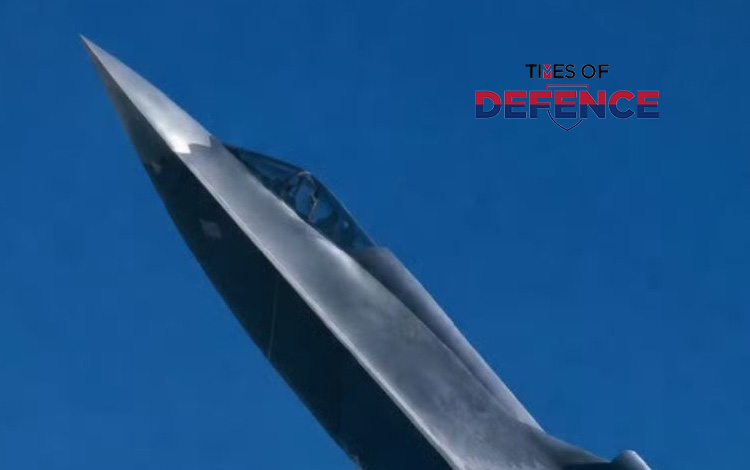
The aircraft widely referred to as the J-36 is an in-development Chinese tailless combat aircraft associated with Chengdu. Its designation has not been officially confirmed.
Available imagery shows a very large aircraft with a three-engine configuration, tailless planform, side-by-side cockpit and large internal weapons bays. Janes has assessed the design as consistent with a long-range fighter-bomber concept. The aircraft also appears to feature electro-optical targeting sensor apertures and sophisticated internal sensor architecture.
The three-engine arrangement has generated considerable speculation about the aircraft’s electrical power and thermal-management capacity. However, there is currently no reliable public evidence proving that the third engine was specifically added to power a laser weapon. Aerospace analysts have explicitly treated that explanation as speculative.
China Has Already Shown a Laser Self-Defense Concept
The J-36 laser discussion is not completely new.
In April 2025, an AVIC promotional video was reported to show a concept involving laser-based self-defense directors on the J-36, apparently engaging incoming missiles. The concept was interpreted as a defensive system intended to interfere with or potentially damage missile seekers rather than as a conventional offensive laser weapon.
The newly surfaced CIDEX material is significant because it shows that China is also displaying a dedicated fighter-aircraft laser weapon tracking and aiming system, potentially representing one of the critical subsystems required for such a capability.
Another Chinese Airborne Laser System
The other image shows an Airborne Electro-Optical Directional Jamming System.
Its stated operating principle is different from a conventional destructive laser weapon. The system uses electro-optical sensing to detect and track incoming infrared-guided missiles and then directs mid-infrared laser energy toward their seekers.
The objective is to disrupt the missile’s ability to acquire or maintain the aircraft as a target.
This type of technology is generally associated with Directed Infrared Countermeasures (DIRCM) and represents a “soft-kill” approach: instead of physically destroying the missile, the system attempts to defeat its guidance system.
Chinese industry has been publicly demonstrating airborne directional infrared countermeasure concepts for years. Earlier Chinese exhibition material described systems designed to detect incoming infrared threats and use directional infrared interference to protect aircraft.
From DIRCM to High-Energy Laser Defense
The potential evolution is significant.
A traditional DIRCM system is primarily intended to defeat infrared-guided missiles by interfering with their seekers.
A sufficiently powerful and precise high-energy laser could potentially provide a broader defensive capability, depending on power, beam quality, atmospheric conditions, tracking accuracy and engagement geometry.
The key technological challenge is therefore not simply generating laser power. An airborne system must also provide:
- extremely accurate target acquisition
- high-speed target tracking
- precision beam pointing
- sufficient electrical power
- thermal management
- stabilization against aircraft vibration and maneuvering
- integration with the aircraft’s sensors and defensive avionics
The ATP system displayed at CIDEX appears particularly relevant to this problem.
What Is Confirmed — and What Is Not?
Confirmed from available evidence:
- China is developing and displaying airborne electro-optical laser countermeasure technology.
- A Chinese exhibition display identifies a laser weapon tracking/aiming system for fighter aircraft.
- The displayed system is stated to weigh less than 380 kg.
- The J-36 has been publicly associated with a laser self-defense concept through AVIC promotional material.
- The J-36 prototype is a large, tailless, three-engine aircraft with internal weapons bays and electro-optical sensor apertures.
Not confirmed:
- That the displayed ATP system is actually installed on a J-36 prototype.
- The exact laser output power.
- The exact tracking accuracy.
- The existence of an operational J-36 laser weapon.
- The J-36’s final production configuration.
- Whether the system is intended primarily for missile defense, sensor attack, or another mission.
The Bottom Line
The strongest conclusion from the available evidence is not that the J-36 has already received an operational laser weapon, but that China appears to be developing the technologies required to put sophisticated laser-based defensive systems on future combat aircraft.
The combination of an AVIC laser self-defense concept associated with the J-36 and a newly displayed fighter-compatible laser tracking-and-pointing system makes the possibility more credible than earlier speculation.
However, the exact relationship between the exhibition system and the J-36 remains unconfirmed, and the aircraft’s official designation and final specifications have yet to be publicly established.
