

China appears to be developing a dedicated mothership for giant uncrewed underwater vehicles, with satellite imagery revealing an unusual vessel under construction at the Hudong-Zhonghua shipyard in Shanghai. If the current assessment is correct, the ship would represent a new approach to deploying and sustaining submarine-sized autonomous systems at sea.
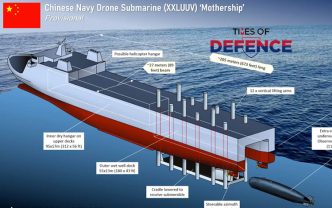
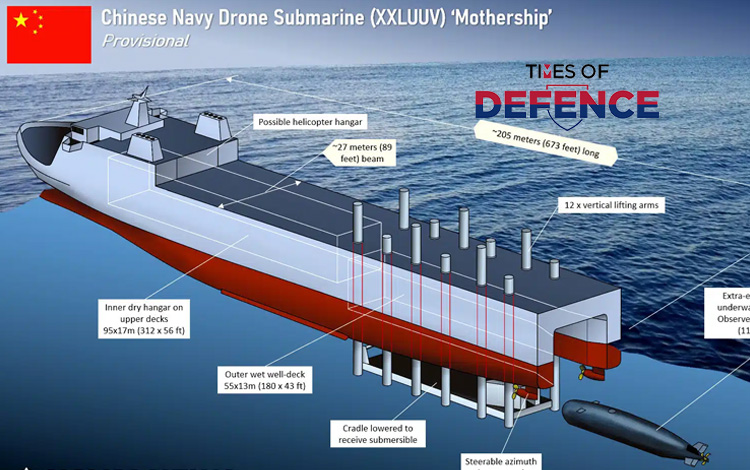
The vessel was identified in satellite imagery reviewed by Naval News. Its unusual configuration includes a large stern well deck, a submerged launch-and-recovery cradle supported by 12 vertical jack-up arms, and a large enclosed hangar forward of the well deck. Based on the observed dimensions and the size of China’s known giant underwater vehicles, Naval News assesses that the ship could accommodate approximately four XXLUUVs in its hangar.
China has not publicly confirmed the ship’s designation, operator or intended mission. Therefore, its role as an unmanned-submarine mothership remains an open-source assessment rather than an officially confirmed Chinese Navy capability.
A ~205-Meter-Class Specialized Vessel
Open-source imagery indicates a vessel approximately 205 meters long, with a configuration superficially resembling an amphibious ship but with a very different stern arrangement.
Instead of a conventional vehicle well deck, the stern appears designed around a large submerged cradle. The cradle can reportedly be lowered below the hull using 12 vertical lifting arms, creating a controlled launch-and-recovery mechanism for extremely large underwater vehicles.
A large enclosed hangar is located forward of the well deck. Based on comparisons with the dimensions of China’s 35- and 45-meter-class XXLUUVs, the hangar could potentially accommodate around four of the largest vehicles, although the exact internal arrangement and capacity have not been officially disclosed.
Observed / Assessed Characteristics
| Characteristic | Open-source assessment |
|---|---|
| Location | Hudong-Zhonghua shipyard, Shanghai |
| Length | Approximately 205 m |
| Likely role | XXLUUV mothership / submarine tender |
| Stern arrangement | Large well deck |
| Launch/recovery system | Submerged cradle |
| Lifting mechanism | 12 vertical jack-up arms |
| Enclosed hangar | Yes |
| Potential XXLUUV capacity | Approximately 4 |
| Displacement | Not confirmed |
| Propulsion | Not confirmed |
| Maximum speed | Not confirmed |
| Sensors/weapons | Not confirmed |
These figures should be treated as estimates derived from satellite imagery, not official specifications.
China’s Giant XXLUUV Program
The ship’s development is particularly significant because it appears to coincide with China’s work on unusually large autonomous underwater vehicles.
Two Chinese XXLUUV designs have been observed undergoing testing around Hainan. They are approximately 35 and 45 meters long, placing them in a category much larger than conventional military UUVs. Naval News assesses that they are approximately 6–8 times the overall size of the U.S. Navy’s Boeing Orca XLUUV.
The Chinese vehicles have reportedly been supported by specialized floating docks during testing. A dedicated mothership would represent a transition from a test-support arrangement toward a potentially deployable logistics architecture.
Instead of moving an autonomous submarine to sea on a floating dock, a dedicated mothership could potentially:
Transport → Launch → Support → Recover → Maintain → Redeploy
multiple large underwater vehicles.
Why the Well Deck Is Important
Launching a 35- or 45-meter unmanned submarine is fundamentally different from launching a small reconnaissance UUV.
A vehicle of this scale requires substantial handling equipment and careful control during the transition between the ship and the sea.
The apparent submerged cradle provides a solution.
Rather than suspending the submarine from a crane above the water, the cradle can potentially support the vehicle while it is lowered into the sea. The vehicle can then be released once sufficient water depth and stability have been achieved.
The same mechanism could be used in reverse during recovery.
This arrangement could reduce the handling risks associated with extremely large underwater vehicles and allow the mothership to perform repeated launch-and-recovery operations at sea.
The Mothership Could Become a Mobile Undersea Base
The most important aspect of the ship may not be its ability to transport the drones, but its potential role as a mobile submarine tender.
A large internal hangar could provide protected space for:
- Vehicle maintenance
- Mission-system preparation
- Spare parts
- Battery or energy-system support
- Payload installation
- Crew and technician work areas
- Mission turnaround
Keeping the XXLUUVs inside the ship when they are not deployed could also reduce their exposure to weather and eliminate the need to keep them continuously in the water.
This would transform the concept from an experimental autonomous submarine into a potentially more sustainable expeditionary system.
What Could the XXLUUVs Do?
China has not publicly released a complete mission specification for the giant vehicles.
However, their size could allow them to carry substantially larger energy stores, sensors and mission payloads than conventional UUVs.
Potential missions could include:
Intelligence, Surveillance and Reconnaissance
Large autonomous submarines could carry sophisticated acoustic, optical and other sensors for persistent undersea surveillance.
Seabed Operations
Their size and endurance could support missions involving seabed mapping, monitoring of underwater infrastructure and other long-duration operations.
Mine Warfare
A large autonomous platform could potentially carry mine-detection or mine-delivery systems, although no specific Chinese weapons configuration has been publicly confirmed.
Anti-Submarine Warfare
Large UUVs could potentially function as distributed underwater sensors, extending the geographic coverage of a broader anti-submarine network.
Long-Range Autonomous Operations
The absence of a crew allows internal volume to be allocated to propulsion, energy storage, sensors and mission payloads rather than life-support systems.
However, China’s actual range, endurance, speed, payload capacity and autonomy level for these XXLUUVs remain undisclosed.
Comparison With the U.S. Navy’s Orca
The most useful publicly documented comparison is the U.S. Navy’s Boeing Orca XLUUV.
Boeing describes Orca as an autonomous, diesel-electric extra-large unmanned undersea vehicle. The current platform is approximately 26 meters long overall, including a 10.4-meter modular payload section, and Boeing states that it can carry up to 8 tons of dry payload. Its advertised range is up to 6,500 nautical miles (12,038 km).
The U.S. Navy describes Orca as an autonomous unmanned diesel-electric submarine designed to carry modular mission payloads, with the ability to operate for extended periods without a crew.
China’s reported 35- and 45-meter vehicles are therefore significantly larger in physical dimensions.
However, larger does not automatically mean more capable. Actual effectiveness depends on propulsion efficiency, battery/fuel capacity, sensors, autonomy, communications, reliability, payload and demonstrated endurance.
There is also an important difference in basing philosophy.
Orca is designed for pier-side launch and recovery without a dedicated support ship, according to Boeing.
China’s apparent approach would instead use a large dedicated mothership to transport, launch, recover and maintain multiple giant underwater vehicles.
From Experimental Platforms to an Undersea Force Architecture
The emergence of the mothership suggests that China’s XXLUUV effort may be moving beyond individual vehicle development.
A deployable system requires more than the submarine itself. It requires:
Vehicle + Launch System + Recovery System + Maintenance + Energy + Payload Support + Command & Control
A dedicated mothership could provide many of these functions from a single mobile platform.
That could potentially allow China to position large autonomous submarines closer to their operating areas without requiring them to travel from mainland or island bases entirely under their own power.
The ship could also provide a centralized location for mission preparation and recovery while allowing multiple underwater vehicles to operate simultaneously.
Could It Operate Far From China?
Some open-source analysis has suggested that China’s large autonomous submarines could eventually support long-range operations in the Western Pacific and beyond.
However, such scenarios should not be presented as established Chinese operational capability.
There are currently no publicly confirmed figures for the Chinese XXLUUVs’ endurance, submerged range, speed, communications architecture or operational payloads.
Likewise, the mothership’s final propulsion system, displacement, sensors, defensive systems and operational status remain unknown.
The strongest evidence currently supports a narrower conclusion: China appears to be building a large specialized vessel whose physical configuration is highly compatible with supporting submarine-sized autonomous underwater vehicles.
Strategic Significance
If the assessment proves correct, the vessel would represent an important development in the evolution of unmanned naval warfare.
Instead of treating UUVs as small auxiliary systems launched from submarines or surface ships, China appears to be exploring a model in which very large autonomous underwater vehicles become the primary mission payload of a dedicated support ship.
The potential advantages include:
- Multiple UUVs deployed from one platform
- Mobile launch and recovery
- Forward maintenance
- Reduced dependence on fixed bases
- Persistent underwater surveillance
- Greater geographic flexibility
- Reduced risk to crewed submarines
At the same time, the mothership itself would be a large surface vessel and therefore potentially detectable and vulnerable in a high-intensity conflict.
Its value would depend heavily on how China integrates it with surface escorts, air defence, intelligence assets, communications networks and other naval forces.
Bottom Line
Satellite imagery points to a ~205-meter Chinese vessel under construction at Hudong-Zhonghua that appears unusually well suited to operating giant uncrewed submarines.
Its combination of an enclosed hangar, stern well deck and large submerged launch-and-recovery cradle is consistent with a dedicated XXLUUV mothership.
If confirmed, it would add another layer to China’s emerging autonomous undersea ecosystem — one that includes giant 35–45-meter-class XXLUUVs, smaller unmanned underwater systems and specialized support infrastructure.
But the vessel’s official role, propulsion, displacement, sensors, weapons, operational status and the actual performance of the Chinese XXLUUVs remain unknown.
For now, the most significant development is not a confirmed new weapon system, but evidence that China may be building the logistics and launch infrastructure required to turn submarine-sized autonomous vehicles into a deployable naval capability. navalnews
