

Türkiye’s Bayraktar TB3 has demonstrated a new anti-submarine warfare capability by deploying sonobuoys from TCG Anadolu during the Denizkurdu-I/2026 exercise.
The carrier-capable unmanned combat aerial vehicle successfully released two sonobuoys using Baykar’s newly developed Sonobuoy Dispenser System, or SAS POD, while operating from the Turkish Navy’s amphibious assault ship TCG Anadolu.
The test was conducted as part of Denizkurdu-I/2026, which is being held simultaneously across the Black Sea, Sea of Marmara, Aegean Sea and Eastern Mediterranean between September 20 and 25.
From UAV to airborne ASW sensor node
The most significant aspect of the demonstration was not simply the physical deployment of the sonobuoys.
According to Baykar, TB3 also operated in coordination with a Turkish maritime patrol aircraft conducting an anti-submarine warfare mission in the same operational area.
The TB3 processed underwater acoustic data from both:
- The two sonobuoys it deployed itself
- Sonobuoys deployed by the manned maritime patrol aircraft
The aircraft then provided a real-time display of the underwater data within the exercise environment.
This demonstrates an important shift in the TB3 concept: rather than functioning only as an isolated UAV, it can become part of a wider distributed ASW sensor network.
What is a sonobuoy?
A sonobuoy is an expendable underwater acoustic sensor deployed from an aircraft or other platform.
After entering the water, a sonobuoy can collect acoustic information associated with underwater activity and transmit relevant data back to the aircraft or processing network.
In an ASW architecture, multiple sonobuoys can be positioned across an area to create a distributed acoustic sensing field. A processing system can then combine information from several sensors to help operators detect, classify and track potential underwater contacts.
The TB3 demonstration is significant because the UAV was not merely acting as a delivery vehicle. It also participated in the processing and presentation of the resulting underwater data.
SAS POD
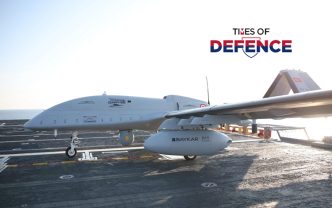
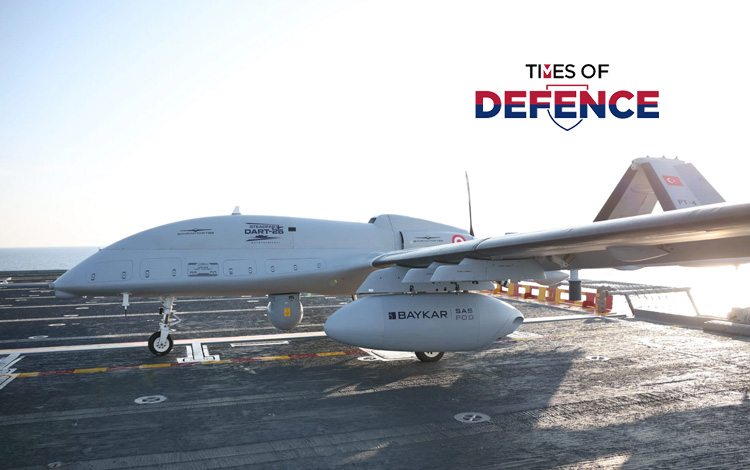
Baykar describes the new payload as the Sonobuoy Dispenser System (SAS POD).
The pod is carried under the TB3’s wing and was used to release two sonobuoys during the Denizkurdu mission. The exact dimensions, weight, number of available launch tubes and detailed electronic architecture of the SAS POD have not been publicly disclosed.
That distinction is important: the two-sonobuoy deployment demonstrated during the exercise should not automatically be interpreted as the pod’s maximum capacity.
Bayraktar TB3 technical baseline
The TB3 was specifically designed for operations from short-deck ships and is capable of autonomous takeoff and landing.
According to Baykar’s published specifications, the aircraft has:
| Parameter | Bayraktar TB3 |
|---|---|
| Length | 8.35 m |
| Wingspan | 14 m |
| Maximum take-off weight | 1,600 kg* |
| Payload | 280 kg |
| Endurance | 24+ hours |
| Operational altitude | 20,000 ft |
| Service ceiling | 25,000 ft |
| Cruise speed | 110 KTAS |
| Maximum speed | 130 KTAS |
| Communications | LOS & BLOS |
| Propulsion | Turbo-diesel engine |
| Take-off/landing | Autonomous |
| Configuration | Land and naval variants |
*Baykar notes that maximum take-off weight can vary for the naval configuration.
The TB3 also incorporates redundant flight-control and communications architecture, including a three-redundant autopilot system, redundant LOS communications, SATCOM/BLOS connectivity and sensor-fusion capabilities.
Why operating from TCG Anadolu matters
The TB3’s ability to operate from TCG Anadolu changes the geographical reach of the ASW sensor network.
A conventional maritime patrol aircraft can cover large areas, but it requires an airfield and represents a relatively high-value manned asset.
A shipborne UAV can instead be launched closer to the area of interest and remain airborne for extended periods.
That creates the possibility of using TB3s to:
Launch → deploy sonobuoys → collect acoustic data → process information → transmit the underwater picture → relocate to another search area
The combination with a manned maritime patrol aircraft could further expand this architecture by allowing crewed and uncrewed platforms to share sensor information.
A potential ASW force multiplier
The demonstration does not mean that TB3 has become a fully autonomous submarine hunter.
No public information confirms that TB3 independently detects, classifies and attacks submarines.
What has been demonstrated is narrower but technically important: sonobuoy deployment, onboard processing of underwater acoustic data and cooperation with a manned maritime patrol aircraft during an ASW scenario.
The next logical development would be deeper integration of TB3 into the Navy’s wider ASW command-and-control architecture, potentially allowing multiple UAVs and manned aircraft to distribute sensors over a larger area.
Baykar has not publicly announced a specific TB3-launched torpedo capability as part of this test.
The bigger picture
The demonstration also strengthens the concept of TCG Anadolu as a drone carrier and distributed maritime aviation platform.
TB3 was already designed around shipborne autonomous operations and can carry electro-optical, surveillance radar and other payloads in addition to guided weapons. Its published specifications include more than 24 hours of endurance and LOS/BLOS communications.
Adding sonobuoy deployment creates another mission layer:
ISR → ASW sensing → maritime surveillance → precision strike
This could allow a relatively small UAV to contribute to multiple phases of a naval mission without requiring a pilot to enter the threat environment.
What has actually been demonstrated?
Confirmed:
- TB3 operated from TCG Anadolu.
- Two sonobuoys were deployed using the SAS POD.
- The mission was conducted within an ASW exercise scenario.
- TB3 coordinated with a maritime patrol aircraft.
- TB3 processed data from its own sonobuoys and those deployed by the manned aircraft.
- Underwater data was displayed in real time during the exercise.
Not publicly disclosed:
- Sonobuoy model/type
- SAS POD maximum capacity
- Detection range
- Acoustic processing specifications
- TB3’s exact ASW sensor-processing architecture
- Any operational submarine-detection or engagement range
The September 2026 test therefore represents a demonstrated ASW sensing and networking capability, rather than proof of a fully autonomous submarine-hunting system.
With the TB3 now demonstrating sonobuoy deployment from TCG Anadolu, Türkiye is effectively testing a new layer in its naval aviation architecture: an unmanned, shipborne platform capable of placing acoustic sensors at sea and contributing directly to the underwater tactical picture.