


Australian Army Reaches Final Operational Capability with Locally Integrated NASAMS
Australia has completed the operational introduction of the National Advanced Surface-to-Air Missile System (NASAMS), with the Australian Army achieving Final Operational Capability (FOC) for its new short-range ground-based air-defence system.
The Australian Department of Defence announced on September 9, 2026, that NASAMS had met all requirements for operational service and was ready to support Australian Defence Force operations. The milestone follows a phased introduction that included live-fire activities and operator training conducted by personnel from 16 Regiment, Royal Australian Artillery.
Raytheon Australia subsequently confirmed that the system is now combat-ready, marking the completion of a multi-year programme designed to provide the Australian Army with a mobile and networked capability against aircraft, helicopters, unmanned aerial systems and cruise missiles.
An Australian-Specific NASAMS Configuration
Australia’s NASAMS is not simply an off-the-shelf configuration. The system was adapted to Australian operational requirements and incorporates significant local technology.
The architecture combines:
- CEA Technologies radars developed in Australia
- KONGSBERG Fire Distribution Centre (FDC) for command and control
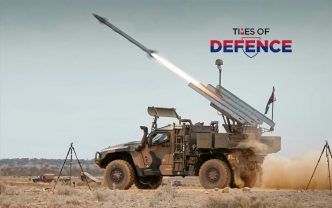
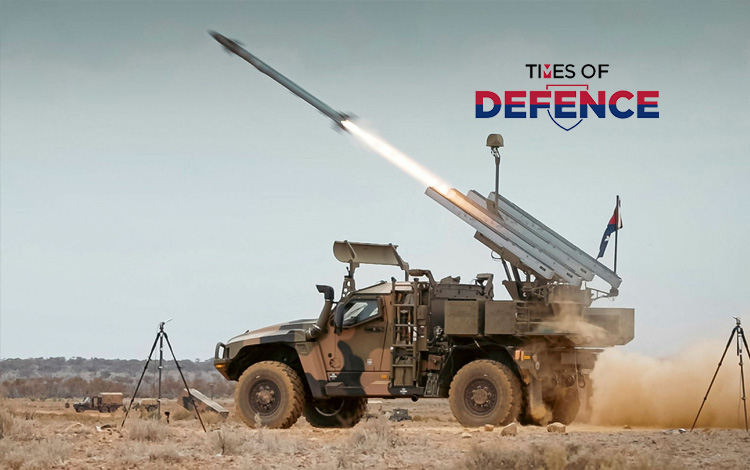
- Raytheon High Mobility Launchers mounted on Australian Army Hawkei vehicles
- Raytheon Australia multispectral ground systems
- A multi-missile effector suite consisting of AMRAAM, AMRAAM-ER and AIM-9X Sidewinder
The Australian configuration is part of the Army’s Short-Range Ground-Based Air Defence (SRGBAD) capability and forms an inner layer of Australia’s wider integrated air and missile defence architecture.
How NASAMS Engages Air Threats
NASAMS operates as a distributed air-defence network rather than as a single launcher.
Sensors detect and track airborne objects before sending the information to the Fire Distribution Centre, which acts as the system’s command-and-control node. The FDC can correlate sensor information, establish the air picture and coordinate the appropriate launcher and missile for an engagement.
KONGSBERG describes the FDC as a BMC4I system with an open architecture capable of integrating different sensors, weapons and tactical data links. It can support distributed operations in which radar and launcher elements are separated geographically from the command post.
This architecture is particularly important for survivability. Rather than concentrating the radar, command element and launchers in one location, NASAMS can distribute its components across the battlespace while maintaining a common operational picture.
Missile Options
One of the system’s major advantages is its ability to employ different air-to-air missiles in a ground-based air-defence role.
AIM-120 AMRAAM
The AIM-120 AMRAAM provides the system’s primary medium-range engagement capability. It uses active radar guidance and is already widely integrated with NASAMS.
Australia conducted its first NASAMS launch of an AIM-120 in November 2023.
AMRAAM-ER
The AMRAAM Extended Range (AMRAAM-ER) uses the AMRAAM guidance section combined with a larger propulsion section designed to increase engagement range and altitude.
Raytheon publicly identified AMRAAM-ER as part of Australia’s NASAMS effector suite for the first time when announcing FOC in September 2026. The exact Australian engagement envelope has not been publicly disclosed.
AIM-9X Sidewinder
The AIM-9X Block II provides a shorter-range infrared-guided option. KONGSBERG states that AIM-9X has been successfully fired from NASAMS and is optimized for shorter-range engagements.
Australia conducted AIM-9X live-fire certification activities at the Woomera Test Range in May 2025.
Hawkei-Based Mobility
The Australian system uses Raytheon’s High Mobility Launcher mounted on the Hawkei protected mobility vehicle, giving the Army a highly mobile launcher architecture suited to Australian land operations.
KONGSBERG’s NASAMS architecture allows launcher and radar elements to be geographically dispersed from the FDC, improving flexibility and potentially reducing the vulnerability of the overall system to counter-fire and attacks on individual nodes.
The launcher architecture can accommodate multiple missile types. KONGSBERG’s Multi-Missile Launcher is designed to carry up to six ready-to-fire missiles, with different missile combinations possible depending on mission requirements.
A Networked Defence Layer
NASAMS is not intended to operate in isolation. Australia’s Department of Defence describes it as part of a broader integrated air and missile defence architecture that combines surface-to-air systems, aircraft and naval capabilities.
Its primary mission is the protection of Australian forces, critical infrastructure and other high-value assets against threats including aircraft, cruise missiles and drones.
The system’s open architecture also allows additional sensors and effectors to be incorporated as requirements evolve. KONGSBERG says the FDC can interface with more than 10 different sensor types and multiple tactical data links, supporting distributed and networked air-defence operations.
Programme Completion
Australia selected NASAMS under LAND 19 Phase 7B in 2019, with Raytheon Australia serving as prime system integrator and KONGSBERG as a major partner.
KONGSBERG completed delivery of the final Fire Distribution Centre to Raytheon Australia in May 2024, bringing the major hardware-production phase to an end. The programme subsequently moved into integration, testing, training and sustainment.
With Final Operational Capability now declared, NASAMS has moved from a programme under development into an operational Australian Army capability.
Editorial note: Australia has confirmed the system’s FOC and its missile compatibility, but specific Australian quantities of launchers, radars and missiles, as well as the precise engagement ranges of the Australian configuration, have not been publicly disclosed. The publicly available range figures for individual missiles should therefore not be presented as confirmed Australian engagement envelopes.
