

Five years after Australia, the United Kingdom and the United States announced the AUKUS security partnership, the three countries are moving from strategic planning toward the construction, deployment and integration of advanced military capabilities.
AUKUS was announced on September 15, 2021, with its central objective of strengthening trilateral defence and technology cooperation in the Indo-Pacific. The partnership has since developed into two major lines of effort: Pillar I, focused on Australia’s acquisition and eventual domestic construction of conventionally armed, nuclear-powered submarines, and Pillar II, focused on advanced military technologies including undersea systems, artificial intelligence, quantum technologies, electronic warfare, cyber capabilities and hypersonic systems.
Pillar I: Building Australia’s Nuclear-Powered Submarine Capability
The submarine component of AUKUS follows a phased pathway.
Australia intends to acquire three U.S. Virginia-class nuclear-powered attack submarines from the early 2030s, with an option to seek approval for up to two additional boats. The submarines are intended to provide an interim nuclear-powered capability before Australia’s domestically built SSN-AUKUS fleet enters service.
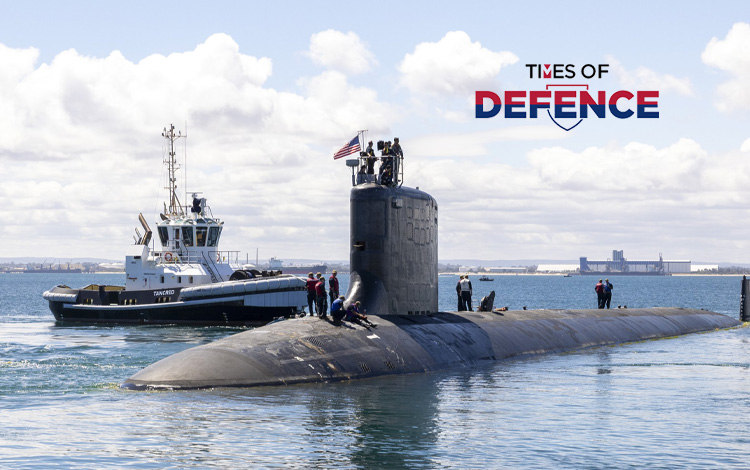
The Virginia class is a nuclear-powered attack submarine designed for anti-submarine warfare, anti-surface warfare, intelligence, surveillance and reconnaissance, special operations support and land-attack missions.
Virginia-Class Technical Profile
- Propulsion: One nuclear reactor, one shaft
- Length: 114.8 m
- Beam: 10.36 m
- Submerged displacement: Approximately 7,800 tonnes
- Speed: More than 25 knots
- Crew: Approximately 145 personnel
- Armament: Tomahawk cruise missiles and Mk 48 Advanced Capability torpedoes
- Torpedo armament: Four torpedo tubes
- Payload systems: Virginia Payload Tubes and, on Block V submarines, the Virginia Payload Module
- Block V VPM: Four additional large-diameter payload tubes, each capable of carrying seven Tomahawk missiles.
The Virginia-class design also incorporates photonics masts instead of traditional optical periscopes, advanced sonar systems, modular construction and an open architecture intended to simplify future upgrades.
The SSN-AUKUS: The Long-Term Objective
The long-term centerpiece of Pillar I is the SSN-AUKUS, a new conventionally armed nuclear-powered attack submarine based on a British design incorporating U.S. submarine technologies.
The platform will incorporate U.S. propulsion-related technology, a common vertical launch system and U.S.-derived weapons, while Australia, the UK and U.S. plan to develop a common combat system based on the existing U.S.-Australian combat-system architecture.
The United Kingdom is expected to begin construction of its first SSN-AUKUS submarine in Barrow-in-Furness in the late 2020s, with delivery to the Royal Navy planned for the late 2030s.
Australia plans to begin construction of its first domestically built SSN-AUKUS submarine at Osborne in South Australia before the end of the 2020s, with delivery targeted for the early 2040s.
The submarines are intended to conduct intelligence, surveillance, undersea warfare and strike missions while providing a common platform for the Australian and British navies.
Submarine Rotational Force-West
Another major milestone is the development of Submarine Rotational Force-West (SRF-West) at HMAS Stirling in Western Australia.
The arrangement is planned to establish a rotational presence of U.S. and UK nuclear-powered attack submarines in Australia. The long-term plan calls for one UK Astute-class submarine and up to four U.S. Virginia-class submarines to rotate through HMAS Stirling.
The facility is also intended to provide Australia with practical experience in operating, maintaining and sustaining nuclear-powered submarines before its own SSN fleet becomes operational.
AUKUS partners finalized the arrangements required for SRF-West in 2026, with the rotational presence scheduled to begin in 2027. Australia has committed significant funding to infrastructure and logistics facilities at HMAS Stirling.
Pillar II Moves Into Its First Signature Project
AUKUS has also expanded beyond submarines.
In May 2026, Australia, the UK and U.S. announced the first AUKUS Pillar II Signature Project, focused on advanced payloads and enabling systems for Uncrewed Undersea Vehicles (UUVs). Initial deliveries are scheduled to begin in 2027.
The project is designed around interoperable technologies that can be integrated across UUVs operated by all three countries.
Potential applications include:
- Undersea surveillance
- Protection of critical seabed infrastructure
- Intelligence and reconnaissance
- Strike missions
- Anti-submarine warfare
- Anti-surface warfare
- Mine countermeasures
- Electronic warfare
- Logistics
- Contested littoral operations
The program will initially develop national payloads that can be made interchangeable and integrated across partner systems. The countries then intend to jointly develop and manufacture trilateral payloads and enabling technologies.
Why UUVs Matter
Unlike crewed submarines, UUVs can operate without personnel onboard and can be used alongside conventional ships and submarines.
Their payloads can include sensors, navigation equipment and offensive systems, while enabling systems allow unmanned platforms to exchange information and cooperate with crewed and uncrewed assets.
For AUKUS, the objective is not simply to build individual unmanned vehicles but to create interoperable undersea systems capable of operating as part of a wider network.
Five Years of Progress — and Remaining Challenges
Five years after its creation, AUKUS has moved beyond the initial political announcement into workforce development, submarine infrastructure, nuclear training, industrial integration and advanced technology programs.
Australian personnel have been training within the U.S. and UK submarine enterprises, while Australian industry has begun integrating into allied submarine supply chains. Infrastructure at HMAS Stirling and the future Osborne submarine construction yard is also being developed.
However, major challenges remain. Independent analysis has highlighted workforce requirements, submarine industrial capacity, the U.S. Virginia-class production rate, regulatory arrangements and the complexity of the SSN-AUKUS design and construction schedule as important factors that could affect the pace of the program. These assessments are not official program determinations, but they illustrate the scale of the industrial challenge involved.
The five-year anniversary therefore marks less the completion of a capability than the transition from strategic agreement to long-term industrial and military implementation.
With SRF-West approaching its operational phase, Virginia-class submarines planned for Australia in the 2030s, and SSN-AUKUS construction moving toward the end of the decade, the next stage of AUKUS will increasingly be measured by submarines, infrastructure, trained personnel and deployable technologies rather than political announcements.
