

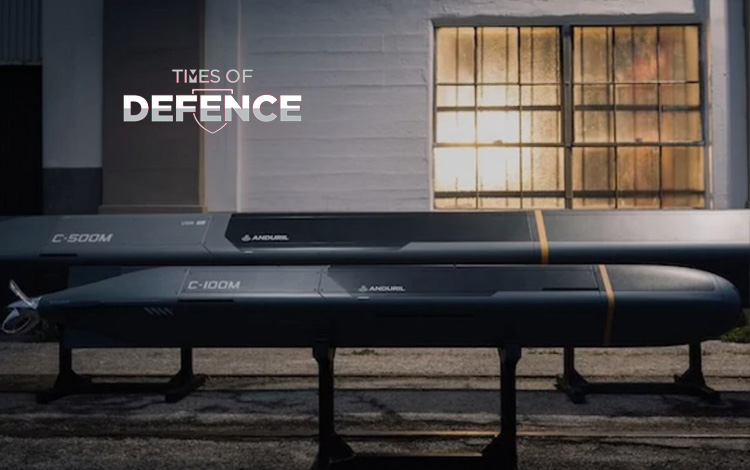
COSTA MESA, Calif. — Defense technology prime Anduril Industries has acquired Sandwich, Massachusetts-based underwater acoustics developer Popoto Modem to expand command, control, and multi-domain communication capabilities across its maritime autonomous ecosystem. Initially targeting deep integration into Anduril’s Copperhead autonomous underwater vehicle (AUV/UUV) family, the acquisition transitions years of joint development into a unified hardware-software architecture. By combining Popoto’s software-defined acoustic modems with Anduril’s Lattice OS open-architecture battle management system, the platform seeks to solve subsea mesh networking constraints, allowing single operators to orchestrate large, scalable formations of uncrewed sub-surface assets in contested maritime domains.
Subsea communications present severe physical challenges, as radio-frequency (RF) signals attenuate rapidly in saltwater, leaving acoustic signaling, optical links, or physical surfacing as the primary data paths. Popoto Modem’s technology utilizes programmable digital signal processing (DSP) running on Linux-based Arm processors, enabling dynamic modulation shifts (from robust frequency-hopping FSK to high-speed PSK at up to 10.24 kbps) to maintain acoustic links through complex multipath and thermal layer environments. The software-defined modems support NATO-standard JANUS (ANEP-87) interoperability alongside low-power acoustic wake-up modes and sub-meter acoustic ranging (<0.3 m). Integrated into platforms like the Copperhead UUV, these modems form underwater acoustic mesh networks that relay data between subsea assets, surface vessels, and land-based command nodes running Lattice software—creating a continuous common operating picture (COP) without requiring UUVs to continuously break surface stealth.
TECHNICAL SPECIFICATIONS: POPOTO MODEM ACOUSTIC COMMUNICATIONS ARCHITECTURE
* System Classification: Programmable Software-Defined Underwater Acoustic Modem / Subsea Mesh Architecture
* Core Developer: Popoto Modem (Sandwich, Massachusetts) / Acquired by Anduril Industries
* Primary Integration Platforms: Anduril Copperhead AUV family, Dive-LD autonomous submarine, and Lattice OS nodes
* Physical & Modular Variants:
* OEM Board Sets (PMM4511 / PMM6081): Low-form-factor single/multi-board units for AUV/ROV internal integration
* Enclosed Pressure Housings (M2000 / M6000): Anodized aluminum & titanium pressure vessels rated to 2,000 m and 6,000 m (full ocean depth)
* Acoustic Performance & Data Processing Envelope:
* Operating Frequency Spectrum: 10 kHz to 100 kHz (Standard operation: 20–35 kHz band)
* Variable Data Rates: Flexible transmission from 80 bps (Frequency Hopping FSK for high noise/reverb) up to 10,240 bps (PSK)
* Transmit Power Level: Up to 100 W output / 185–190 dB SPL re 1µPa @ 1m
* Operational Acoustic Range: 1 to 8 kilometers (dependent on oceanographic conditions and selected modulation scheme)
* Acoustic Ranging Accuracy: Precise sub-meter slant-range calculation (<0.3 m accuracy)
* Onboard Processing & Computing Architecture:
* System Core: Quad-Core 1.4 GHz Arm® Cortex®-A53 processor running embedded Debian Linux
* Interoperability Protocols: Native support for NATO JANUS (ANEP-87), Phorcys Stheno/Euryale, and custom user-defined APIs (Python, C++, MATLAB, JSON)
* Power Efficiency: Ultra-low power acoustic wake-up (<45 mW deep sleep / <10 µW GPIO sleep) preserving UUV battery endurance