

Airbus is taking a proven helicopter design and removing one of its most important components: the pilot.
The company’s new U145 is an uncrewed and autonomous derivative of the H145 family, designed primarily to transport heavy cargo into environments where sending a crewed helicopter could expose personnel to unacceptable risks.
Airbus unveiled the U145 at the ILA Berlin Airshow in June 2026. The aircraft is currently in development, with a maiden flight planned for the end of 2026. Airbus says it expects the system to be ready for series production by the end of the decade, while its June announcement placed entry into service at the beginning of the 2030s.
From H145 to U145
The U145 is based directly on the mature H145 architecture. Airbus says more than 1,800 H145-family helicopters are currently in service and have accumulated more than 8.5 million flight hours, providing the programme with an established airframe and propulsion foundation.
The underlying H145M configuration has a maximum take-off weight of 3,800 kg, a useful load of 1,893 kg, a fast cruise speed of approximately 241 km/h, and a standard-fuel range of around 637 km. It uses two Safran Arriel 2E turboshaft engines, each producing up to 667 kW / 894 shp at take-off.
Airbus has not released a complete independent performance datasheet for the production U145. However, the company confirms a 3,800 kg MTOW for the U145 development and says the aircraft has been modified specifically to increase mission payload compared with the crewed configuration.
No Cockpit
One of the most visible changes is the removal of the physical cockpit.
Instead of human pilots operating conventional flight controls, the U145 uses automated electromechanical actuation and onboard computing to reproduce the functions normally performed by the crew.
Airbus says the conversion requires automation of pilot actions including flight-control inputs, as well as dedicated modifications for automated takeoff and landing.
The second major challenge is replacing the pilot’s ability to perceive the environment.
The U145 therefore incorporates a specialised sensor suite combined with artificial intelligence. These systems are intended to detect obstacles, understand the aircraft’s surroundings and support autonomous manoeuvring, particularly during low-level flight.
Designed Around Cargo
The U145 is not simply an H145 with its cockpit removed.
Airbus has redesigned the aircraft’s internal cargo arrangement around autonomous logistics.
The helicopter features a dedicated flat cargo floor and an integrated nose door with a foldable loading table. Combined with the nose, rear and side openings, this provides 360-degree access to the cargo compartment, allowing loads to be moved into and out of the aircraft from multiple directions.
This configuration is particularly relevant to military logistics.
An autonomous helicopter could deliver ammunition, spare parts, fuel-related equipment, medical supplies or other heavy cargo directly to forward positions without placing a crew onboard.
More Than an Autonomous Cargo Truck
Although logistics is the primary mission Airbus is targeting, the company is designing the U145 as a modular multi-mission platform.
Potential applications include:
- Autonomous military logistics
- Battlefield resupply
- Disaster response
- Firefighting
- Surveillance
- Armed scouting
- Crewed-uncrewed teaming
- Air-launched-effects deployment
The last role could be particularly significant.
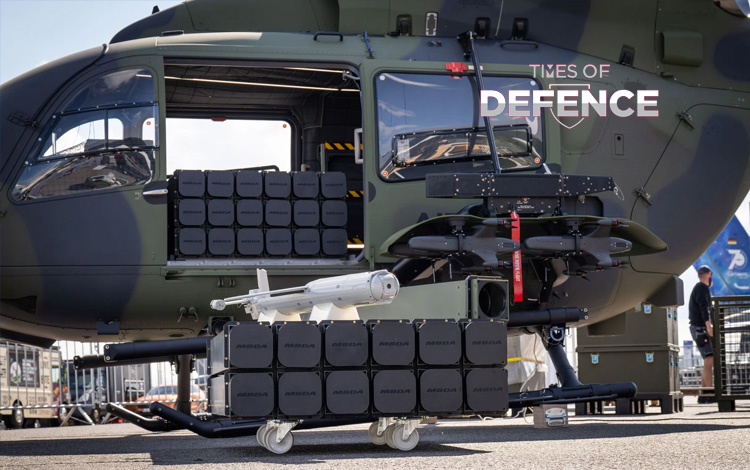
Airbus envisions the U145 acting as an air-launched-effects mothership, carrying smaller autonomous drones into a contested or hostile area before releasing them. Those smaller systems could then conduct their own missions while the U145 remains outside the immediate threat area. Airbus has also identified a partnership with MBDA in this area.
A Modular Path to Full Autonomy
Airbus is not necessarily expecting every customer to immediately operate the aircraft without anyone onboard.
The company says it is developing several intermediate configurations. One option could retain a safety pilot, which may be particularly useful for operations over populated areas where aviation regulations require or favour onboard human supervision.
Airbus says at least four major development steps are envisaged, with two of those steps potentially reusable for existing H145 customers.
This creates a potential transition path:
Crewed H145 → Assisted Automation → Safety-Pilot Configuration → Fully Autonomous U145
Such an approach could allow operators to progressively introduce autonomous functions rather than replacing their existing helicopter fleets immediately.
Technical Snapshot
| Feature | U145 / H145-family basis |
|---|---|
| Configuration | Uncrewed autonomous helicopter |
| Base platform | Airbus H145 family |
| MTOW | 3,800 kg |
| Propulsion | 2 × Safran Arriel 2E |
| Engine power | 667 kW / 894 shp each at take-off |
| H145M fast cruise | 241 km/h |
| H145M standard-fuel range | 637 km |
| Primary mission | Autonomous cargo transport |
| Cargo access | 360-degree access |
| Cockpit | Removed |
| Autonomy | Dedicated sensors + AI + automated flight controls |
| Secondary roles | Surveillance, disaster response, firefighting, armed scouting |
| Future concept | Air-launched-effects mothership |
| Maiden flight | Planned for end-2026 |
| Series production | Targeted by end of decade |
| Entry into service | Beginning of the 2030s |
The performance figures in the table that are explicitly identified as H145M figures should not be interpreted as a complete certified U145 performance specification. Airbus has not yet published the full production U145 flight-performance envelope.
Why the U145 Matters
The U145 represents a different approach to the autonomous helicopter problem.
Rather than developing an entirely new unmanned aircraft from scratch, Airbus is starting with a mature twin-engine helicopter architecture and rebuilding the aircraft around autonomy, cargo and mission flexibility.
That could reduce some of the engineering risk associated with developing an entirely new rotorcraft, while giving operators access to a much larger payload class than many conventional tactical UAVs.
The concept also fits into Airbus’ wider autonomous-aircraft strategy, which includes the VSR700 unmanned helicopter and larger uncrewed combat-aircraft programmes.
But the key test will come next.
The U145 has not yet demonstrated autonomous flight in operational conditions. Its first flight, planned with a safety pilot onboard, is expected at the end of 2026. The subsequent development phases will determine how quickly Airbus can transition the concept from a full-scale airshow demonstrator into a production autonomous helicopter.
Bottom line: Airbus is turning the H145 from a crewed utility helicopter into a potentially autonomous logistics and mission platform. If the programme meets its development targets, the U145 could give European operators a reusable helicopter-sized autonomous aircraft capable of carrying heavy loads into areas considered too dangerous for crewed operations.