


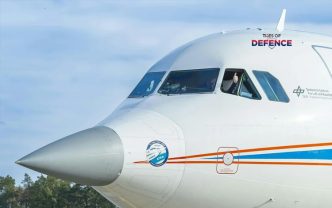
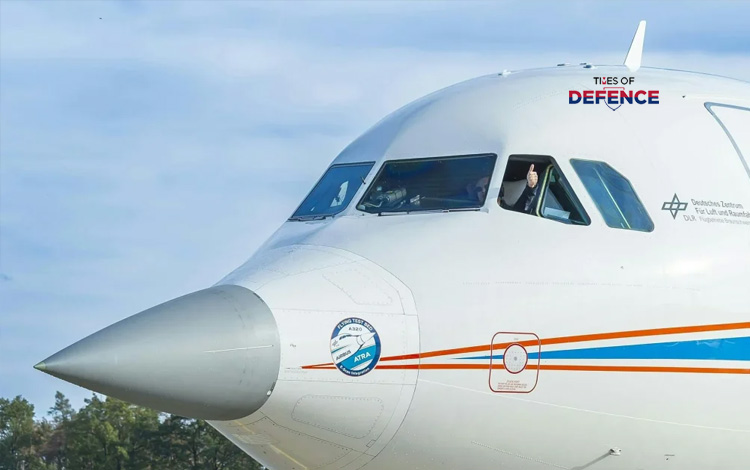
Airbus Defence and Space, in collaboration with the German Aerospace Center (DLR), announced on November 6, 2026, that the A320 ATRA (Advanced Technology Research Aircraft) flying testbed has completed commissioning flights at Manching Air Base, entering active operational service.
Modified with a Eurofighter Typhoon radome and forward nose section, the commercial airframe will serve as the primary airborne evaluation platform for the Eurofighter Common Radar System Mk1 (ECRS Mk1) Active Electronically Scanned Array (AESA) radar. Jointly developed by Hensoldt and Indra, the ECRS Mk1 is targeted for integration on German Air Force (Luftwaffe) Quadriga and Tranche 5 fighters, Spanish Air and Space Force (Ejército del Aire y del Espacio) Halcón program aircraft, and potential legacy fleet retrofits. Initial structural airworthiness flights occurred in early 2025 without active radar, followed by extensive ground integration and recent airborne validation.
TECHNICAL SPECIFICATIONS: AIRBUS A320 ATRA ECRS MK1 TESTBED ARCHITECTURE
Testbed Platform Modification & Industrial Workshare
⚡ Operating Authority: Airbus Defence and Space / German Aerospace Center (DLR)
⚡ Operating Base: Manching Air Base, Bavaria, Germany
⚡ Aircraft Platform: Airbus A320-232 ATRA (Advanced Technology Research Aircraft / Registration: D-ATRA)
⚡ Target Radar System: Eurofighter Common Radar System Mk1 (ECRS Mk1 / E-Scan Mk1) AESA
⚡ Primary Radar Developers: Hensoldt (Germany / Lead contractor for sensor hardware & receiver architecture) & Indra Sistemas (Spain / Lead for receiver/processor modules)
⚡ Airframe Modifications:
• Forward Fuselage Integration: Structural reinforcement of the forward pressure bulkhead and radome attachment frame to accommodate the pointed Eurofighter Typhoon nose cone
• Thermal Management: Integrated high-capacity liquid-and-air cooling system to regulate high-power AESA Transmit/Receive Module (TRM) thermal dissipation
• Data Wiring & Telemetry: Installation of hundreds of meters of high-bandwidth fiber-optic and coaxial data buses connecting radar back-end processors to interior cabin workstations
• Airborne Workstations: Multiple operator stations enabling real-time engineering visualization of radar raw data, signal processor metrics, pilot display emulation, and in-flight software updating 
ECRS Mk1 AESA Kinematics, Modes & Sensor Capabilities
💥 Antenna Architecture: Mechanical repositioner (swashplate / tilt-remover platform) driving a multi-channel AESA array, providing an expanded Field of Regard (FoR) up to ±90° (180° total azimuth coverage)
💥 Operational Modes:
• Air-to-Air: Wide-angle long-range target detection, multi-target tracking, frequency agility, high resistance to electronic countermeasures (ECM), and non-cooperative target recognition (NCTR)
• Air-to-Surface: Ultra-high-resolution Synthetic Aperture Radar (SAR) mapping, Ground Moving Target Indication (GMTI), maritime search, and targeted electronic attack (EA) / directional energy projection
💥 Operational Timeline: Airborne testbed validation throughout 2026–2027; serial deliveries for Luftwaffe Tranche 4 / Quadriga and Spanish Halcón Eurofighters planned from 2027 onward
TIMES OF DEFENCE ASSESSMENT
The entry into service of the A320 ATRA flying radar testbed provides critical strategic advantages for the Eurofighter consortium:
1. **Accelerating Complex AESA Software & Hardware Maturation**: Utilizing a commercial airframe like the A320 provides an expanded power baseline, interior space for multi-station engineering teams, and longer endurance compared to single/twin-seat fighter test flights. Flight engineers can analyze hardware telemetry and test real-time software patches “under the nose” in flight, significantly compressing development cycles for ECRS Mk1 algorithms.
2. **Standardizing 4.5-Generation Airborne Sensor Superiority**: Transitioning from legacy mechanically scanned Captor-M radars to the ECRS Mk1 AESA restores competitive sensor capabilities against modern adversary platforms. The repositionable swashplate design grants Eurofighter pilots an extreme off-boresight tracking geometry during beyond-visual-range (BVR) missile engagements, allowing tactical maneuverability while maintaining missile guidance links.
3. **De-Risking Tranche 4/5 and Halcón Delivery Schedules**: Joint flight testing by Airbus and DLR mitigates integration risks before full-rate serial installation on German and Spanish Eurofighters. Validating environmental cooling, high-voltage power distribution, and multi-mode radar software on a dedicated testbed protects operational delivery timelines for NATO’s European air defense component.

