


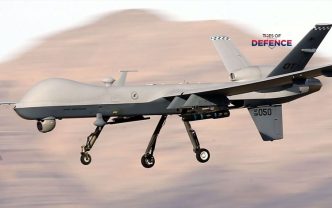
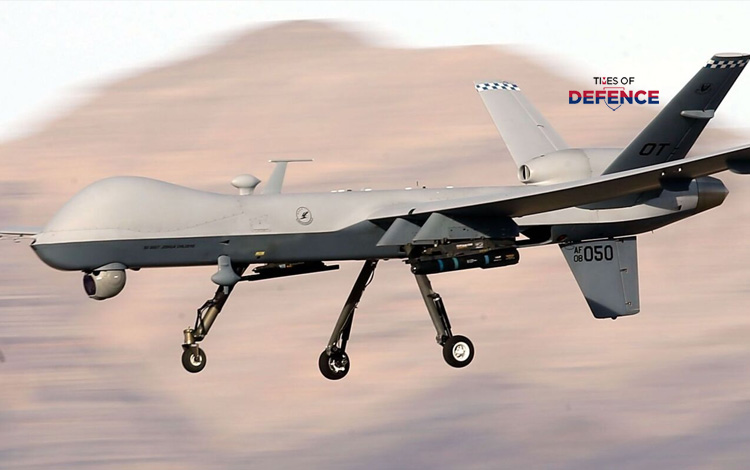
Iranian state media carried a statement on November 6, 2026, from the Islamic Revolutionary Guard Corps (IRGC) Aerospace Force reporting the successful detection and destruction of a U.S. MQ-1 class Unmanned Combat Aerial Vehicle (UCAV) over Qeshm Island near the Strait of Hormuz.
According to IRGC Public Relations, the aircraft was intercepted and destroyed by an integrated air defense system operating within Iran’s national air defense network. Teheran claims this engagement represents the 16th MQ-1 series drone (including MQ-1C Gray Eagle and operational derivatives) brought down since hostilities commenced on February 28, 2026. Total Iranian claims now stand at 72 U.S. MALE (Medium-Altitude Long-Endurance) drones downed, comprising 16 MQ-1 and 56 larger MQ-9 Reaper platforms. U.S. Air Force and Central Command (CENTCOM) officials have not verified the loss metrics, maintaining standard operational security protocols regarding ISR flight tracking.
TECHNICAL SPECIFICATIONS: MQ-1C GRAY EAGLE & REGIONAL AIR DEFENSE ENGAGEMENT
MQ-1C Gray Eagle / Predator Series Platform Baseline
⚡ Primary Operating Service: U.S. Army (MQ-1C Gray Eagle) / Legacy USAF Storage Reserves (MQ-1B Predator derivatives)
⚡ OEM & Powerplant: General Atomics Aeronautical Systems / Thielert Centurion 1.7 Heavy-Fuel Engine (HFE) producing 165 hp (123 kW)
⚡ Kinematic Performance Envelope:
• Maximum Speed: 167 knots (309 km/h)
• Operational Ceiling: 29,000 ft (8,840 m)
• Flight Endurance: 25 to 30 hours continuous persistent surveillance window
⚡ Payload & Sensor Integration:
• External Hardpoints: 4× wing pylons capable of carrying 4× AGM-114 Hellfire missiles or 4× GBU-69/B Small Glide Munitions
• Internal Avionics: Synthetic Aperture Radar (SAR) with Ground Moving Target Indicator (GMTI), Electro-Optical/Infrared (EO/IR) laser designator turrets, and electronic intelligence (ELINT) pods 
Iranian Air Defense Interception Architecture
💥 Radar Detection & Target Acquisition: Multi-band 3D phased-array tracking systems integrated into Iran’s Integrated Air Defense System (IADS) node on Qeshm Island
💥 Engagement Effector Matrix: Native surface-to-air missile (SAM) batteries, including 3rd Khordad, Sevom Khordad, and 15th Khordad medium-range SAM systems using Taer-2 and Sayyad-2/3 radar-guided interceptors
💥 Target Operational Profile: MALE drones executing low-speed, high-altitude ISR orbits over maritime transit chokepoints along the Strait of Hormuz
TIMES OF DEFENCE ASSESSMENT
The reported downing of additional U.S. MALE drones near the Strait of Hormuz underlines ongoing operational attrition dynamics:
1. **Strategic Shift Toward Expendable ISR Assets**: The high combat attrition of larger, higher-cost platforms like the MQ-9 Reaper (costing ~$30M per airframe) has accelerated operational reliance on lower-cost MQ-1 variants. Deploying MQ-1C Gray Eagles and reactivated reserve assets allows military commanders to maintain persistent ISR cover over critical maritime routes without risking strategic strike capabilities.
2. **Dense Multi-Layered Air Defense Envelopes in Strategic Maritime Chokepoints**: Operating unescorted, non-stealthy MALE drones within range of integrated land-based SAM networks (such as those stationed around Qeshm Island) exposes low-speed aircraft to high-probability-of-kill ($\text{P}_\text{k}$) SAM engagements. Ground-based 3D radars effectively acquire unstealthy RCS signatures, creating severe survival challenges for non-penetrating ISR platforms.
3. **Depletion of Procurement Inventories and Rapid Force Regeneration Challenges**: Sustained losses of medium-altitude long-endurance drones strain operational fleets, leading defense procurement agencies to seek rapid replacement contracts and tap legacy airframe reserves. This highlights the strategic necessity for next-generation, low-observable (LO) attritable unmanned systems capable of surviving modern integrated air defense networks.

