


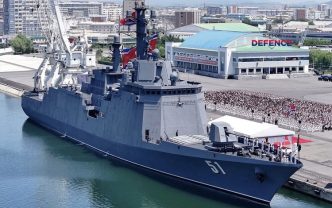
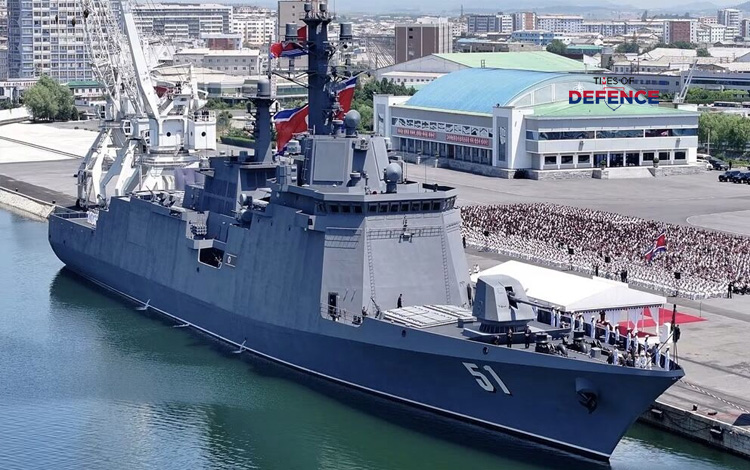
Satellite imagery analysis from early November 2026 confirms that the Democratic People’s Republic of Korea (DPRK) has expanded its surface combatant construction program across three main naval shipyards: Nampho on the west coast, alongside Chongjin and Rajin on the east coast.
The multi-site expansion supports Pyongyang’s stated naval doctrine to launch two surface combatants annually over a five-year modernization cycle. Following the initial launch of two ~5,000-ton Choe Hyon-class guided-missile destroyers in 2025, recent high-level inspections on November 2 at Nampho by Korean Workers’ Party Chairman Kim Jong Un revealed a new hull under construction assessed at approximately 10,000 tons displacement. The simultaneous deployment of three shipyards for large surface combatant production outpaces current U.S. destroyer manufacturing infrastructure, which relies primarily on two major shipyards (General Dynamics Bath Iron Works and Huntington Ingalls Industries).
TECHNICAL SPECIFICATIONS: DPRK COMBATANT SHIPBUILDING & WEAPONS INTEGRATION
Shipyard Infrastructure & Industrial Division of Labor
⚡ Primary Yards (West Coast): Nampho Shipyard — Lead integration and assembly facility for large surface combatants; undergoing physical expansion of slipways and drydocks
⚡ Secondary Yards (East Coast): Chongjin Shipyard & Rajin Naval Shipyard — Active in hull module fabrication, structural section prefabrication, and fitting-out operations
⚡ Industrial Velocity Metrics:
• DPRK Production Target: 2× destroyers per year (operational baseline established in 2025 with Choe Hyon-class)
• Comparative U.S. Baseline: ~1.6 Arleigh Burke-class (Flight III) destroyers per year split between Bath Iron Works and Ingalls Shipbuilding
• Comparative PRC Baseline: 6 to 10 destroyers per year across Dalian and Jiangnan shipyards 
Warship Platform Kinematics & Kinetic Payload Architecture
💥 Baseline Platform Variant (Choe Hyon-Class): ~5,000-ton displacement multi-role guided-missile destroyer
💥 Next-Generation Platform Variant (10,000-Ton Class): Hull under construction at Nampho featuring expanded beam and displacement exceeding legacy 9,600-ton U.S. Arleigh Burke Flight III platforms
💥 Sensor & Air Defense Suite: Navalized derivative of the Pyongae-6 (KN-06 follow-on) long-range surface-to-air missile (SAM) system integrated into vertical launch system (VLS) cells for area air defense
💥 Standoff Strike & Anti-Ship Ordnance: Integrated vertical and inclined canisters carrying naval hypersonic glide vehicles (HGVs), Mach 5+ hypersonic cruise missiles, and long-range nuclear-capable land-attack cruise missiles (LACM)
TIMES OF DEFENCE ASSESSMENT
The expansion of North Korea’s destroyer production infrastructure highlights significant strategic shifts in East Asian naval dynamics:
1. **Leveraging Distributed Prefabrication to Boost Naval Mass**: Operating three shipyards (Nampho, Chongjin, Rajin) enables the Korean People’s Navy (KPN) to adopt modular prefabrication techniques. Fabricating hull blocks across multiple yards and assembling them at main slipways allows Pyongyang to maintain a high construction output despite industrial resource constraints.
2. **Prioritizing Heavy Anti-Surface Strike Volleys over Multi-Mission Defense**: U.S. Navy Arleigh Burke Flight III destroyers focus on anti-ballistic missile (ABM) defense using SM-3/SM-6 interceptors alongside Aegis C4ISR integration. In contrast, DPRK destroyer designs prioritize anti-surface warfare (ASuW) and standoff land attack. Integrating hypersonic cruise missiles and nuclear-capable LACMs provides high-salvo strike capacity to contest regional sea lines of communication.
3. **Implications of the U.S. Naval Industrial Base Bottleneck**: With U.S. surface combatant production constrained to two principal yards facing supply-chain and labor bottlenecks, North Korea’s dual-vessel annual output narrows the numerical fleet gap in localized regional waters. While U.S. platforms maintain sensor and ASW advantages, Pyongyang’s rapid hull generation expands its anti-access/area-denial (A2/AD) architecture.

