

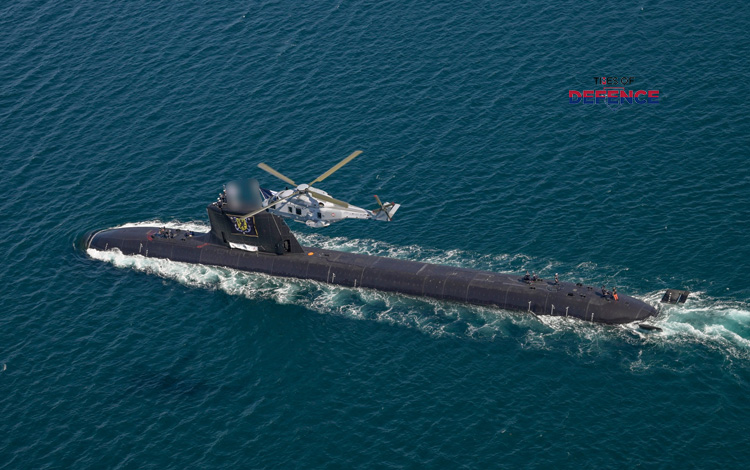
The French Navy (Marine Nationale) has formally admitted its fourth Suffren-class (Barracuda programme) nuclear-powered attack submarine (SNA), De Grasse (S638), into active service on November 20, 2026. Built by Naval Group in Cherbourg with nuclear propulsion engineered by TechnicAtome, the commissioning brings two-thirds of France’s six-boat Suffren-class fleet into operational service as the service phases out its legacy 1980s-era Rubis-class SSNs.
Following its assembly-hall rollout in May 2025, reactor criticality in December 2025, sea trials beginning in February 2026, and homeport arrival in Toulon in July 2026, De Grasse enters active service alongside sister submarines Suffren (commissioned in June 2022), Duguay-Trouin (April 2024), and Tourville (July 2025). Notably, De Grasse introduces spiral electronic upgrades over the first three hulls—featuring an updated software baseline for the SYCOBS combat management system and a new-generation electronic warfare suite—while construction continues in Cherbourg on the final two units, Rubis (rolled out in October 2026) and Casabianca, scheduled for delivery through 2029–2030 under France’s Military Programming Law.
TECHNICAL SPECIFICATIONS: SUFFREN-CLASS (BARRACUDA) SSN — SNA DE GRASSE (S638)
1. Hull Geometry, Nuclear Propulsion & Acoustic Stealth
⚡ Prime Shipbuilder & Propulsion Partner: Naval Group (Cherbourg shipyard) and TechnicAtome (nuclear propulsion plant), contracted by the French Directorate General of Armaments (DGA)
⚡ Dimensions & Displacement: Overall length of 99.5 meters (326 ft), beam of 8.8 meters (29 ft), draught of 7.3 meters (24 ft), surface displacement of ~4,700–4,765 metric tons, and submerged displacement of ~5,100–5,300 metric tons
⚡ Propulsion & Hydrodynamics: Powered by a 150 MW TechnicAtome K15 pressurized water reactor (utilizing low-enriched uranium with a 10-year refueling interval) driving turbo-electric propulsion and a quiet pump-jet propulsor, paired with an X-shaped stern rudder configuration for enhanced maneuverability and low acoustic signature
⚡ Speed, Diving Depth & Endurance: Submerged speed exceeding 25 knots (14 knots surfaced), diving depth beyond 350 meters, 70-day patrol endurance (limited primarily by food provisions), annual operational availability of roughly 260 days at sea, and a standard crew of ~60–65 personnel 
2. Combat Management, Weapons Suite & Special Operations
💥 Upgraded Combat & Electronic Warfare Systems: Integrates an enhanced software version of Naval Group’s SYCOBS combat management system alongside a next-generation electronic warfare suite (building on the NEMESIS electronic countermeasure architecture and Safran optronic masts), fed by Thales UMS-3000 hull/flank arrays and towed-array sonars
💥 Torpedo-Tube Armament (20 Weapons): Equipped with four 533 mm bow torpedo tubes and stowage for 20 weapons, including Naval Group F21 Artemis heavyweight torpedoes, MBDA Exocet SM39 Mod 2 anti-ship missiles, and MBDA Missile de Croisière Naval (MdCN) deep-strike land-attack cruise missiles
💥 Special Operations Insertion: Accommodates up to 12–15 Commandos Marine and supports a removable dry deck shelter (DDS) aft of the sail to deploy underwater swimmer delivery vehicles for covert coastal reconnaissance and raids
TIMES OF DEFENCE ASSESSMENT
The commissioning of SNA De Grasse (S638) into active service with the French Navy highlights three critical shifts in European undersea warfare, naval shipbuilding cadence, and multi-domain deterrence:
1. Passing the Two-Thirds Fleet Milestone in France’s Undersea Recapitalization: With four of six Suffren-class SSNs now operational—and the fifth boat, Rubis, already rolled out for trials—France is steadily replacing its smaller 1980s Rubis-class submarines while boosting at-sea availability toward 260 days per hull annually across the Mediterranean and Atlantic.
2. Embedding Spiral Electronic Warfare and Software Upgrades Mid-Production: Incorporating an updated SYCOBS combat management baseline and new-generation electronic warfare suite starting on the fourth hull demonstrates Naval Group and the DGA’s ability to insert modern software and electromagnetic spectrum capabilities without disrupting hull delivery schedules.
3. Combining Deep-Strike Cruise Missiles With Covert Special Operations Reach: Unlike legacy Rubis-class boats, Suffren-class SSNs pair quiet pump-jet acoustics with torpedo-tube-launched MdCN land-attack cruise missiles and removable dry deck shelters—giving Paris both strategic conventional strike and clandestine littoral insertion options.