



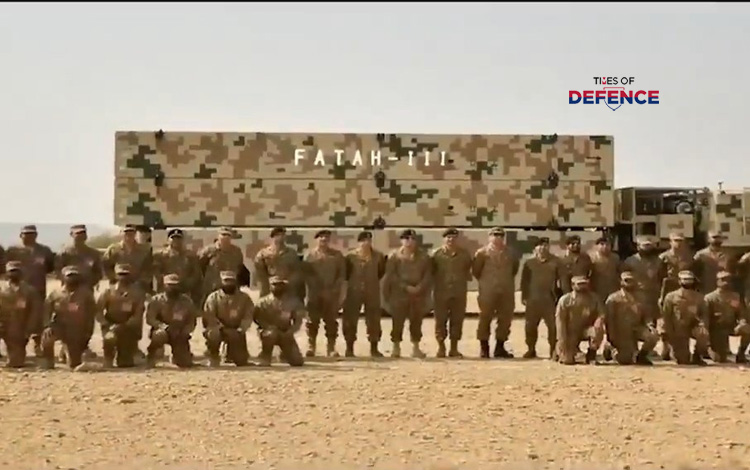
The Pakistan Army has announced the successful test launch of the Fatah-III supersonic cruise missile on November 18, 2026, validating the platform’s propulsion, navigation, and terminal precision capabilities.
Witnessed by the Commander of the Army Rocket Force Command (ARFC), senior military officers, and defense scientists and engineers, the launch marks a major milestone in expanding Pakistan’s conventional deep-strike arsenal. According to the Inter-Services Public Relations (ISPR), the Fatah-III is equipped with advanced navigation and propulsion systems engineered to engage high-value targets at extended ranges with high precision and supersonic speed. First unveiled in May 2026 during the anniversary of Operation Bunyan al-Marsoos, the weapon joins a rapidly expanding family of conventional precision munitions—including the Fatah-I and Fatah-II guided rocket/missile systems and the subsonic Fatah-IV cruise missile—operated under the dedicated Army Rocket Force Command established in August 2025.
TECHNICAL SPECIFICATIONS: PAKISTAN ARMY FATAH-III SUPERSONIC CRUISE MISSILE ARCHITECTURE
1. Propulsion System, Airframe & Supersonic Flight Profile
⚡ Propulsion Architecture: Combines a jettisonable solid-fuel rocket booster for initial launch acceleration with an air-breathing ramjet sustain engine fed by four side-mounted air intakes, visually analogous to the HD-1 supersonic missile architecture
⚡ Flight Speed & Terminal Lethality: Sustains high supersonic cruise velocities (assessed in the Mach 3 to Mach 4 class) throughout midcourse and terminal phases, significantly compressing adversary radar detection timelines and air-defense reaction windows
⚡ Launch Platform: Deployed from road-mobile Transporter Erector Launchers (TELs) operated by the Pakistan Army Rocket Force Command, enabling rapid shoot-and-scoot survivability across varied terrain 
2. Guidance Suite, Range Envelope & Fatah Family Integration
💥 Navigation & Precision Guidance: Integrates an advanced multi-mode guidance package—combining inertial navigation (INS), satellite navigation, and terminal seekers—to deliver pinpoint strike accuracy against hardened command nodes, airbases, and surface targets
💥 Operational Range Classification: Assessed in the 300 to 650 km medium-to-long-range conventional strike bracket, bridging the gap between the tactical Fatah-II (400 km) and the long-range subsonic Fatah-IV (750 to 1,000+ km) cruise missiles
💥 Conventional Deterrence Role: Provides high-speed, non-nuclear deep-strike firepower alongside recent October 2026 tests of the Fatah-II Extended Range (ER) and Fatah-IV ER variants
TIMES OF DEFENCE ASSESSMENT
The Pakistan Army’s successful test firing of the Fatah-III supersonic cruise missile highlights three critical strategic developments in South Asian military posture and conventional deterrence:
1. Closing the Supersonic Conventional Strike Gap: While subsonic cruise missiles like the Fatah-IV rely on terrain-hugging stealth to penetrate air defenses, pairing them with a ramjet-powered supersonic system like the Fatah-III introduces high-speed kinetic penetration that severely stresses modern surface-to-air missile interception envelopes.
2. Operationalizing the Army Rocket Force Command (ARFC): Established following the May 2025 border crisis, the ARFC consolidates Pakistan’s tactical and operational-level precision fires under a single dedicated command. Rapidly testing the Fatah-II ER, Fatah-IV ER, and Fatah-III within a five-week span signals an aggressive push to achieve full-spectrum conventional strike readiness.
3. Raising the Nuclear Threshold Through Credible Conventional Options: By fielding a diverse, tiered family of precision-guided rockets, ballistic missiles, and supersonic/subsonic cruise missiles, Islamabad aims to hold deep regional military infrastructure at risk conventionally—enhancing crisis stability without immediate reliance on strategic nuclear assets.

