


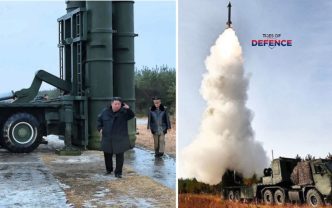
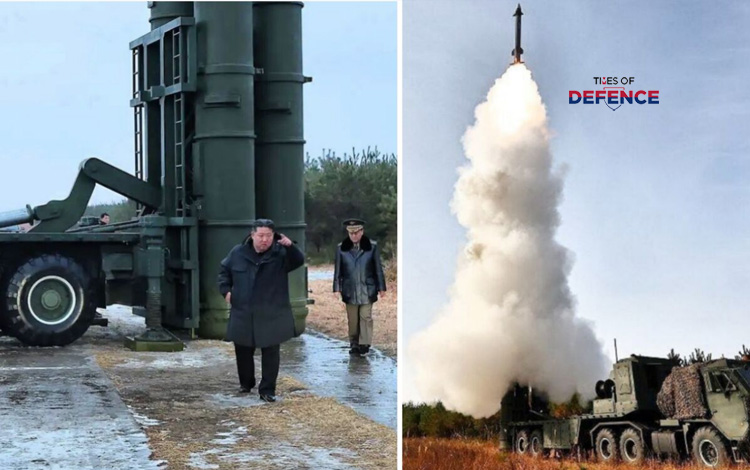
North Korea executed a live-fire test-flight of its premier Pyongae-6 long-range surface-to-air missile (SAM) system on November 4, 2026. According to the Korean Central News Agency (KCNA), the evaluation was overseen by Kim Jong-sik, a senior official of the Workers’ Party of Korea (WPK) Central Military Commission.
The flight test verified technical specifications and operational reliability, focusing on intelligent multi-mode guidance systems, dynamic target identification, real-time threat data processing, and ECCM (electronic counter-countermeasures) performance in heavy electronic warfare environments. Operating as the long-range successor to the Pyongae-5 (S-300PMU-1/2 analogue), the Pyongae-6 system provides the Korean People’s Army Air and Anti-Air Force (KPAAF) with a mobile, long-range area air defense system (analogous to the Russian S-400 Triumf architecture).
TECHNICAL SPECIFICATIONS: PYONGAE-6 SAM SYSTEM ARCHITECTURE
System Configuration, Propulsion & Kinematics
⚡ Managing Authority: Korean People’s Army Air and Anti-Air Force (KPAAF / DPRK)
⚡ Transporter-Erector-Launcher (TEL): 10×10 heavy all-terrain tactical chassis carrying four containerized vertical launch tubes
⚡ Propulsion Architecture: Solid-propellant dual-impulse (double-impulse) rocket motor providing sustained energy management across long-range intercept trajectories
⚡ Control & Aerodynamics: Twin-rudder aerodynamic control system featuring multi-set control surfaces for terminal agility against maneuvering targets
⚡ Operational Engagement Envelope:
• Estimated Range: 200 km to 250 km (124 to 155 miles)
• Engagement Targets: Subsonic/supersonic tactical aircraft, standoff ISR platforms, cruise missiles, and medium-altitude UAVs 
Radar, Sensor Netting & Guidance Matrix
💥 Guidance System: Multi-mode guidance architecture integrating mid-course inertial/command guidance paired with active/passive radar homing seekers
💥 Radar Integration: Mobile 3D active electronically scanned array (AESA) target acquisition and multi-channel engagement radar operating across high-frequency bands
💥 EW Hardening: Advanced signal processing algorithms designed to maintain target track lock against complex airborne radar jamming and electronic attack (EA)
TIMES OF DEFENCE ASSESSMENT
The flight validation of the Pyongae-6 system highlights key trends in North Korea’s integrated air defense architecture:
1. **Phase-Out of Legacy Stationary SAM Systems**: The deployment of the mobile Pyongae-6 allows North Korea to decommission legacy, static Soviet-era air defense systems, such as the S-75 (SA-2 Guideline), S-125 (SA-3 Goa), and S-200 (SA-5 Gammon). Replacing fixed missile sites with high-mobility 10×10 TELs complicates adversary suppression of enemy air defenses (SEAD) and destruction of enemy air defenses (DEAD) operations.
2. **Terminal Maneuverability via Dual-Impulse Propulsion**: Utilizing a dual-impulse solid-fuel rocket motor provides a second thrust phase during terminal homing. This preserves kinetic energy at extended ranges (>200 km), allowing the interceptor to maneuver against high-G tactical aircraft and low-RCS threats attempting evasive maneuvers.
3. **Establishing Standoff Anti-Access/Area-Denial (A2/AD) Bubbles**: With an operational engagement radius reaching up to 250 km, Pyongae-6 batteries deployed near the Military Demarcation Line (MDL) or coastal zones extend North Korea’s surface-to-air threat envelope into regional airspace. This forces high-value intelligence, surveillance, and reconnaissance (ISR) platforms—such as AWACS and maritime patrol aircraft—to operate at greater standoff distances.

