


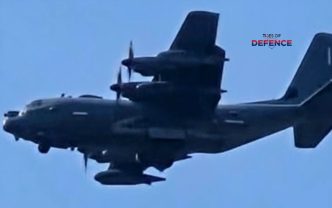
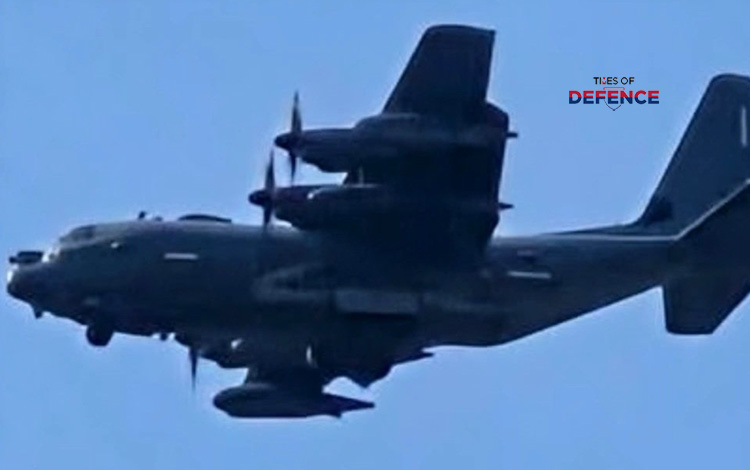
Local military aircraft tracking assets reported that a U.S. Air Force Special Operations Command (AFSOC) MC-130 transport aircraft executed a low-visibility landing at Hamat Air Base in northern Lebanon on November 8, 2026.
Operating under the callsign SMOKE83, the aircraft approached the Batroun district installation from the east at 19:25 local time with its Automatic Dependent Surveillance-Broadcast (ADS-B) transponder deactivated. This flight marks at least the third unannounced AFSOC MC-130 rotation to Hamat Air Base in recent weeks, following verified sorties under callsigns SMOKE52 on October 22 and BURN83 on October 31, alongside earlier flight imagery captured on September 24. The tactical rotation occurs amid a heightened U.S. military logistics lift across Eastern Mediterranean and Middle Eastern operational hubs.
TECHNICAL SPECIFICATIONS: AFSOC MC-130J COMMANDO II ARCHITECTURE
Airframe System Baseline, Kinematics & Payload Capacity
⚡ Platform Variant: Lockheed Martin MC-130J Commando II (Special Operations Forces Transport / Tanker)
⚡ Operating Command: U.S. Air Force Special Operations Command (AFSOC)
⚡ Powerplant Baseline: 4× Rolls-Royce AE 2100D3 turboprop engines generating 4,637 shp each, driving GE-Dowty Aerospace 6-bladed composite propellers
⚡ Kinematic Envelope: Maximum speed 363 knots (665 km/h) at 22,000 ft; service ceiling 28,000 ft with payload
⚡ Operational Range & Radius: Unrefueled mission radius of 3,000 nmi (5,500 km); extended via internal wing tanks and air-to-air refueling receptivity
⚡ Operational Capacity: Multi-role cargo bay configured for 52 fully equipped SOF operators, 40 paratroopers, or up to 42,000 lbs (19,050 kg) of tactical cargo / light armored vehicles 
Avionics, Stealth Navigation & In-Flight Refueling Payload
💥 Low-Level Stealth Navigation: Integrated Raytheon AN/APN-241 terrain-following / terrain-avoidance radar paired with Electro-Optical/Infrared (EO/IR) sensor turrets and Night Vision Goggle (NVG) combat lighting suites
💥 Electronic Warfare & Self-Protection: AN/ALQ-211 digital Radar Warning Receiver (RWR), Missile Launch Detection Systems (MLDS), and automated chaff/flare countermeasure dispensers
💥 Aerial Refueling System: Outfitted with dual wing-mounted refueling pods (Cobham 48-000 series) to conduct low-altitude, night-vision helicopter/tiltrotor in-flight refueling (HAAR) for MH-60M Black Hawks, MH-47G Chinooks, and CV-22B Ospreys
💥 Secure C4I & Tactical Datalinks: Encrypted Line-of-Sight (LOS) V/UHF, SATCOM, and Link 16 datalinks allowing real-time tactical command updates in GPS-denied environments
TIMES OF DEFENCE ASSESSMENT
The repeated deployment of AFSOC MC-130 assets to Hamat Air Base underscores several key strategic and operational realities:
1. **Strategic Hub for U.S. Special Operations in the Levant**: Hamat Air Base serves as a primary forward operating location for U.S. military assistance teams, joint training missions, and contingency logistics in northern Lebanon. The arrival of MC-130J platforms provides low-signature, organic airlift capable of inserting specialized personnel, extracting high-value assets, or delivering sensitive equipment directly to the Levant without relying on major regional commercial airfields.
2. **Operational Exploitation of Low-Emissions Flight Protocols**: Deactivating ADS-B transponders during low-altitude transits is standard operational security (OPSEC) procedure for AFSOC missions in contested or high-threat airspace. Utilizing specialized terrain-following sensors and encrypted communications allows MC-130J crews to minimize electronic signatures, mitigating tracking by non-state threat actors and hostile signals intelligence (SIGINT) networks across the region.
3. **Balancing Operational Footprint Against Regional Geopolitical Tensions**: Following security incidents and heightened regional tensions, the Lebanese Ministry of Defense reaffirmed that Hamat Air Base remains strictly under Lebanese Army Command authority while hosting international training teams. Maintaining periodic, rapid-in/rapid-out MC-130 flights enables U.S. forces to sustain critical logistics and operational readiness without establishing a permanent heavy footprint on the ground.

