


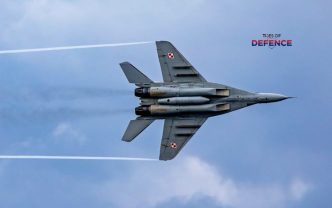
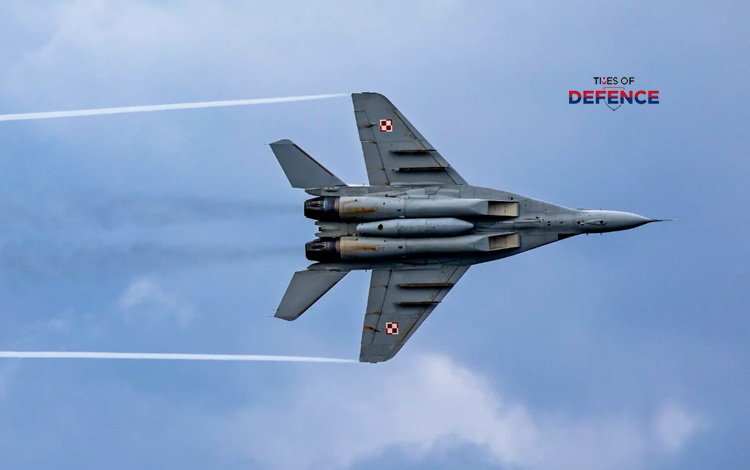
Reserve Lt. Gen. Dariusz Łukowski, Director of the Strategy and Defense Planning Department at the Polish Ministry of National Defense, has confirmed that Poland will deliver two additional Mikoyan MiG-29 (NATO reporting name: “Fulcrum”) fighter jets to the Ukrainian Air Force.
Financed under a broader €50 million ($56 million USD) bilateral military assistance package, the decision marks the resumption of airframe transfers drawing from retired or transitioning Polish Air Force inventories. The procurement includes one flight-capable, airworthy operational fighter jet and one flight-exhausted airframe intended primarily for cannibalization to support Ukrainian depot-level repairs and spare parts pipelines. Alongside the airframes, the €50M package delivers critical munitions, including 155mm/152mm NATO and Soviet-standard artillery shells, 20×102mm cannon ammunition for Ukrainian F-16 C/D platforms, and additional Mesko Piorun MANPADS air defense missiles.
TECHNICAL SPECIFICATIONS: POLISH AIR FORCE MiG-29FULCRUM & MUNITIONS PACKAGE
Contractual Governance, Donor Framework & Transfer Metrics
⚡ Transferring Authority: Polish Ministry of National Defense (MON — Warsaw, Poland)
⚡ Receiving Operator: Ukrainian Air Force (Militarny / Tactical Aviation Brigades)
⚡ Package Value: ~€50 Million EUR ($56 Million USD)
⚡ Airframe Allocation: 2× MiG-29 (1× Flight-Ready Airworthy Unit, 1× Non-Operational Spare Parts Donor)
⚡ Total Polish MiG-29 Transfer Footprint: 16 Airframes Total (14 transferred across 2022–2023; 2 units in current FY2026 tranche)
⚡ Transition Capability Replacement: Quick Reaction Alert (QRA) missions over Poland/Baltics fully transitioned to Polish Lockheed Martin F-16 Block 52+ and KAI FA-50 Block 10 light combat aircraft 
MiG-29 Fulcrum Platform Kinematics & Avionics Profile
💥 Airframe Origin & Upgrades: Legacy Warsaw Pact MiG-29A (Product 9.12) / MiG-29UB (Product 9.51) trainers, featuring NATO-interoperable avionics modifications (MIL-STD-1553B bus integration, Rockwell Collins NAV/COM, and AXR-150 UHF/VHF radios)
💥 Propulsion Architecture: 2× Klimov RD-33 turbofan engines producing 18,300 lbf of thrust each with afterburner
💥 Flight Envelope & Performance: Max Speed: Mach 2.25 (2,400 km/h) at altitude | Service Ceiling: 59,100 ft (18,000 m) | Tactical Radius: 700 km
💥 Tactical Integration in Ukraine: Integrated with Western precision-guided air-to-ground ordnance via specialized launcher pylons (e.g., AGM-88 HARM anti-radiation missiles, ADM-160 MALD decoys, and AASM Hammer / JDAM-ER glide bombs)
Auxiliary Munitions & Air Defense Components in €50M Package
🚀 F-16 Cannon Munitions: 20×102mm M50-series ammunition dedicated to the M61A2 Vulcan 6-barrel rotary cannon aboard Ukrainian F-16s, optimized for intercepting low-flying Russian loitering munitions (Shahed-136 / Geran-2)
🚀 Ground Artillery Shells: Dual-calibrated inventory featuring 155mm (NATO STANAG-compliant) and 152mm (Soviet-legacy) high-explosive artillery rounds
🚀 Short-Range Air Defense (SHORAD): Additional Mesko Piorun (Thunder) Man-Portable Air Defense System (MANPADS) missiles featuring dual-band infrared (IR) seekers and proximity-fuzed warheads
TIMES OF DEFENCE ASSESSMENT
Poland’s approval of two additional MiG-29 fighters highlights the ongoing technical challenges surrounding Ukraine’s air power capabilities. While the transfer of Western platforms (such as F-16s and Mirage 2000s) remains a strategic priority, maintaining the operational availability of Ukraine’s legacy Soviet-built tactical air fleet remains critical for daily air operations.
From an engineering and air-warfare perspective, the transfer yields key operational insights:
1. **Depot-Level Spare Parts and Fleet Sustainment**: The decision to include a non-flyable MiG-29 airframe specifically for cannibalization addresses a persistent bottleneck facing the Ukrainian Air Force: a shortage of high-wear airframe components, Klimov RD-33 engine spares, and hydraulic assemblies. In a high-intensity conflict where structural fatigue and combat damage reduce mission-capable rates, single donor airframes provide critical parts to keep active jets flying.
2. **Transition to FA-50 and F-16 Fleet Architecture**: Poland can clear these final MiG-29 airframes from its inventory because its domestic airspace defense and NATO Baltic Air Policing commitments have successfully migrated to Lockheed Martin F-16 Block 52+ fighters and newly fielded South Korean KAI FA-50 light combat aircraft (which achieved initial operational readiness in 2026).
3. **Dedicated Counter-UAV Ammunition**: Supplying 20×102mm ammunition for the F-16’s M61 Vulcan cannon provides a cost-effective counter-drone capability. Using internal cannon fire instead of AIM-9X or AMRAAM guided missiles to shoot down Russian Shahed loitering munitions preserves high-cost radar-guided and infrared missiles for higher-tier air defense threats.

