


French President Emmanuel Macron and UAE President Sheikh Mohamed bin Zayed Al Nahyan oversaw the formal execution of an intergovernmental agreement between Paris and Abu Dhabi to co-develop the Dassault Rafale F5 standard.
Signed in Abu Dhabi on October 20, 2026, the bilateral framework revives defense-industrial cooperation following an earlier impasse over program cost-sharing and sensitive technology access. The agreement establishes technical, financial, and industrial participation mechanisms for the United Arab Emirates Armed Forces within the French Air and Space Force’s next-generation combat aviation roadmap. Preparatory industrial contracts have been aligned across Dassault Aviation, Thales, MBDA, and Safran—in conjunction with UAE defense conglomerate EDGE Group—ahead of the formal Rafale F5 development program launch scheduled for late 2026.
TECHNICAL SPECIFICATIONS: DASSAULT RAFALE F5 STANDARD & COMBAT SYSTEM ARCHITECTURE
Program Governance & Industrial Partners
⚡ Intergovernmental Signatories: Ministry of Armed Forces (France) & Ministry of Defence (United Arab Emirates)
⚡ Primary OEM Integrator: Dassault Aviation (Saint-Cloud, France)
⚡ Key System Integrators: Thales Group (Avionics/Radars), MBDA (Precision Munitions), Safran Aircraft Engines (Propulsion), and EDGE Group (Emirati Industrial Integration)
⚡ Fleet Context: Aligns with the UAE Air Force’s 2021 order of 80 Rafale F4 fighters, establishing a modernization pathway to upgrade or field the F5 standard beyond 2030 
Propulsion & Airframe Enhancements
💥 Engine Configuration: 2× Safran M88 T-REX (Thrust Enhancement eXperiment / Modernized Variant)
💥 Thrust Performance: ~9.0 tonnes (~88.2 kN) of thrust per engine with dry/afterburner optimization (representing a ~20% thrust increase over baseline M88-2 engines at 7.5 tonnes)
💥 Thermal Management & Power: Upgraded Auxiliary Power Units (APU) and enlarged heat exchangers engineered to drive high-capacity active sensors and advanced processing units
💥 Airframe Geometry: Low-observable composite modifications, reinforced hardpoints, and aerodynamic refinements optimized for supersonic persistence and heavy payload carriage
Avionics, Sensors & Sensor Fusion Architecture
🚀 Radar System: Next-generation Thales RBE2-X (or advanced AESA variant) incorporating Gallium Nitride (GaN) transmit/receive modules for extended search ranges and high-density electronic counter-countermeasures (ECCM)
🚀 Optronics & Targeting Suite: Next-generation Front Sector Optronics (FSO-NG) combined with advanced SWIR/MWIR targeting pods for multi-spectral long-range passive target identification
🚀 Electronic Warfare (EW): Integrated SPECTRA EW suite upgraded with cognitive artificial intelligence (AI) algorithms, automated RF threat neutralization, and high-power digital RF memory (DRFM) jamming
🚀 Collaborative Combat Data-Link: High-bandwidth, directional satellite and tactical data-links enabling secure real-time connectivity across multi-domain networks, NATO systems, and loyal wingman platforms
Armament & Uncrewed Teaming Capabilities
🚀 ASN4G Hypersonic Missile Integration: Primary airborne vector for France’s ASN4G (Air-Sol Nucléaire 4ème Génération) hypersonic ramjet cruise missile (French Air Force configuration)
🚀 Conventional Precision Ordnance: Integration of MBDA Meteor long-range air-to-air missiles, MICA NG, SmartGlider standoff weapons, and indigenous Emirati precision-guided munitions (via EDGE Group)
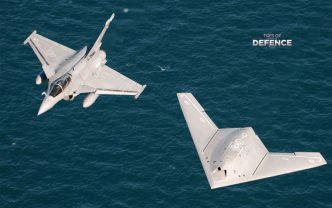
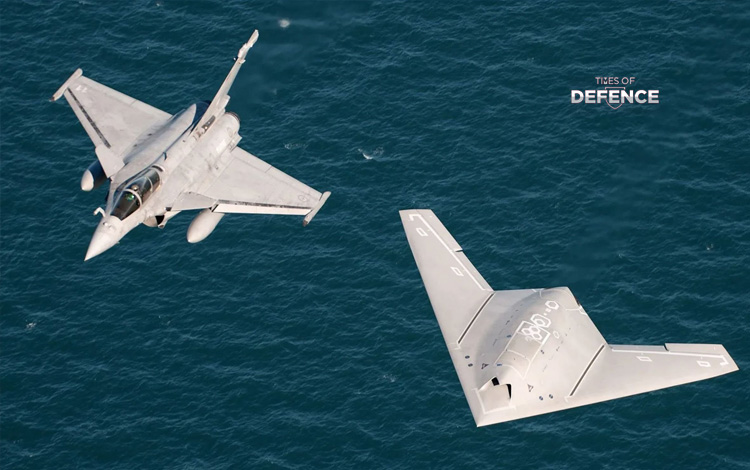
🚀 Loyal Wingman Combat Drone: Native operational integration with Dassault Aviation’s stealth Unmanned Combat Aerial Vehicle (UCAV)—derived from the nEURon demonstrator—for autonomous suppression of enemy air defenses (SEAD) and deep-strike screening
TIMES OF DEFENCE ASSESSMENT
The October 20, 2026 agreement between France and the UAE restores critical momentum to the Rafale F5 program. Development of the F5 standard is not a routine incremental upgrade; it represents a comprehensive mid-life modernization that transforms the Rafale into a 5th-generation-plus combat platform designed to bridge French and allied air power toward 6th-generation Future Combat Air System (FCAS) capabilities.
From an engineering and strategic perspective, bringing the UAE back into the F5 development framework addresses key industrial and financial requirements. Development of the F5 standard—which encompasses the 9-tonne thrust M88 T-REX engines, GaN-based AESA radars, hypersonic weapon integration, and stealth loyal wingman drone teaming—requires massive capital investment. Partnering with Abu Dhabi provides vital financial backing while granting the Emirati defense industry (such as EDGE Group) structural participation in advanced sensors, uncrewed systems, and ordnance manufacturing. This bilateral cooperation ensures that both nations retain high-intensity air combat capabilities capable of penetrating contested A2/AD bubbles across European and Middle Eastern operational theaters.

