

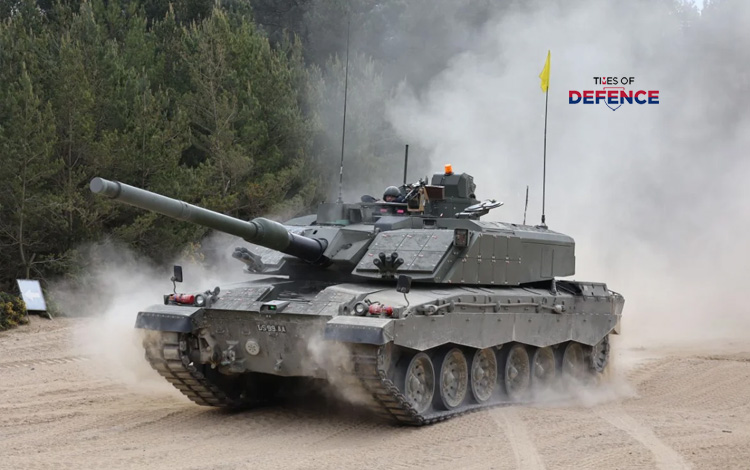
TELFORD, United Kingdom — Rheinmetall BAE Systems Land (RBSL) confirmed that the British Army’s next-generation Challenger 3 (CR3) Main Battle Tank (MBT) prototype fleet has surpassed 2,000 km (1,240 miles) of automotive trials, fired over 200 main gun rounds, and deployed 100 smoke grenades ahead of an expanded testing phase scheduled for November 2026.
Under an £800 million ($1.06 billion) Ministry of Defence (MoD) transformation contract, RBSL is re-engineering 148 legacy Challenger 2 hulls into the digitally integrated Challenger 3 standard. The comprehensive overhaul transitions the British Army from the legacy 120 mm L30A1 rifled gun system to the NATO-standard Rheinmetall 120 mm L55A1 high-pressure smoothbore cannon, allowing full logistics and ammunition interoperability (including DM73 APFSDS and DM11 programmable HE rounds) with allied Leopard 2 and M1A2 Abrams fleets. Integrated with an all-new digital turret architecture, upgraded day/night thermal sights, modified Hydrogas suspension, and Rafael’s Trophy Medium Armor (MV) Active Protection System (APS), the Challenger 3 is slated to reach Initial Operating Capability (IOC) in 2027 and Full Operating Capability (FOC) by 2030.
TECHNICAL SPECIFICATIONS: BRITISH ARMY CHALLENGER 3 (RBSL) MAIN BATTLE TANK 
* Developer & Conversion Lead: Rheinmetall BAE Systems Land (RBSL Telford Facility)
* Conversion Quantity & Life Cycle: 148 Challenger 2 airframe/hull deep rebuilds (Planned service life through >2040)
* Main Armament & Ordnance Compatibility:
* Primary Cannon: 120 mm Rheinmetall L55A1 high-pressure smoothbore gun (replaces L30A1 rifled cannon)
* Ammunition Standard: Full NATO STANAG 4385 compliance (DM73 kinetic energy armor-piercing / DM11 programmable multipurpose high-explosive)
* Survivability & Active Protection Suite:
* Active Protection System: Rafael Trophy Medium Armor (MV) Hard-Kill APS (radar tracking + counter-explosive interceptors)
* Passive & Modular Armor: Next-generation Farnham internal composite base armor + Epsom modular applique package
* Countermeasures: High-speed smoke grenade dispenser array (100+ rounds deployed in trials)
* C4ISR & Digital Turret Architecture:
* Architecture: Open-architecture Generic Vehicle Architecture (GVA) standard
* Sensor Suite: Thales Orion commander’s panoramic sight & Trailblazer driver/gunner day/night thermal imaging systems
* Fire Control: Fully digitized computerized fire control system with automatic target tracking
* Mobility & Automotive Performance:
* Powerplant: Upgraded Perkins CV12-9A 26.1-liter V12 diesel engine (1,200 hp / 890 kW)
* Suspension & Drive: Third-generation Hydrogas suspension system and upgraded David Brown Santasalo TN54E transmission
* Mobility Milestones: 2,000 km cross-country/road distance achieved; 2026 crewed live-fire validation completed
TIMES OF DEFENCE ASSESSMENT:
The completion of 2,000 km of mobility testing and 200 live-fire main gun engagements marks an essential transition point for the UK’s armored capability as RBSL prepares to move the Challenger 3 into high-stress qualification trials in November 2026. Re-arming the British Army with the 120 mm L55A1 smoothbore cannon resolves a decades-long logistics bottleneck, ending reliance on obsolete, out-of-production 120 mm two-piece rifled ammunition and achieving direct battlefield ammunition interchangeability with NATO allies.
Furthermore, pairing an upgraded Hydrogas chassis with Rafael’s Trophy hard-kill APS and Farnham/Epsom composite armor provides crucial survivability against modern top-attack anti-tank guided missiles (ATGMs) and uncrewed loitering munitions. However, with a constrained fleet size of just 148 converted tanks, the British Army’s armored warfighting capacity will rely entirely on maintaining high operational availability and seamless digital integration within NATO’s broader armored battle groups.