



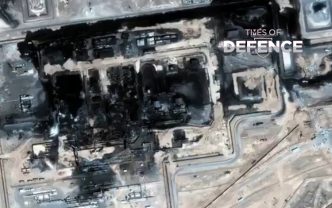
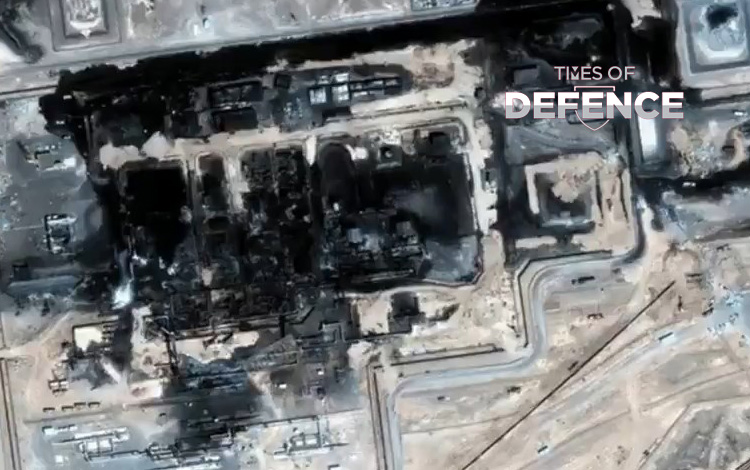
Newly released satellite imagery shows the before-and-after condition of a facility along Saudi Arabia’s strategic East-West Oil Pipeline, also known as Petroline, following an aerial attack on September 10, 2026.
The imagery indicates significant fire damage at a pipeline facility southeast of Medina, including extensive blackened areas and destruction around the affected infrastructure. Saudi Arabia subsequently shut down the pipeline as a precautionary measure.
Important attribution clarification
The attack should not be described as definitively carried out by the Houthis based on the currently available evidence.
Saudi authorities said the drones targeting the pipeline in the Riyadh and Medina regions originated from Iraq. Iraq subsequently launched an investigation and took measures against military personnel following the incident. Public reporting has linked the attack to Iran-backed Iraqi militias, while some reports have described possible Houthi involvement or coordination. However, there has not been sufficient public evidence to establish that the Houthis themselves launched the drones.
This distinction is important for an accurate news report.
What the Satellite Images Show
Planet Labs imagery released through Reuters shows the same pipeline facility before and after the attack.
The before image, dated September 8, shows an intact industrial site with visible pipeline infrastructure and associated facilities.
The after image, taken on September 11, shows extensive fire damage, darkened ground and damaged infrastructure surrounding the facility. Another satellite image captured on September 10 showed a large plume of black smoke rising from the area.
NASA’s FIRMS system also detected thermal activity in the vicinity, providing additional evidence that a significant fire occurred in the area.
The East-West Pipeline: Key Technical Facts
Saudi Arabia’s East-West Pipeline, commonly known as Petroline, is one of the world’s most strategically important crude-oil transportation systems.
- Length: approximately 1,200 km (746 miles)
- Route: from Saudi Arabia’s eastern oil-producing region toward Yanbu on the Red Sea
- Main strategic purpose: transporting crude without requiring tankers to pass through the Strait of Hormuz
- Recent reported throughput: approximately 4 million barrels per day
- Maximum pipeline capacity: reported at up to approximately 7 million barrels per day
- Western terminal: Yanbu on the Red Sea
- Strategic importance: provides Saudi Arabia with an alternative export route when Persian Gulf shipping is disrupted.
The pipeline is therefore particularly important during the current regional crisis because shipping through the Strait of Hormuz has been severely disrupted.
Reuters estimates that the affected route can move around 4 million barrels of crude per day, equivalent to roughly 4% of global oil supply.
Why the Damage Matters
The pipeline is more than a domestic transportation system. It is effectively a strategic bypass around the Strait of Hormuz.
Crude produced and processed in eastern Saudi Arabia can be transported westward across the Arabian Peninsula before reaching export terminals at Yanbu on the Red Sea.
That means Saudi Arabia can potentially continue exporting oil toward international markets without sending every barrel through the Persian Gulf and Hormuz.
The temporary shutdown therefore creates a significant vulnerability at a time when regional oil infrastructure and maritime routes are already under pressure.
Pipeline Shutdown and Repair Concerns
Saudi Arabia’s Ministry of Energy said the pipeline was shut down as a precautionary measure after multiple attacks. Emergency and specialized technical teams were dispatched to secure the pipeline and assess its condition. Several people were reportedly injured.
The exact extent of the latest damage and the timetable for restoring normal operations have not been officially disclosed.
There is, however, a relevant precedent. After another attack on a pumping station along the same pipeline earlier in 2026, Saudi Arabia reportedly restored the facility and returned it to full capacity within approximately three days. The damage from the September attack could be different, however, so that previous repair time should not be treated as a forecast for the current incident.
Global Energy Impact
The incident comes at an extremely sensitive moment for global energy markets.
With the East-West Pipeline temporarily out of service and maritime routes through the Strait of Hormuz already heavily disrupted, traders are concerned about the availability of Saudi crude exports.
Reuters reported that the outage could threaten as much as 4% of global oil supply if the pipeline is not restored quickly. Saudi Arabia can use oil already stored near its Red Sea export infrastructure as a temporary buffer, but those reserves are finite.
Brent crude subsequently moved above $108 per barrel on September 14 as concerns over supply disruptions intensified.
Bottom Line
The satellite imagery provides a striking visual comparison of a key Saudi oil infrastructure site before and after the September 10 attack.
But the available evidence supports describing this as an aerial/drone attack on Saudi Arabia’s East-West Pipeline, with Saudi Arabia saying the drones originated from Iraq, rather than definitively attributing the strike directly to the Houthis. The attack nevertheless occurred amid a major escalation involving the Houthis, Iranian-backed groups and critical Saudi energy infrastructure.
