


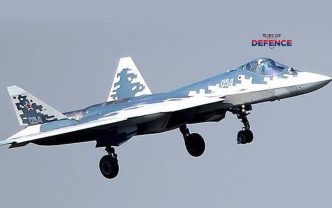
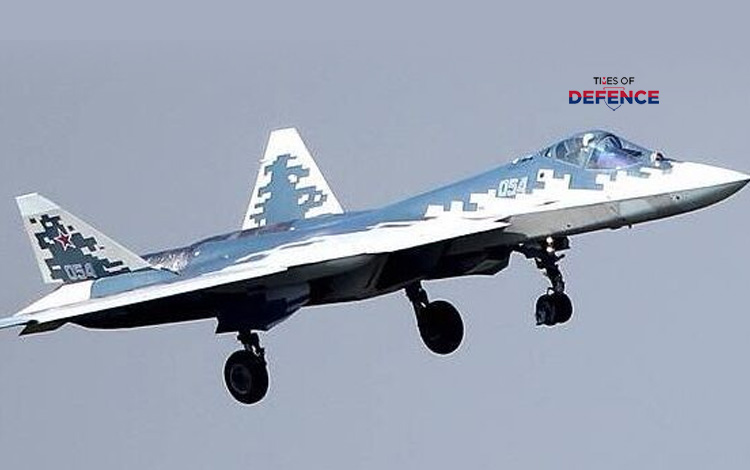
Russia’s state-owned United Aircraft Corporation (UAC), operating under parent conglomerate Rostec, announced on November 19, 2026, the handover of a new batch of modernized Sukhoi Su-57 (NATO reporting name: Felon) fifth-generation multirole fighter aircraft to the Russian Aerospace Forces (VKS), marking the third publicly disclosed delivery batch of 2026 following earlier transfers in February and September.
Manufactured at the Komsomolsk-on-Amur Aviation Plant (KnAAZ) in Russia’s Far East—where expanded assembly and testing facilities were commissioned in August 2025 to support serial production—the newly delivered airframes completed factory ground checks and military pilot acceptance flights prior to unit transfer. While UAC and Rostec withheld exact aircraft quantities and specific subsystem designations, UAC CEO Vadim Badekha confirmed that the airframes incorporate upgraded onboard electronics, sensors, and weapons suites shaped by operational lessons from Ukraine and earlier deployments in Syria. Built under Moscow’s 2019 state defense contract for 76 aircraft by 2028, the Su-57 program continues parallel domestic deliveries alongside export production for launch foreign customer Algeria, which received its initial Su-57E aircraft in November 2025.
TECHNICAL SPECIFICATIONS: SUKHOI SU-57 (FELON) MODERNIZED ARCHITECTURE
1. Airframe Geometry, Powerplant & Kinematic Envelope
⚡ Prime Developer & Manufacturer: Sukhoi Design Bureau / United Aircraft Corporation (KnAAZ, Komsomolsk-on-Amur, Russia)
⚡ Dimensions & Weight Class: Overall length of 20.1 meters (65 ft 11 in), wingspan of 14.1 meters (46 ft 3 in), height of 4.6 meters (15 ft 1 in), empty weight of ~18,000 kg, and maximum takeoff weight of 35,000 kg (77,160 lbs)
⚡ Propulsion & Thrust Vectoring: Serial production aircraft currently fly on two Saturn AL-41F1 (izdeliye 117) afterburning turbofans (~147 kN / 33,000 lbf thrust each) with 3D-acting canted thrust-vectoring nozzles; next-generation AL-51F-1 (izdeliye 30) engines (~162–176 kN thrust class) with reduced infrared/radar signature nozzles remain in flight-test integration
⚡ Flight Performance & Aerodynamics: Top speed of Mach 2.0 (~2,135 km/h) at altitude, supercruise capability, service ceiling of 20,000 meters (65,000 ft), ferry range up to 3,500 km (with aerial refueling probe), and Leading-Edge Vortex Controllers (LEVCON) paired with all-moving tailplanes for post-stall supermaneuverability 
2. Sensor Fusion, Electronic Warfare & Internal/External Armament
💥 Integrated Sensor Suite: Built around the Sh121 multifunctional radio-electronic system featuring the N036 Byelka nose X-band AESA radar (1,514 T/R modules), cheek-mounted N036B lateral X-band arrays, wing-root N036L L-band IFF/detection arrays, and the 101KS Atoll electro-optical/IRST and Directed Infrared Countermeasures (DIRCM) suite
💥 Weapons Carriage & Bays: Features 12 total hardpoints—six internal (two tandem main fuselage bays and two wing-root side bays) for low-observable operations and six external wing/fuselage pylons—plus an internal 30 mm GSh-30-1 (9A1-4071K) autocannon with 150 rounds
💥 Modernized Munitions Portfolio: Employs R-77M (izdeliye 180) active radar-guided and R-74M2 (izdeliye 760) infrared air-to-air missiles internally, long-range R-37M hypersonic air-to-air missiles externally, and standoff precision strike weapons including the low-observable Kh-69 cruise missile, Kh-38M tactical missiles, Kh-58UShK anti-radiation missiles, and KAB-series guided bombs
TIMES OF DEFENCE ASSESSMENT
The handover of the third 2026 Su-57 batch alongside UAC’s emphasis on ongoing subsystem upgrades highlights three critical realities in Russian tactical aviation and defense industrial output:
1. Incremental Spiral Modernization Compensating for Second-Stage Engine Delays: While serial Su-57s continue to rely on interim AL-41F1 powerplants pending full production readiness of the AL-51F-1 (izdeliye 30), UAC is channeling immediate combat feedback into iterative avionics, electronic warfare, and standoff weapon upgrades—notably integrating low-observable Kh-69 cruise missiles for long-range strike outside dense air defense envelopes.
2. Low Serial Production Cadence Relative to Strategic Targets: Despite facility expansions at Komsomolsk-on-Amur and fulfillment of initial export commitments to Algeria, undisclosed small-batch handovers indicate that annual output remains modest compared to the 76-aircraft 2028 target and Western fifth-generation production rates.
3. Doctrinal Emphasis on Standoff Strike and Sensor Networking Over Deep Penetration: Operating predominantly in standoff strike and counter-air roles rather than deep contested penetration reflects both the Su-57’s higher radar cross-section relative to the F-22 and F-35 and Moscow’s priority on preserving high-value airframes while fielding long-range precision munitions.

