


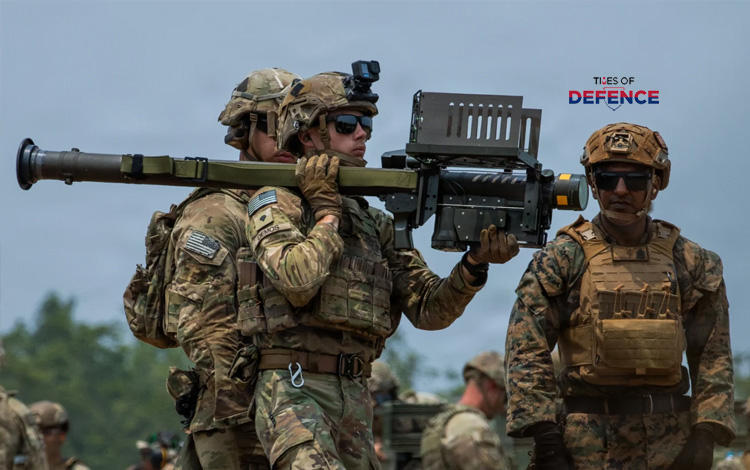
Army Contracting Command at Redstone Arsenal (ACC-RSA) issued a Call for Solutions on November 20, 2026, on behalf of the Short and Intermediate Effectors for Layered Defense (SHIELD) project office seeking a ready-made alternate interceptor under the Next Generation Short Range Interceptor (NGSRI) programme to replace the legacy FIM-92 Stinger man-portable and vehicle-mounted air-defense missile.
Designed to introduce competitive pricing leverage and a third contender alongside incumbent developers Lockheed Martin and RTX’s Raytheon (selected in March 2023), the solicitation requires solution briefs by 4:00 p.m. Central on December 20, 2026, ahead of live-fire demonstrations planned for May–June 2027 and prototype Other Transaction Agreement (OTA) awards targeted for September 2027. Bidders must propose mature, near-ready prototype interceptors capable of defeating helicopters, fixed-wing aircraft, and Group 2 and Group 3 unmanned aerial systems (UAS) at extended ranges—specifically demonstrating pass/fail intercepts of Group 3 drones at 5,000 to 8,000 meters—while meeting affordability targets of under $200,000 per missile and under $200,000 per launcher across a 10-year baseline of at least 11,000 missiles and 2,200 launchers.
TECHNICAL SPECIFICATIONS: NGSRI ALTERNATE INTERCEPTOR REQUIREMENTS & TIMELINE
1. Performance Envelope, Target Set & Platform Compatibility
⚡ Contracting & Program Office: U.S. Army Contracting Command – Redstone Arsenal (ACC-RSA) for the Short and Intermediate Effectors for Layered Defense (SHIELD) project office (solicitation MOSAIC-26-04)
⚡ Target Threats & Engagement Ranges: Soldier-portable, fire-and-forget surface-to-air missile engineered for day/night operations against rotary-wing, fixed-wing, and Group 2/Group 3 drones—extending well past the ~4.8 km (3-mile) range benchmark of Stinger on SGT STOUT, with required Group 3 drone intercepts at 5,000 to 8,000 meters (3.1 to 5 miles) and a 6,000-meter “Hot Plate” target shot
⚡ Legacy Launcher & Vehicle Backwards Compatibility: Must fire from existing FIM-92 Stinger launchers and integrate with legacy platforms including the Army’s Stryker-based M-SHORAD / SGT STOUT air-defense vehicle and the U.S. Marine Corps’ Marine Air Defense Integrated System (MADIS)
⚡ Live-Fire Evaluation Criteria: Invited contenders must fire at least one warhead round and one telemetered round from a soldier-portable launcher in May–June 2027—including head-on and 90-degree beam Group 3 drone engagements scored on a pass/fail basis via direct hit or lethal proximity detonation 
2. Cost Targets, Production Scale & Eligibility Rules
💥 Affordability & 10-Year Volume Benchmarks: Targets unit costs below $200,000 per missile and below $200,000 per launcher across at least 11,000 missiles and 2,200 launchers over 10 years, within an Army FY2027 budget request that includes $215 million for NGSRI development inside $460.9 million for maneuver short-range air defense
💥 Post-Demo Delivery & LRIP Schedule: Selected winners must deliver at least 50 test missiles and six launchers within three months of live fire and reach low-rate initial production (LRIP) no later than Q4 FY2028 under firm-fixed-price prototype OTAs up to 12 months
💥 Program Context & Nontraditional Participation: Complements flight and seeker testing by Lockheed Martin and Raytheon through 2026; restricted to eligible U.S. firms (or foreign entities with U.S. partners) cleared for SECRET material, with statutory OTA requirements involving nontraditional defense contractors, nonprofits, small businesses, or at least one-third non-federal cost share
TIMES OF DEFENCE ASSESSMENT
The U.S. Army’s call for an alternate NGSRI interceptor capped at under $200,000 per missile highlights three critical shifts in short-range air defense (SHORAD), counter-drone economics, and acquisition competition:
1. Enforcing Strict Cost Discipline Ahead of High-Volume Drone Interception: With counter-UAS engagements demanding thousands of interceptors rather than rare, high-cost surface-to-air rounds, setting a sub-$200,000 target across an 11,000-missile baseline directly counters cost-asymmetry against Group 2/Group 3 drones while maintaining competition pressure on incumbents.
2. Demanding Extended Range and Backwards Compatibility Simultaneously: Pushing engagement envelopes out to 5–8 km against Group 3 drones while requiring compatibility with existing Stinger launchers, SGT STOUT, and MADIS reflects the need to upgrade fielded short-range air-defense formations without wholesale vehicle or launcher replacement.
3. Using Competitive Live-Fire Shootouts to Accelerate Mature Prototypes: Requiring ready-to-fire hardware by May–June 2027 and LRIP readiness by Q4 FY2028 filters out paper concepts and pushes nontraditional and established missile developers toward rapid, test-proven fielding.

