

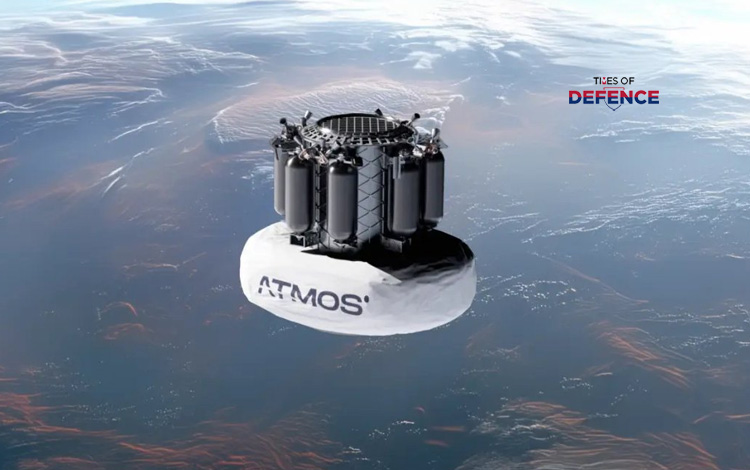
German orbital logistics startup ATMOS Space Cargo and missile manufacturer MBDA Deutschland announced on November 18, 2026, the signing of a cooperation agreement to assess and pursue the development of a Precision Orbital Deep Strike (PODS) capability—a space-based conventional strike concept designed to hold non-nuclear payloads in orbit and de-orbit them onto terrestrial targets on command.
Framed by both firms as a step toward strengthening sovereign European conventional deterrence, the agreement covers systems architecture, technical feasibility, payload integration studies, and potential technology demonstrations, with no contract value, hardware prototype, or fielding schedule yet disclosed. While ATMOS Space Cargo emphasized that its civilian PHOENIX orbital cargo capsule programme remains strictly separate from the dedicated defense study, the partnership pairs ATMOS’s inflatable atmospheric re-entry capsule technology—validated in orbit during its April 21, 2025 PHOENIX 1 SpaceX Bandwagon-3 flight—with MBDA Deutschland’s expertise in warhead engineering, terminal guidance, and military weapon qualification.
TECHNICAL SPECIFICATIONS: PRECISION ORBITAL DEEP STRIKE (PODS) CONCEPT
1. Industrial Division of Labor, Programme Status & Governance
⚡ Partner Consortium: ATMOS Space Cargo GmbH (Lichtenau, Germany; orbital flight, propulsion/de-orbit, and atmospheric re-entry architecture) and MBDA Deutschland GmbH (Schrobenhausen, Germany; precision guidance, conventional warhead engineering, and weapon qualification)
⚡ Agreement Scope & Maturity: Conceptual and feasibility cooperation agreement announced November 18, 2026 covering systems architecture, payload integration, and potential demonstrations; specific development phases remain subject to further evaluation and separate contracts, with no disclosed budget or deployment timeline
⚡ Separation From Civil Spaceflight Line: ATMOS maintains an operational firewall between its civilian PHOENIX microgravity return programme (including the 100 kg-class PHOENIX 2 and 1-tonne-class PHOENIX 3 concepts) and defense-focused initiatives managed under its dedicated Atmos Works government/defense arm 
2. Orbital Re-Entry Architecture & Conventional Strike Envelope
💥 Orbital Deployment & Re-Entry Concept: Positions conventional strike capsules in low Earth orbit (where orbital velocities reach ~28,000 km/h), enabling on-command de-orbit maneuvers, controlled atmospheric re-entry, and high-speed terminal guidance onto distant ground targets—with ATMOS leadership previously citing global responsiveness within roughly 60 minutes
💥 Re-Entry Thermal & Aerodynamic Heritage: Draws upon ATMOS’s deployable inflatable heat-shield and aerodynamic deceleration technology—flight-tested aboard PHOENIX 1 in April 2025—adapted to survive extreme re-entry heating while transitioning to precision terminal homing
💥 Strategic Deterrence & Legal Context: Engineered strictly as a non-nuclear conventional deep-strike capability (remaining compliant with Outer Space Treaty prohibitions against orbiting nuclear or weapons of mass destruction) to complement terrestrial Deep Precision Strike cruise and hypersonic programmes
TIMES OF DEFENCE ASSESSMENT
The cooperation agreement between ATMOS Space Cargo and MBDA Deutschland on the Precision Orbital Deep Strike (PODS) concept highlights three critical dynamics in European space-defense convergence, long-range deterrence, and orbital strike economics:
1. Merging Commercial New-Space Re-Entry Hardware With Prime Missile Engineering: Combining ATMOS’s flight-tested inflatable re-entry technology with MBDA’s guidance and warhead integration marks a notable effort by European industry to explore sovereign, intercontinental-reach conventional strike without relying on traditional heavy ballistic missile boosters.
2. High Velocity and Unpredictable Trajectories Versus Severe Orbital Economics: While on-orbit conventional payloads offer global reach, rapid response times, and steep high-Mach trajectories that stress terrestrial missile defenses, launching and maintaining dedicated strike capsules in orbit carries substantial per-shot launch costs, orbital vulnerability to anti-satellite threats, and strategic escalation risks.
3. Early Feasibility Study Rather Than Near-Term Operational Fielding: With no public funding, hardware prototypes, or delivery dates yet attached, PODS remains an exploratory architecture study whose viability will depend on European government backing, launch-cost reductions, and clear operational trade-offs against terrestrial hypersonic systems.