


The U.S. Navy’s Office of Naval Research (ONR) exercised an $11.3 million contract modification (P00002 to contract N0001426C2208) on November 5, 2026, with Integer Technologies to advance autonomous ocean soundscape mapping algorithms for undersea and seabed warfare.
Titled Operationalizing Marine Acoustics for Strategic Awareness, the research program is based in Durham, New Hampshire, and extends through October 2029. The project focuses on converting passive acoustic data into dynamic, edge-processed environmental decision aids for crewed fast-attack submarines (such as the Virginia-class fleet) and Unmanned Undersea Vehicles (UUVs). By integrating physics-based propagation models with advanced machine learning and military super intelligence frameworks, the software allows autonomous assets to dynamically interpret shifting acoustic environments in real time without human analyst intervention.
TECHNICAL SPECIFICATIONS: PASSIVE ACOUSTIC SOUNDSCAPE MAPPING ARCHITECTURE
Contractual & Organizational Framework
⚡ Awarding Authority: Office of Naval Research (ONR)
⚡ Prime Contractor: Integer Technologies (Columbia, SC / Durham, NH)
⚡ Contract Vehicle: Modification P00002 under N0001426C2208 (Operationalizing Marine Acoustics for Strategic Awareness)
⚡ Funding Allocation: Option I value of $11,265,876 (FY26 RDT&E funds obligated: $7.58 million)
⚡ Operational Window: Research and development lifecycle executing through October 2029
⚡ Key Research & Test Partners: University of New Hampshire (Center for Acoustic Research and Education / Judd Gregg Marine Research Complex) 
Software Mechanics, Data Fusion & Acoustic Terrain Modeling
💥 Acoustic Data Exploitation: Strictly leverages passive hydrophone arrays and onboard passive acoustic sensors—recording ambient ocean noise without active acoustic emissions that reveal platform position
💥 Environmental Variable Processing: Maps real-time variations in seawater temperature profiles, salinity layers, bathymetry, and pressure gradients to calculate dynamic ray-tracing and sound ducting paths
💥 Super Intelligence & Edge AI Integration: Utilizes edge-computed ML models to automatically filter surface vessel traffic, weather noise, and biological background interference, turning raw acoustic feeds into tactical terrain maps
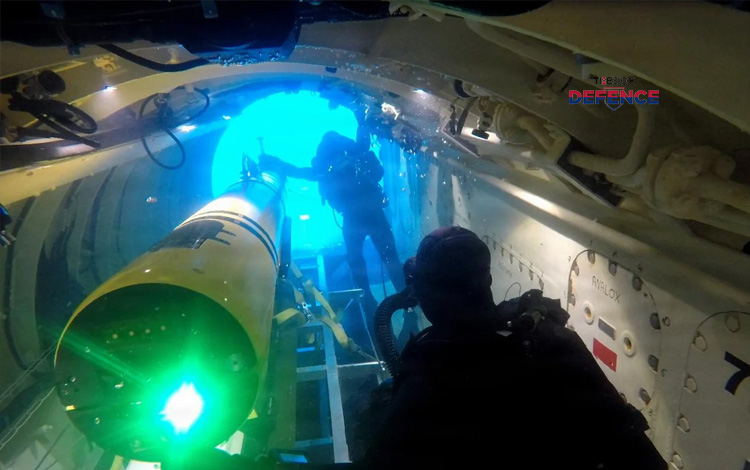
💥 Autonomous Vehicle Integration: Enables UUVs (e.g., Razorback, Snakehead) and crewed submarines to automatically adjust transit depth, acoustic modem communication windows, and passive sonar search sectors based on live acoustic propagation forecasts
TIMES OF DEFENCE ASSESSMENT
The Navy’s investment in automated underwater soundscape mapping highlights a fundamental shift in undersea warfare:
1. **Transforming Passive Acoustics into Tactical Battlefield Terrain**: In oceanography, sound channels behave like terrestrial terrain—thermoclines and salinity gradients create acoustic “hills” and “shadow zones” that can hide an attacking submarine or deaden acoustic communications. Transitioning from historical static databases to real-time, onboard passive mapping allows crewed and robotic platforms to continuously exploit local acoustic shadow zones to maintain stealth.
2. **Enabling High-Autonomy Operations for UUV Fleet Integration**: Autonomous undersea vehicles operating deep in anti-access/area-denial (A2/AD) waters cannot rely on high-bandwidth RF links or human acoustic intelligence (ACINT) specialists to process raw sonar feeds. Processing soundscapes onboard using machine learning gives autonomous platforms the tactical self-awareness required to modify mission paths independently.
3. **Reinforcing Subsea and Seabed Warfare (SSW) Defense**: Mounting geopolitical threats to critical seabed infrastructure—such as undersea fiber-optic communications cables and offshore energy pipelines—have pushed the Navy to deploy expanded SSW surveillance grids. Unifying acoustic mapping with UUV operations directly supports the U.S. Submarine Forces’ SSW campaign plan and paves the way for organic seabed warfare payloads planned for future Virginia-class Block VI submarines.

