


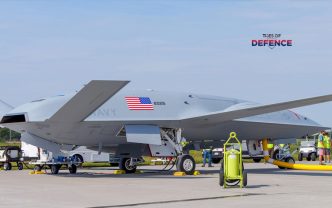
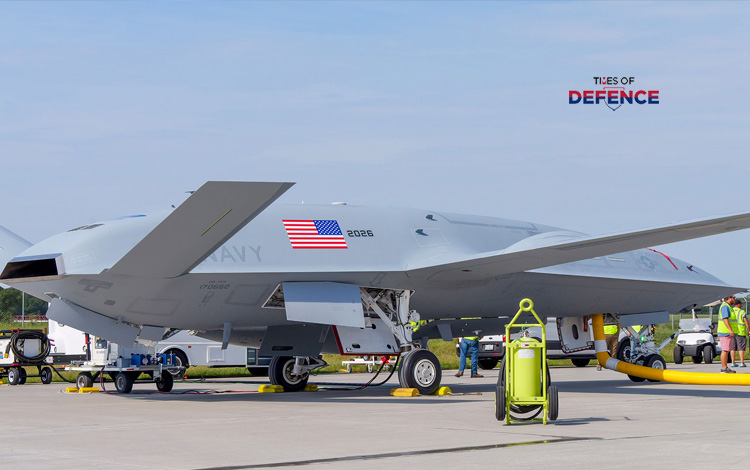
The joint Boeing, U.S. Navy, and Lockheed Martin Integrated Test Team (ITT) has successfully validated a Beyond-Line-Of-Sight (BLOS) satellite Command-and-Control (C2) link connecting a carrier-based control node directly to the Boeing MQ-25A Stingray uncrewed aerial refueler over a distance exceeding 2,100 miles.
Executed while the Nimitz-class aircraft carrier USS Ronald Reagan (CVN 76) operated at sea in the Pacific Ocean and in port, shipboard operators stationed inside the vessel’s Unmanned Air Warfare Center (UAWC) utilized a production Lockheed Martin MD-5C Ground Control Station (GCS) to command an MQ-25A test aircraft stationed at Boeing’s flight test facility in Mascoutah, Illinois. The milestone marks the first time an MQ-25A was remotely controlled from an underway aircraft carrier using the U.S. Navy’s operational Command, Control, Communications, Computers, and Intelligence (C4I) architecture over a proliferated Low Earth Orbit (pLEO) satellite network. The successful end-to-end data link validation lays the C2 foundation for the carrier air wing’s future uncrewed aerial refueling and autonomous ISR operations.
TECHNICAL SPECIFICATIONS: MQ-25A STINGRAY & MD-5C C4I CONTROL ARCHITECTURE
Development Team & Program Management
⚡ Lead Aircraft Prime & System Integrator: Boeing Defense, Space & Security (Stirling, Virginia / St. Louis, Missouri)
⚡ Control Station Hardware/Software Lead: Lockheed Martin Skunk Works / Rotary and Mission Systems (MDCX baseline)
⚡ Sponsoring Program Office: Naval Air Systems Command (NAVAIR) PMA-268 (Unmanned Carrier Aviation Program Office)
⚡ Test Platform Host: USS Ronald Reagan (CVN 76) — Unmanned Air Warfare Center (UAWC) 
Control Node Architecture (MD-5C Ground Control Station)
💥 System Designation: MD-5C System Control Station (GCS variant designed for shipboard and land-based operations)
💥 Software & Hardware Suite: Lockheed Martin MDCX (Unmanned Command and Control) software framework combined with U.S. Government-furnished equipment (GFE)
💥 Network Integration: Direct interface with the U.S. Navy’s operational C4I network architecture and pLEO (Proliferated Low Earth Orbit) satellite communications
💥 Operational Scope: Serves as the primary C2 interface for the MQ-25A Stingray and establishes the scalable baseline architecture for future uncrewed Carrier Air Wing (CVW) platforms
MQ-25A Stingray Aircraft Performance Parameters
🚀 Platform Role: Carrier-based Uncrewed Aerial Refueler and Intelligence, Surveillance, and Reconnaissance (ISR) asset
🚀 Dimensional Geometry: Wingspan: 22.9 m (75 ft) | Length: 15.5 m (51 ft) | Folded width for carrier elevator/hangar handling: 9.5 m (31 ft)
🚀 Powerplant: 1× Rolls-Royce AE 21008 turbofan engine generating ~9,000 lbf (40 kN) thrust
🚀 Refueling Capacity: Delivers 6,800 kg (15,000 lb) of jet fuel to carrier strike aircraft at an operational radius of 930 km (500 nautical miles)
🚀 Aerial Refueling Hardware: Integrated Cobham Aerial Refueling Store (ARS) pod featuring a hose-and-drogue fuel transfer line
Strategic Impact on Carrier Air Wing Operations
🚀 Extension of Strike Radius: Extends the unrefueled combat radius of F/A-18E/F Super Hornets and F-35C Lightning II fighters from ~830 km to past 1,850 km (1,000+ nmi)
🚀 Asset Preservation: Relieves combat-coded F/A-18E/F Super Hornets from “buddy-tanking” duties, freeing up to 20–30% of fighter sorties for primary offensive counter-air and strike missions
TIMES OF DEFENCE ASSESSMENT
The validation of an end-to-end BLOS satellite command-and-control link between the USS Ronald Reagan and an MQ-25A airframe over 2,100 miles away represents a major operational hurdle cleared for naval uncrewed aviation. Historically, integrating autonomous aircraft into naval flight deck operations faced immense C4I networking challenges due to strict shipboard bandwidth constraints, satellite latency, and complex electromagnetic environments.
From an engineering and doctrine perspective, routing high-throughput BLOS C2 telemetry through a proliferated Low Earth Orbit (pLEO) satellite array to Lockheed Martin’s MD-5C control station solves critical latency and reliability issues. This success confirms that shipboard operators inside the Unmanned Air Warfare Center (UAWC) can seamlessly control distant uncrewed assets through standard Navy combat networks. Replacing tactical “buddy-tanking” Super Hornets with dedicated MQ-25A Stingrays doubles the strike range of carrier air wings, allowing carriers to operate safely outside the primary engagement zones of enemy anti-ship ballistic missiles while keeping strike fighters focused on combat missions.

