


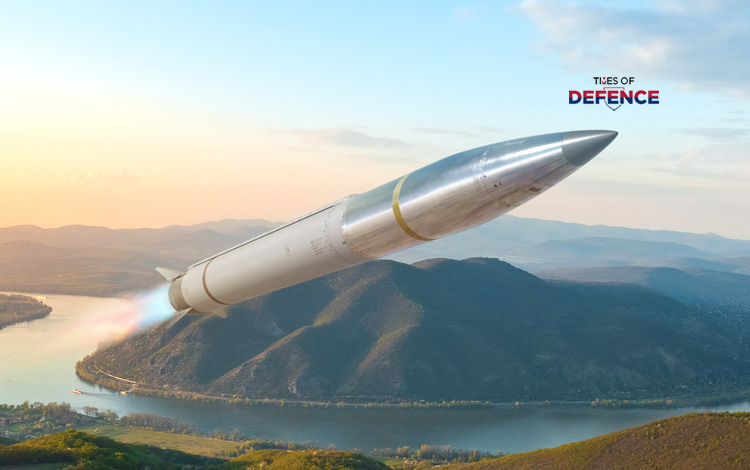
Defense prime Lockheed Martin has officially received Milestone C authorization from the U.S. Army to transition the Extended Range Guided Multiple Launch Rocket System (ER GMLRS) into low-rate initial production (LRIP) and operational fielding.
The acquisition decision follows the successful execution of two operational flight tests led by U.S. Army personnel at White Sands Missile Range in September and October 2026. Fired in rapid succession from an M270A2 Multiple Launch Rocket System launcher, both the Unitary high-explosive warhead and Alternative Warhead (AW) area-effects variants demonstrated full flight profile stability, tail-driven maneuvering, and pinpoint accuracy out to 150 kilometers (93 miles)—more than doubling the operational reach of legacy M30/M31 GMLRS rockets. Designed to operate seamlessly within existing launch platforms, six ER GMLRS rockets fit per pod, allowing M142 HIMARS (1 pod) and M270A2 MLRS (2 pods) launchers to deploy extended-range precision fires without requiring structural launcher retrofits.
TECHNICAL SPECIFICATIONS: LOCKHEED MARTIN ER GMLRS & LAUNCHER INTERACTION
Developer, Manufacturer & Acquisition Authority
⚡ Lead Integrator & Prime Contractor: Lockheed Martin Missiles and Fire Control (Grand Prairie, TX / Camden, AR)
⚡ Executive Authority: U.S. Army Program Executive Office (PEO) Missiles and Space / Precision Fires Rocket & Missile Systems
⚡ Program Milestone: Milestone C Low-Rate Initial Production (LRIP) Approval & Operational Fielding Decision 
Flight Kinematics, Range & Platform Geometry
💥 Caliber & Outer Diameter: 254 mm (10-inch class airframe) — enlarged motor diameter compared to legacy 227 mm GMLRS
💥 Range Envelope: Minimum effective range: ~15 km | Maximum operational engagement range: 150 km (93 miles)
💥 Guidance & Control Architecture: Inertial Navigation System (INS) coupled with Anti-Jam GPS (AJ-GPS) driving tail-mounted control surfaces
💥 Precision Metric: Circular Error Probable (CEP) < 5 meters across maximum range trajectories
💥 Pod Compatibility: Standard 6-round launch pod container fully compatible with M142 HIMARS (1 pod / 6 rockets) and M270A1/A2 MLRS (2 pods / 12 rockets)
Munition Variants & Warhead Options
🚀 ER GMLRS Unitary (High-Explosive):
• Payload: ~90 kg (200 lb) high-explosive (HE) fragmentation unitary warhead equipped with multi-option fuze (point-detonation, delay, airburst)
• Target Profile: Hardened point targets, command posts, fortified C2 nodes, and critical infrastructure
🚀 ER GMLRS Alternative Warhead (AW):
• Payload: ~90 kg payload containing pre-formed tungsten fragmentation penetrators (eliminating unexploded ordnance/dud hazards)
• Target Profile: Dispersed soft targets, SAM radar sites, staging areas, supply depots, and artillery batteries
Launcher Integration & C4ISR Architecture
🚀 Compatible Launch Systems: M142 HIMARS, M270A1, M270A2, and European MARS II / LRU variants
🚀 Fire Control Software: Fully integrated into the Universal Fire Control System (UFCS) and AFATDS (Advanced Field Artillery Tactical Data System)
TIMES OF DEFENCE ASSESSMENT
The U.S. Army’s Milestone C approval for the ER GMLRS represents a key modernization step for Western rocket artillery doctrine. By pushing the engagement range of standard-pod rockets from 70 km out to 150 km, ground commanders gain the ability to strike deep tactical targets—such as logistics hubs, air defense radars, and command centers—without committing operational-level ballistic missiles like ATACMS or the Precision Strike Missile (PrSM).
From an engineering and force-structure perspective, the design achievement of ER GMLRS lies in its pod-compatible packaging. Enlarging the solid rocket motor propellant core while relocating control surfaces from the nose to the tail allows Lockheed Martin to double the rocket’s range while maintaining the six-rockets-per-pod geometry. This allows militaries operating M142 HIMARS and M270A2 launchers to upgrade their deep-strike capabilities purely through munitions procurement, bypassing the massive capital expenditures associated with fielding entirely new launcher chassis.

