

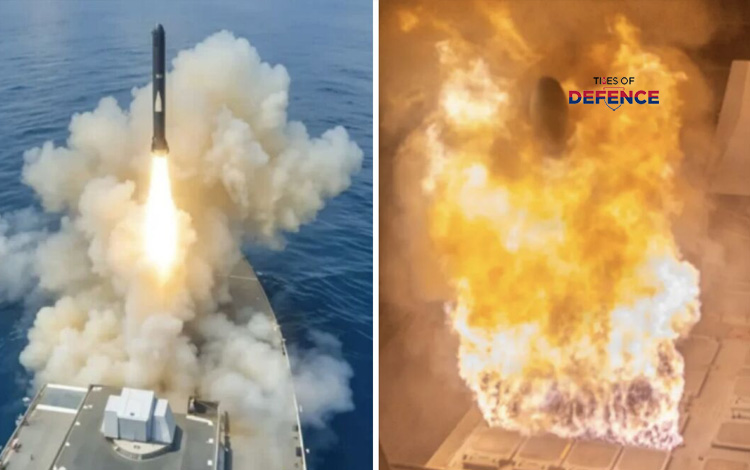
TUCSON, Arizona — The U.S. Navy has initiated preparations to enter Low-Rate Initial Production (LRIP) for the Tomahawk Block Vb cruise missile configuration, integrating the Joint Multiple Effects Warhead System (JMEWS).
Developed as a post-production modernization upgrade for the existing Tactical Tomahawk (TACTOM) inventory, the Block Vb variant incorporates a multi-stage penetrating warhead architecture designed to defeat hardened surface structures, reinforced command centers, and protected military infrastructure. The JMEWS payload combines initial hard-target penetration with programmable, secondary blast-fragmentation detonation, enabling a single subsonic standoff cruise missile platform to breach fortified barriers before initiating interior volumetric destruction. The variant preserves the full baseline navigation, satellite communication, and long-range engagement capabilities of the Block V family across surface ship, submarine, and land-based Typhon (Mid-Range Capability) launchers.
TECHNICAL SPECIFICATIONS: RAYTHEON / U.S. NAVY TOMAHAWK BLOCK Vb (JMEWS) 
* Systems Developer & Integrator: Raytheon (RTX) / Naval Air Systems Command (NAVAIR)
* Platform Classification: Long-Range Subsonic Land-Attack Cruise Missile (TLAM)
* Warhead Architecture (Joint Multiple Effects Warhead System – JMEWS):
* Warhead Class: 1,000-lb (~454 kg) class multi-stage penetrating/blast-fragmentation warhead
* Target Spectrum: Hardened command-and-control bunkers, reinforced concrete structures, missile storage depots, and earth-sheltered facilities
* Detonation Mechanism: Hardened penetration nose sleeve combined with programmable multi-mode delay fuzing
* Propulsion & Range Profile:
* Powerplant: Williams International F415-WR-400 turbofan engine with solid-fuel rocket booster
* Operational Range: >900 nautical miles (>1,660 km / ~1,000 statute miles)
* Speed Profile: High subsonic (Mach 0.74–0.80) operating at low-altitude terrain-following profiles
* Guidance, Navigation & C4I Suite:
* Primary Guidance: Anti-jam GPS coupled with Inertial Navigation System (INS)
* Terrain & Target Matching: TERCOM (Terrain Contour Matching) and DSMAC (Digital Scene Matching Area Correlation)
* Connectivity & In-Flight Control: Two-way UHF satellite data-link enabling real-time target redirection, loitering, and post-strike Battle Damage Assessment (BDA) image transmission
* Launch Compatibility & Deployment Platforms:
* Surface Platforms: Mk 41 Vertical Launching System (VLS) aboard Arleigh Burke-class destroyers and Ticonderoga-class cruisers
* Submarine Platforms: Submarine Vertical Launch System (SVLS) and torpedo tubes on Virginia-class and Los Angeles-class attack submarines
* Ground-Based Platforms: U.S. Army / U.S. Navy Typhon Mid-Range Capability (MRC) mobile land launchers