


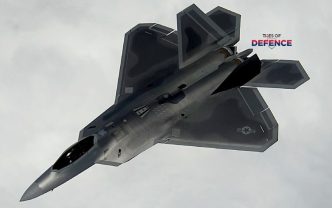
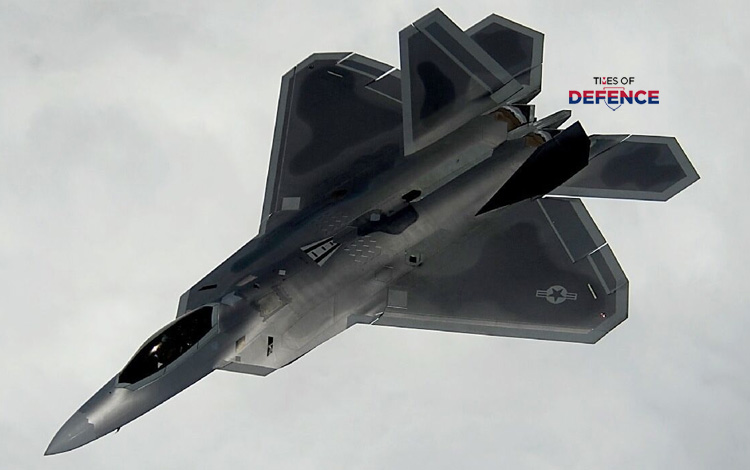
The United States Air Force has executed a rotational deployment of Lockheed Martin F-22 Raptor fifth-generation air superiority fighters from Alaska to Kadena Air Base in Okinawa, Japan, reinforcing forward air assets alongside rotating F-15C/D and F-15E units.
The deployment continues the USAF’s interim rotational posture following the complete withdrawal of Kadena’s permanently assigned F-15C/D fleet in January 2025. While the U.S. Department of the Air Force plans to permanently station 36 modernized F-15EX Eagle II fighters at the installation, production and delivery schedules have lagged, with initial F-15EX airframes for Kadena leaving production facilities in late August 2026. Situated approximately 700 kilometers (435 miles) from Taiwan, Kadena remains a vital strategic hub in the Western Pacific; however, its proximity to the Chinese mainland exposes the facility to severe tactical risks from high-volume ballistic, cruise missile, and loitering munition saturation strikes in the event of a regional conflict.
TECHNICAL SPECIFICATIONS: LOCKHEED MARTIN F-22 RAPTOR vs. REGIONAL THREAT ENVIRONMENT
Deployment Architecture & Fleet Transition at Kadena
⚡ Forward Operating Base: Kadena Air Base (Okinawa, Japan — 700 km from Taiwan)
⚡ Rotating Asset: Lockheed Martin F-22A Raptor (5th-generation air superiority fighter)
⚡ Permanent Fleet Replacement Plan: 36× Boeing F-15EX Eagle II 4.5-generation fighters (scheduled to replace retired legacy F-15C/Ds)
⚡ Strategic Vulnerability: Extreme proximity to mainland Chinese anti-access/area-denial (A2/AD) missile umbrellas, precluding survivable heavy fighter staging without hardened shelter infrastructure 
F-22 Raptor Airframe, Avionics & Maintenance Profile
💥 Stealth & Aerodynamics: Low-observable (LO) faceted carbon-composite airframe, internal weapons bays, and Pratt & Whitney F119-PW-100 afterburning turbofans with 2D thrust-vectoring nozzles delivering supercruise capability (Mach 1.8+)
💥 Avionics & Sensor Suite: APG-77 Active Electronically Scanned Array (AESA) radar, ALR-94 receiver system, and legacy INEWS electronic warfare suite (limited by 1990s-era data-bus architecture)
💥 Maintenance & Fleet Readiness: Historically lowest mission-capable availability rates across the USAF fighter inventory due to delicate radar-absorbent material (RAM) coatings, intensive depot-level structural sustainment, and obsolete un-upgraded computing sub-systems
💥 Combat Limitations: Lacks modern open-architecture mission computer upgrades, advanced IRST (Infrared Search and Track) passive sensors, and helmet-mounted cueing systems found on newer F-35 variants
Operational Viability Concerns in the Indo-Pacific Theater
🚀 Forward Base Survivability: Heavy reliance on large fixed airbases (Kadena) vulnerable to runway cratering and mass missile barrages, contrasting with Agile Combat Employment (ACE) doctrines designed for dispersed, austere operations
🚀 Sensor & Data Integration: Legacy data-link architecture limits high-bandwidth, multi-domain sensor fusion with allied 5th-generation (F-35) and 4th-generation platforms compared to modern Open Mission Systems (OMS)
🚀 Fleet Retirement Horizon: Planned complete phase-out of the F-22 fleet by the mid-2030s, with funding redirected toward the Next Generation Air Dominance (NGAD) crewed platform and Collaborative Combat Aircraft (CCA) programs
TIMES OF DEFENCE ASSESSMENTT
The rotational deployment of F-22 Raptors to Kadena Air Base highlights the tactical dilemma facing U.S. airpower in the Western Pacific. While the Raptor remains an exceptional air-to-air dogfighter with unmatched kinematics and frontal stealth, its operational utility in a high-intensity conflict against a peer adversary like China is increasingly constrained by technological aging and geographic vulnerability.
From an engineering and operational perspective, three major factors limit the F-22’s viability in the Indo-Pacific theater:
1. **Extreme Proximity and Base Vulnerability**: Kadena Air Base lies well within the engagement envelope of China’s shore-based ballistic and cruise missile inventories. Stationing high-value, maintenance-intensive stealth assets at fixed, unhardened forward mega-bases exposes them to catastrophic pre-launch destruction during the opening hours of a conflict—violating the core tenets of Agile Combat Employment (ACE).
2. **Technological Stagnation**: Conceived in the late 1980s and fielded in the early 2000s, the F-22’s computing infrastructure, data-buses, and sensor suites have missed critical modernization cycles due to repeated funding cuts and prioritization of the F-35 program. It lacks modern infrared search and track (IRST) sensors, open-architecture software loops, and advanced data-link sharing capabilities that define contemporary multi-domain combat.
3. **Maintenance Footprint**: The F-22’s low-observable radar-absorbent skin requires specialized, climate-controlled hangar facilities and intensive labor hours per flight hour. Deploying the type to forward, contested island bases places an unsustainable logistical strain on ground crews, severely degrading sortie generation rates during sustained high-tempo operations.
Ultimately, while the F-22 serves as a potent political and tactical deterrent signal in East Asia, its long-term utility is waning as Beijing fields advanced 5th-generation (J-20) and emerging 6th-generation fighters backed by vast long-range strike networks.

