


The Democratic People’s Republic of Korea (DPRK) launched a simultaneous salvo of approximately 10 short-range ballistic missiles (SRBMs) from the Wonsan coastal axis toward the East Sea (Sea of Japan) at approximately 12:30 p.m. local time on October 29, 2026.
According to trajectory data released by South Korea’s Joint Chiefs of Staff (JCS) and Japan’s Ministry of Defence, the projectiles traversed a flight envelope of approximately 250 kilometers (155 miles) at low apogees before impacting the maritime zone off the eastern coast of the Korean Peninsula, remaining outside Japan’s Exclusive Economic Zone (EEZ). Executed under 17 days after Pyongyang’s October 12 tactical missile drills, the high-density salvo utilizes North Korea’s KN-25 600mm “super-large” multiple launch rocket system (MLRS) architecture. The test demonstrates saturated barrage-strike tactics designed to overwhelm forward Allied theater air defense systems—such as PAC-3 PATRIOT and Terminal High Altitude Area Defense (THAAD) batteries—along key operational vectors.
TECHNICAL SPECIFICATIONS: KN-25 600mm SUPER-LARGE MLRS / SRBM HYBRID
System Developer, Operational Classification & Launch Profile
⚡ System Integrator: Korean People’s Army (KPA) Artillery Brigade / DPRK Missile Administration
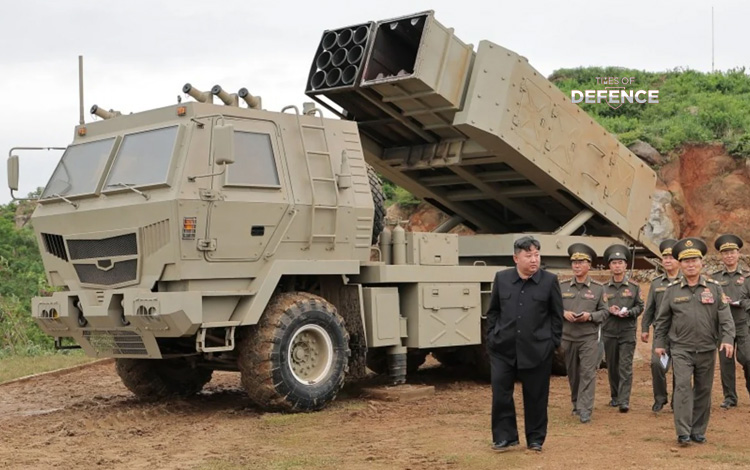
⚡ Western Designation: KN-25 “Super-Large” Multiple Launch Rocket System (600mm SRBM Hybrid)
⚡ Firing Origin: Wonsan Coastal Area (Kangwon Province, North Korea)
⚡ Volley Density & Flight Metrics: ~10 missiles fired in rapid sequence; Trajectory Distance: ~250 km; Peak Altitude: ~30–50 km
⚡ Target Vectors: Coastal maritime impact grid simulating forward command nodes, airfields, and logistical hubs in South Korea (e.g., Kunsan, Osan, Camp Humphreys) 
Launch Vehicle Chassis & Salvo Mechanics
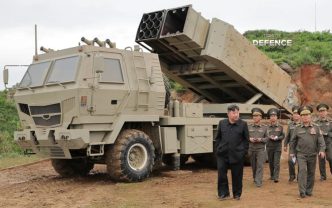
💥 Transporter Erector Launcher (TEL) Options: 6-tube wheeled 8×8 heavy truck chassis or 6-tube armored tracked chassis variants
💥 Firing Interval Dynamics: Demonstrated rapid sequential ripple-fire capabilities (<20 seconds per tube), enabling saturation barrage profiles
💥 Re-Arming Architecture: Pre-loaded factory-sealed canister launch tubes optimized for rapid reload cycles in austere camouflage hides
Ordnance Engineering, Guidance & Warhead Suites
🚀 Missile Dimensions: Diameter: 600 mm | Length: ~8.6 meters | Overall Launch Weight: ~3,000 kg
🚀 Propulsion Architecture: High-thrust Solid Rocket Motor (SRM) providing rapid off-the-rail acceleration and low-altitude depressed ballistic trajectories
🚀 Guidance & Terminal Precision: Integrated Inertial Navigation System (INS) augmented by satellite navigation (GNSS) and front-mounted aerodynamic control vanes, achieving circular error probable (CEP) metrics under 10 meters
🚀 Payload Options: High-explosive fragmentation (300–500 kg), thermobaric sub-munitions, or tactical nuclear warhead integration (Hwasan-31 standardized nuclear warhead configuration)
TIMES OF DEFENCE ASSESSMENT
North Korea’s launching of a 10-missile salvo from Wonsan reflects a tactical shift in Pyongyang’s strike doctrine: prioritizing operational saturation over single-round ballistic demonstrations. While strategic strategic platforms like the Hwasong-17 and Hwasong-18 ICBMs act as global strategic deterrents, the KN-25 platform is built as a frontline theater weapon.
From an engineering and C4ISR perspective, high-density SRBM salvos present serious air defense challenges:
1. **Radar and Interceptor Saturation**: Simultaneous multi-tube salvo launches compress the engagement timeline for ground-based theater air defense systems. Firing 10 heavy 600mm guided rockets simultaneously within a brief window aims to deplete interceptor magazines (such as Patriot PAC-2/PAC-3 or South Korea’s M-SAM II) and saturate target tracking radars.
2. **Depressed Trajectory Profiles**: Flying at low apogees (~30–50 km) over a 250 km range keeps the KN-25 below optimum tracking brackets for high-altitude interceptors like THAAD, while giving lower-tier point defenses less reaction time during terminal guidance.
3. **Dual-Capable Tactical Nuclear Threat**: Mass-producing 600mm guided artillery systems provides the Korean People’s Army with a flexible delivery mechanism. By engineering the KN-25 to accommodate tactical warheads like the Hwasan-31, Pyongyang can integrate conventional saturation strikes with tactical nuclear options, raising the operational risks for Allied forces in a conflict.

