


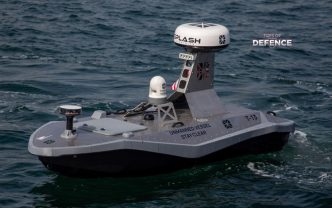
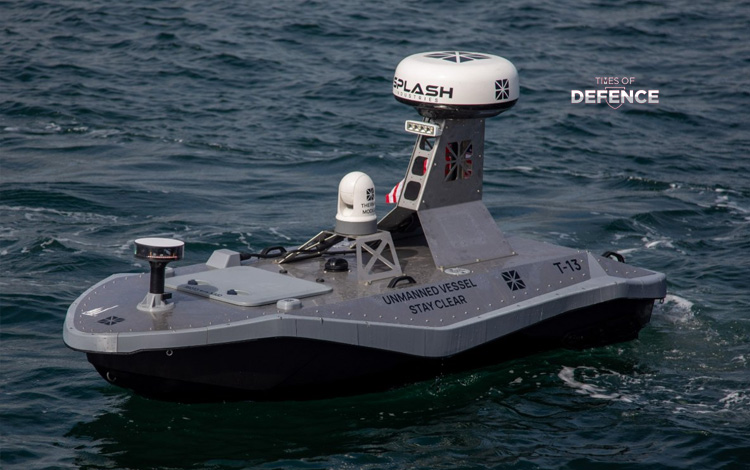
Maritime autonomy defense startup Splash Industries has executed live operational demonstrations of its 3.4-meter (11-foot) Typhoon Unmanned Surface Vessel (USV) at Marine Corps Air Station (MCAS) Iwakuni during Exercise Keen Sword 27.
Conducted on October 21, 2026, alongside U.S. Navy and Japan Self-Defense Forces (JSDF) maritime components, the exercise highlighted the Typhoon’s dynamic naval interdiction, maritime interception, high-speed perimeter security, and intelligence, surveillance, and reconnaissance (ISR) capabilities in contested littoral waters. Designed as a low-cost, mass-producible autonomous surface platform, the Typhoon leverages Splash’s proprietary C2 autonomy stack to execute complex missions—including autonomous shipboard well-deck recovery, contested cargo delivery/resupply, and strike operations using its modular deck-mounted “Airstrike Pack” one-way attack drone launcher.
TECHNICAL SPECIFICATIONS: SPLASH INDUSTRIES TYPHOON USV PLATFORM
Manufacturer & Systems Architecture
⚡ Lead System Integrator: Splash Industries (United States)
⚡ Operational Classification: Small-Class Autonomous Unmanned Surface Vessel (SWaP-USV)
⚡ Primary Tactical Roles: Naval Interception, Contested Logistics/Resupply, Coastal Patrol/ISR, C-UAS/Strike Launch Platform
⚡ Command & Control Architecture: Splash Autonomous C2 Stack (GPS-denied visual/RF navigation, single-button tasking) 
Airframe & Hull Kinematics
💥 Hull Geometry: Compact 3.4-meter (11 ft) composite displacement/planing hull designed for well-deck and davit launching
💥 Maximum Speed: >50–58 knots (~93–107 km/h; peak test velocities exceeding 70 knots recorded)
💥 Operational Range: >600 nautical miles (690+ miles / 1,110+ km) at economic cruise speed
💥 Mission Endurance: Up to 5 days loitering capability in forward maritime patrol areas
💥 Manufacturing Metric: Rapid assembly architecture scalable for high-volume serial production (8-hour build-time per hull)
Payload Architecture & Operational Modules
🚀 Naval Interception & Coastal Security: Sensor fusion combining high-resolution optical/IR gimbals and marine radar for automated threat detection and vessel tracking
🚀 Contested Logistics & Cargo Resupply: Internal payload bay configured for autonomous ship-to-ship and ship-to-shore delivery of critical warfighter materiel
🚀 Modular Strike Capability (Airstrike Pack): Deck-mounted launcher module deploying one-way aerial attack effectors for Beyond Line-of-Sight (BLOS) precision strike
🚀 Autonomous Ship Integration: Verified autonomous well-deck ingress and exit capabilities inside amphibious warship well-decks without active human operator intervention
TIMES OF DEFENCE ASSESSMENT
The operational deployment of the Splash Industries Typhoon USV during Exercise Keen Sword 27 at Iwakuni illustrates the shifting balance in maritime domain awareness and littoral interdiction tactics. Compact, high-speed uncrewed surface vessels (USVs) provide naval planners with an effective, low-cost means to monitor maritime chokepoints, track high-value naval assets, and execute distributed interception operations without risking human crews.
From an engineering and force-structure perspective, the Typhoon’s combination of high speed (>50 knots), long operational range (600+ nautical miles), and modular payload bays addresses key challenges in Pacific theater contested logistics. By integrating both autonomous cargo delivery and strike options (such as the Airstrike Pack one-way drone launcher) into an 11-foot hull, the system demonstrates how small autonomous platforms can create significant asymmetric sea-denial capabilities across distributed island networks.

