


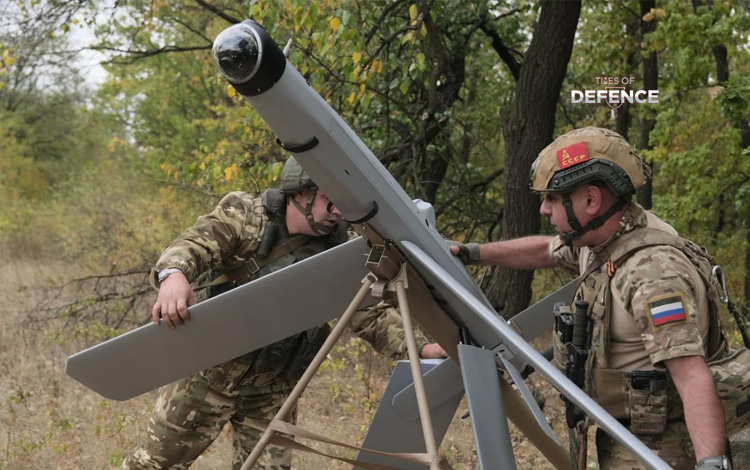
Field intelligence reports originating from former pro-Russian militia commander Pavel Gubarev and echoed by defense monitoring groups highlight a significant decline in the operational hit probability of Russia’s ZALA Lancet (Izdeliye-51/52) loitering munition family.
According to account metrics provided from a 3-month operational window executed by a section of the Russian “Sparta” unit (commanded by Senior Lt. Kirill Ozerov), approximately 100 Lancet sorties yielded only 3 confirmed target strikes—interdicting one self-propelled artillery piece, one infantry dugout, and a roadside structure. The remaining ~97 launches failed due to a combination of layered Ukrainian electronic warfare (EW) jamming, physical interception by specialized hunter-killer C-UAS drones, and friendly-fire incidents stemming from poor inter-unit airspace coordination. With single-unit procurement costs ranging between 3 million to 5.5 million rubles ($37,000–$67,000 USD), the estimated expenditure of $3.7 million to $6.1 million USD per 3 confirmed hits highlights a steep rise in cost-per-effective-engagement for Russia’s frontline loitering munition fleet.
TECHNICAL SPECIFICATIONS: ZALA LANCET (IZDELIYE-51 / IZDELIYE-52) SYSTEM ARCHITECTURE
Developer, Manufacturer & Unit Procurement Cost
⚡ Original Equipment Manufacturer (OEM): ZALA Aero Group (Kalashnikov Group Subsidiary — Izhevsk, Russia)
⚡ Production Nomenclature: Izdeliye-51 (Lancet-3 Baseline) / Izdeliye-52 (Lancet-1 Light Variant) / Izdeliye-53 (Canister-Launched Variant)
⚡ Unit Cost Metric: ~3.0 Million to 5.5 Million Rubles (~$35,000–$68,000 USD) per airframe
⚡ Operational Launch Method: Portable catapult rail system (or multi-canister launcher for Izdeliye-53) driven by ground control station (GCS) briefcase terminals 
Airframe Geometry & Aerodynamic Dynamics
💥 Airframe Layout: Double X-wing cruciform wing/tail surface layout constructed from lightweight composite materials
💥 Wingspan & Dimensions: Length: 1.65 meters | Wingspan: 1.2 meters | Max Takeoff Weight (MTOW): 12 kg (Izdeliye-51) / 5 kg (Izdeliye-52)
💥 Propulsion Mechanics: Rear-mounted electric motor driving a two-blade pusher propeller
💥 Flight Envelope Limits: Cruise Speed: 80–110 km/h | Terminal Dive Speed: 300 km/h | Flight Endurance: 30–40 minutes
Guidance, Payload & Terminal Homing Electronics
🚀 Engagement Range Envelope: Operational strike radius: 40 km to 50 km (Upgraded variants claiming up to 70–80 km via relay UAVs)
🚀 Warhead Configuration: 3 kg to 5 kg High-Explosive Fragmentation (HE-Frag) or KZ-6 Shaped-Charge (HEAT) armor-piercing payload
🚀 Guidance Architecture: Dual-band Electro-Optical / Infrared (EO/IR) nose-mounted camera array with manual TV guidance, autonomous optical tracking, and INS navigation
🚀 Command Data-Link Frequencies: Dual-frequency radio control link operating across 868–870 MHz and 902–928 MHz bands with frequency-hopping capability
Emerging Vulnerabilities & Countermeasures Encountered
🚀 C-UAS Interceptor Drones: Vulnerable to high-speed Ukrainian FPV/quadcopter interceptors hunting at loiter altitudes
🚀 RF & Optical Jamming: Directional RF jamming degrading video telemetry links; optical/laser countermeasures blinding terminal homing sensors
🚀 Soft-Kill / Hard-Kill Defenses: Wire mesh cages, anti-drone netting, and portable EW guns severely degrading terminal hit probability
TIMES OF DEFENCE ASSESSMENT
The reported loss of effectiveness of the ZALA Lancet loitering munition represents a notable shift in frontline tactical drone dynamics. For much of the war, the Lancet served as Russia’s primary counter-battery and precision strike asset against high-value Western-supplied artillery systems, air defense radars, and armored vehicles. However, the reported drop to a ~3% success rate highlights how quickly counter-unmanned aerial systems (C-UAS) technologies can adapt to neutralize once-dominant airborne threats.
From an engineering and tactical perspective, the decline in Lancet performance stems from three primary vulnerabilities:
1. **Airframe Flight Profile**: The Lancet’s low cruising speed (80–110 km/h) and predictable loiter patterns make it highly susceptible to visual detection and engagement by fast-moving Ukrainian drone interceptors.
2. **RF Link Fragility**: Despite operating across dual 868/902 MHz frequency bands, heavy electronic warfare environments disrupt the real-time video feed needed for operators to guide the munition during its terminal dive phase.
3. **Command & Airspace Coordination**: Poor airspace management between adjacent Russian units has reportedly led to fratricide, where friendly electronic warfare systems or air defense gunners target incoming Lancets.
To restore the weapon system’s combat utility, ZALA Aero is attempting to integrate automated target recognition (AI optical tracking), anti-jamming CRPA antennas, and canister-launched swarming variants (Izdeliye-53). However, as Ukrainian forces expand their interceptor drone networks and multi-layered EW coverage, the Lancet no longer enjoys the unhindered tactical advantages it once held over the battlefield.

