



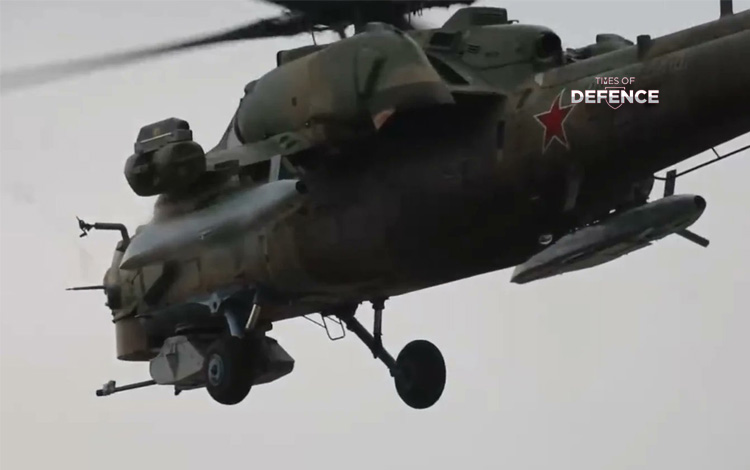
Official video footage released by the Russian Ministry of Defense on November 6, 2026, confirms the first operational employment of a jet-powered low-cost cruise missile—identified as the Dan-T (a variant of the S8000 Banderol/Izdeliye 8000 family)—launched from a Mi-28NM “Night Hunter” attack helicopter.
Developed by Kronstadt Group, the compact turbojet-powered cruise missile offers an operational range estimated at 450 km to 500 km. Firing from deep within friendly territory allows Russian Army Aviation to bypass frontline Ukrainian Short-Range Air Defense (SHORAD) zones while delivering precision standoff strikes against high-value logistics nodes, radar sites, and fixed installations.
TECHNICAL SPECIFICATIONS: DAN-T / S8000 BANDEROL CRUISE MISSILE ARCHITECTURE
Missile Kinematics, Airframe & Powerplant Profile
⚡ Lead Developer / OEM: JSC Kronstadt Group (Russia)
⚡ System Nomenclature: Dan-T / S8000 “Banderol” (Izdeliye 8000)
⚡ Airframe Configuration: Compact composite fuselage (~5.0 meters in length) featuring deployable pop-out swept wings
⚡ Gross Launch Weight: ~270 kg (~595 lbs)
⚡ Powerplant: Miniature internal turbojet engine driving high-subsonic cruise
⚡ Kinematic Performance Envelope:
• Cruise Velocity: ~500 km/h (Mach ~0.4)
• Maximum Operational Standoff Range: 450 km to 500 km (~280–310 miles)
• Launch Envelope: Standoff air-launch from sub-5,000 ft altitudes or ground-based mobile launcher rails 
Payload, Guidance & Target Engagement Dynamics
💥 Warhead Mass & Composition: ~130 kg (standard variant) to ~50 kg (long-range light variant) high-explosive blast-fragmentation payload
💥 Navigation & Mid-Course Guidance Suite: Satellite-assisted inertial navigation system (GLONASS/GPS) paired with optical terrain contour/scene matching sensors (Kompas/DSMACE architecture)
💥 Terminal Guidance Options: Pre-programmed coordinates with optical/IR terminal homing, designed to resist tactical EW jamming environments
💥 Platform Integration Scope: Pod-mounted or rail-slung payload integrated on Mi-28NM, Mi-8/Mi-17 transports, fixed-wing platforms (MiG-29), and land-based launch containers
TIMES OF DEFENCE ASSESSMENT
The operational fielding of the Dan-T / Banderol cruise missile on the Mi-28NM marks a major shift in rotary-wing doctrine.
From an aerospace defense and doctrine perspective, three key strategic implications emerge:
1. **Exponential Range Expansion for Attack Helicopters**: Traditional rotary-wing precision weapons (such as the 9M127-1 Vikhr or Kh-39 LMUR) operate at ranges between 10 km and 15 km. Integrating a 500 km cruise missile expands the Mi-28NM’s effective strike radius by more than thirtyfold, effectively transforming the attack helicopter into an airborne stand-off missile carrier.
2. **Survival Beyond Frontline SHORAD and FPV Threats**: Operating close to the Forward Line of Own Troops (FLOT) has exposed Russian attack helicopters to Ukrainian MANPADS, long-range SAMs, and FPV interceptor drones. Launching cruise missiles 100+ km behind the border keeps the host aircraft out of enemy radar envelopes.
3. **Convergence of Helicopters, Cruise Missiles, and Launched Effects**: The deployment aligns with wider global trends (such as the US Marine Corps’ LR-RAM / Red Wolf on the AH-1Z Viper) that blur the distinction between traditional attack helicopters and long-range uncrewed strike platforms.

