


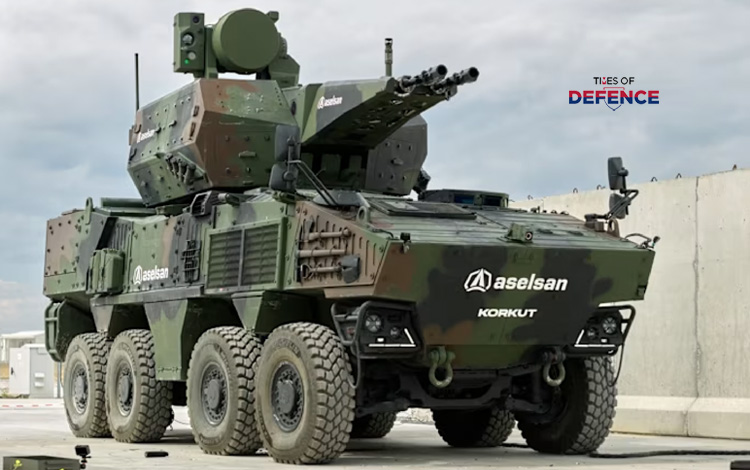
State-backed Turkish defense electronics giant Aselsan has confirmed that its Korkut Self-Propelled Anti-Aircraft Gun (SPAAG) system is currently operational in nine countries, achieving a notable presence across Eastern Europe and the Gulf region.
In a statement published by the Financial Times on October 22, 2026, Aselsan Chief Executive Officer Ahmet Akyol disclosed that the system has successfully engaged and eliminated “hundreds of drones” in active combat operational theaters. Notably, the Ukrainian Air Force confirmed that a specialized air defense unit has been equipped with an undisclosed quantity of Korkut batteries to defend critical infrastructure against swarms of loitering munitions (such as Russian Geran/Shahed-136 variants). Delivering a cost-per-engagement under $10,000 per drone interception—utilizing Aselsan’s ATOM 35mm airburst smart ammunition priced at ~$1,000 per round—the Korkut system addresses the asymmetric cost exchange ratio of modern C-UAS warfare, offering a sustainable alternative to multi-million-dollar surface-to-air missile (SAM) interceptors.
TECHNICAL SPECIFICATIONS: ASELSAN KORKUT 35MM SELF-PROPELLED AIR DEFENSE SYSTEM
Developer, Manufacturer & System Integrator
⚡ System Lead & Prime Integrator: Aselsan A.Ş. (Ankara, Türkiye)
⚡ Armament & Ordnance Developer: MKE A.Ş. (Makine ve Kimya Endüstrisi)
⚡ Armored Carrier Platform: FNSS Savunma Sistemleri (ACV-30 tracked platform baseline) 
Platform Architecture & Unit Configuration
💥 Operational Battery Structure: 3× Weapon System Vehicles (SSA – Silah Sistem Aracı) + 1× Command and Control Vehicle (KKA – Komuta Kontrol Aracı)
💥 Tracking & Fire Control Radar: 3D Ku-band tracking radar mounted on each SSA weapon vehicle + 3D X-band search radar (70 km detection range) mounted on the KKA command vehicle
💥 Optical Targeting Suite: Integrated Thermal/Day Camera, Laser Rangefinder (LRF), and Electro-Optical (EO) tracking capability on each turret
Armament, Kinetic Rate & Ordnance Integration
🚀 Main Armament: 2× 35mm twin-barrel automatic cannons (MKE-built license variants of Oerlikon KDA)
🚀 Fire Rate & Muzzle Velocity: Combined rate of fire up to 1,100 rounds per minute (550 rpm per barrel) | Muzzle velocity: 1,175 m/s
🚀 Ammunition Feed System: Automatic Linkless Ammunition Feeding Mechanism (ALAFM) allowing dynamic switching between standard HEI rounds and ATOM airburst rounds in under 1 second
ATOM 35mm Smart Airburst Ordnance Metrics
🚀 Ordnance Type: ATOM 35mm Airburst Ammunition (Programmable tungsten-pellet distribution)
🚀 Engagement Cost Efficiency: ~$1,000 per round | Total target elimination cost: <$10,000 per drone engagement
🚀 Target Engagement Envelope: Effective engagement slant range: 4.0 km (4,000 meters) against low-flying aircraft, cruise missiles, and low-RCS loitering UAVs
Mobility & Base Carrier Envelope
🚀 Carrier Platform: FNSS ACV-30 fully amphibious tracked vehicle
🚀 Speed & Operational Range: Maximum road speed: 65 km/h | Amphibious water speed: 6 km/h | Cruising range: 500 km
🚀 Armor Protection: STANAG 4569 level protection against small arms fire, shell splinters, and anti-personnel mines
TIMES OF DEFENCE ASSESSMENT
The operational deployment of the Aselsan Korkut 35mm SPAAG across nine export nations—including active combat deployment with the Ukrainian Armed Forces—highlights a critical shift in global air defense doctrine toward high-rate kinetic gun systems. The economic imbalance of firing $1M+ Patriot or IRIS-T interceptor missiles against $20,000 mass-produced loitering munitions creates rapid magazine depletion and unsustainable defense expenditures.
From an engineering and tactical perspective, the Korkut offers an efficient C-UAS layer within integrated air defense networks. By combining a Ku-band tracking radar with ATOM 35mm programmable airburst ammunition, the system detonates tungsten fragment clouds precisely ahead of incoming aerial targets. Firing programmable airburst bursts at a rate of 1,100 rounds per minute ensures high hit probability against low-RCS threats—such as Shahed-136, Wing Loong, and low-altitude cruise missiles—at a fraction of the cost of traditional surface-to-air missile systems.

