


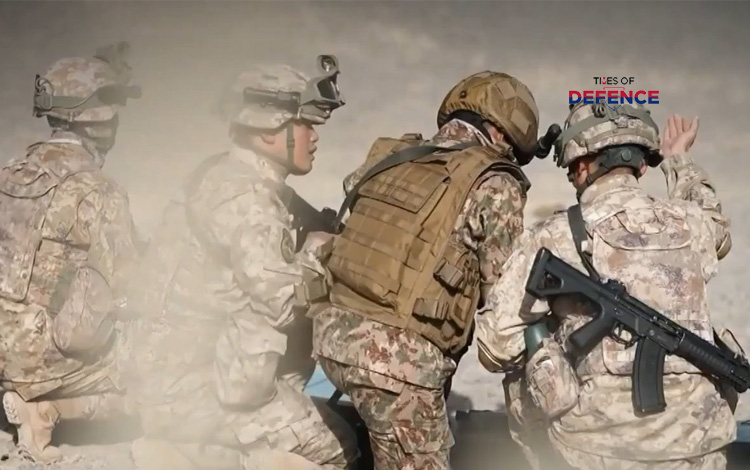
The People’s Liberation Army (PLA) Ground Force and the Pakistan Army have successfully concluded the bilateral “Karakoram-2026” joint army training exercise at a major tactical maneuver base near Korla in northwest China’s Xinjiang Uygur Autonomous Region.
Executing operational routines from October 14 to October 22, 2026, the nine-day maneuver represents the inaugural regular army-to-army joint exercise between China and Pakistan, complementing their historical “Warrior” series (PLA/Pakistan Army Special Forces) and “Shaheen” series (PLAAF/PAF Air Force) drills. Focused on joint counter-terrorism clearance and high-altitude combat operations, participating forces deployed mixed combat groupings operating under a unified C2 command structure. The final live-force validation exercise evaluated small unmanned aerial vehicle (sUAV) integration, mobile precision marksmanship, anti-drone armor protection, long-range sniper interdiction, and combined-arms assault maneuvers across high-altitude terrain profiles.
TECHNICAL SPECIFICATIONS: PLA & PAKISTAN ARMY KARAKORAM-2026 TACTICAL ARCHITECTURE
Exercise Framework & Command Structure
⚡ Exercise Designation: “Karakoram-2026” Joint Army Training (First Dedicated Regular Army Bilateral Exercise)
⚡ Operational Location: PLA Ground Force Training Base — Korla, Xinjiang Uygur Autonomous Region (XUAR)
⚡ Participating Entities: PLA Ground Force (Western Theater Command) & Pakistan Army Combined Infantry/Armour Elements
⚡ Tactical Objectives: High-altitude mountain warfare, counter-terrorism tactical clearance, C-UAS integration, and joint C2 interoperability 
Participating Mechanized Platforms & Armor Adaptations
💥 PLA Type 08 / ZBL-08 8×8 Wheeled Armored Infantry Fighting Vehicles (IFVs):
• Armor Upgrades: Fitted with cage/slat armor grilles over roof and side hull profiles to counter FPV kamikaze drones and overhead loitering munitions
• Armament: 35mm automatic cannon, 7.62mm coaxial machine gun, and HJ-73C anti-tank guided missile (ATGM) launchers
💥 Pakistan Army Armored/Mechanized Contingent:
• Platform Integration: Cross-domain operation with PLA-supplied Type 85-IIAP / VT-4 MBT and ZBL-08 armored vehicles
• Mobility Profile: High-altitude tactical maneuvering, steep incline navigation, and coordinated fire-and-movement assault drills
Tactical Training Modules & Technical Capabilities
🚀 sUAV Operations & Reconnaissance-Strike Loop:
• Deployment of small multi-rotor and fixed-wing reconnaissance drones for real-time target designation, artillery spotting, and battle damage assessment (BDA)
🚀 On-the-Move Engagement & Marksmanship:
• Dynamic firing exercises testing stabilized remote weapon stations (RWS) and small arms engagement of moving targets from armored chassis
🚀 Long-Range Precision Sniper Interdiction:
• High-altitude ballistics firing drills utilizing heavy anti-material sniper systems (12.7mm QBZ-141 / QBU-10 and Pakistan Army sniper assets)
🚀 Joint Command & Integrated C2 Architecture:
• Unified tactical command center combining PLA and Pakistan Army staff officers using encrypted data-link networks for multi-national unit routing
TIMES OF DEFENCE ASSESSMENT
The conclusion of the “Karakoram-2026” exercise in Xinjiang marks a significant expansion in China-Pakistan military interoperability. While previous military cooperation focused primarily on air force exercises (“Shaheen”) and specialized counter-terrorism drills (“Warrior”), establishing a dedicated army-to-army training framework demonstrates a shared focus on conventional combined-arms integration and regional border security.
From a technical perspective, Karakoram-2026 serves as a testing ground for integrating drone technology and anti-drone modifications into high-altitude infantry tactics. Equipping PLA Type 08 IFVs with anti-drone cage armor during live-force drills reflects hard-earned lessons from current conflicts, where cheap FPV drones pose a constant threat to armored columns. By training Pakistani soldiers directly on PLA-standard C4ISR networks and mechanized platforms, both nations build practical interoperability that supports joint counter-terrorism operations and protects critical infrastructure along the China-Pakistan Economic Corridor (CPEC).

