


Leonardo DRS has received a contract from BAE Systems to develop a next-generation infrared focal plane array (FPA) for the seeker assembly of the Terminal High Altitude Area Defense (THAAD) ballistic missile interceptor, the company announced on November 19, 2026.
While financial terms were not disclosed, the award tasks Leonardo DRS with advancing infrared detector architecture to strengthen terminal-phase target acquisition and discrimination against increasingly complex ballistic and maneuvering threats. Development and parallel foundry capacity expansion are underway at Leonardo DRS’s 200,000-square-foot infrared sensor facility in Dallas, Texas, aligning with broader efforts alongside prime contractor Lockheed Martin and seeker integrator BAE Systems to scale THAAD seeker and interceptor output—including a stated program objective to expand seeker production to roughly four times historical levels.
TECHNICAL SPECIFICATIONS: THAAD SEEKER SENSOR & INTERCEPTOR ARCHITECTURE
1. Next-Generation Infrared Sensor & Foundry Scaling
⚡ Sensor Subcontractor & Foundry: Leonardo DRS (Arlington, Virginia; development and capacity expansion at its 200,000-sq-ft foundry in Dallas, Texas)
⚡ Seeker Integration Partner: BAE Systems (seeker development and manufacturing across U.S. facilities including Nashua, New Hampshire; Endicott, New York; and Huntsville, Alabama)
⚡ Detector & Seeker Role: Next-generation infrared focal plane array (FPA) integrated into the THAAD interceptor seeker to capture thermal signatures of incoming ballistic warheads and decoys during high-speed terminal engagement
⚡ Production Scaling Target: Supports ongoing industrial expansion aimed at increasing THAAD seeker manufacturing to approximately four times historical production levels across cooled and uncooled infrared sensor lines 
2. THAAD Missile Interceptor & Air Defense System Profile
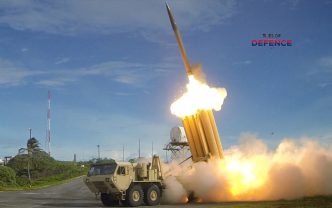
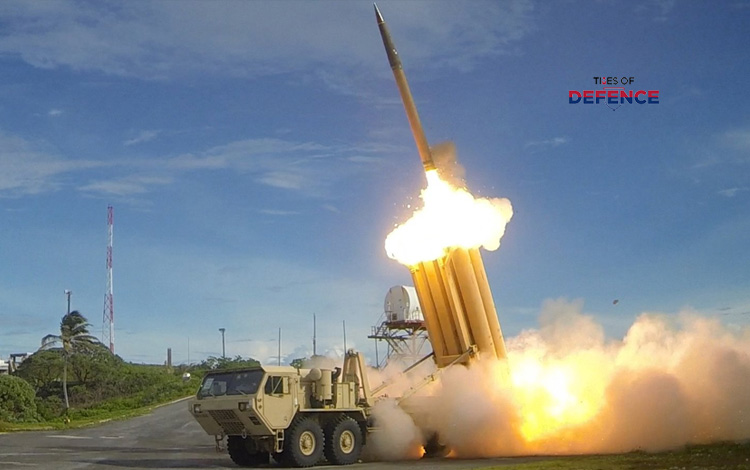
💥 Interceptor & System Prime: THAAD missile interceptor and battery architecture led by Lockheed Martin for the U.S. Missile Defense Agency and U.S. Army, alongside allied operators
💥 Intercept Regime & Lethality: Designed for high-altitude and upper-atmosphere terminal-phase defense against short-, medium-, and intermediate-range ballistic missiles, employing hit-to-kill kinetic energy rather than an explosive warhead
💥 Tactical & Sensor Network: Operates within an integrated air and missile defense architecture paired with the AN/TPY-2 X-band radar, tactical operations stations, and eight-round mobile truck launchers
TIMES OF DEFENCE ASSESSMENT
BAE Systems’ contract with Leonardo DRS for a next-generation THAAD infrared focal plane array highlights three critical shifts in missile defense sensing, industrial capacity scaling, and threat adaptation:
1. Advancing Infrared Discrimination Against Complex Ballistic Threats: As adversary ballistic missiles incorporate maneuvering reentry vehicles, decoys, and faster terminal profiles, higher-sensitivity infrared focal plane arrays are essential for reliable target detection, tracking, and hit-to-kill accuracy in contested environments.
2. Scaling High-Precision Seeker Foundries Alongside Interceptor Demand: Expanding specialized infrared sensor and seeker output toward roughly four times historical levels addresses one of modern air and missile defense’s toughest constraints—semiconductor and electro-optical detector fabrication capacity.
3. Deepening Tiered Industrial Specialization Across Missile Defense Primes: Pairing Lockheed Martin as system prime, BAE Systems on seeker engineering and integration, and Leonardo DRS on infrared focal plane arrays illustrates how specialized sensor foundries underpin high-end ballistic missile defense readiness.

