


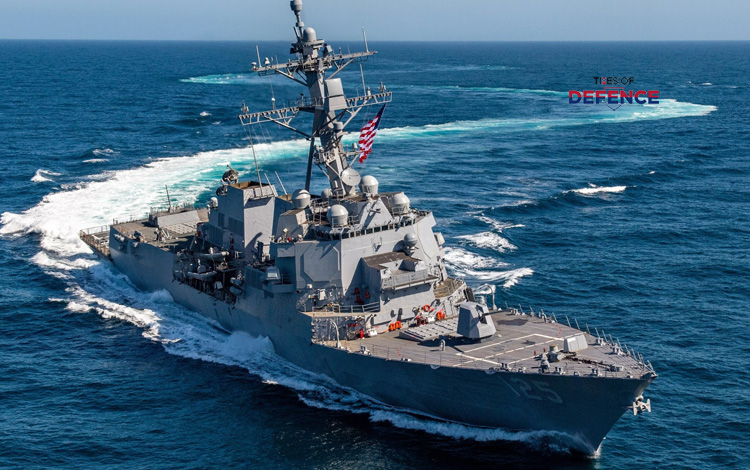
L3Harris Technologies announced the successful completion of U.S. Navy operational evaluations for its advanced **FleetLink** communications architecture, following rigorous live-environment trials conducted aboard an *Arleigh Burke*-class guided-missile destroyer.
Developed under the Navy’s Scalable, Modular, Radio Cluster (SMRC) program framework, FleetLink is engineered to replace legacy shipboard communication suites with a high-speed, modular, multi-band framework. The system integrates advanced software-defined waveforms and multi-source data processing, reinforced by NSA-certified Type 1 cryptographic security to ensure robust information dominance in contested maritime environments.
TECHNICAL SPECIFICATIONS: FLEETLink COMMUNICATIONS ARCHITECTURE
System Variants & Modular Configurations
⚡ Prime Contractor & Developer: L3Harris Technologies (Mission Critical Communications division)
⚡ Program Foundation: Developed under the U.S. Navy’s Scalable, Modular, Radio Cluster (SMRC) initiative
⚡ Core Architectural Variants:
• Four-Channel High-Frequency (HF) Variant: Optimized for long-range, beyond-line-of-sight (BLOS) maritime connectivity when satellite links are jammed or unavailable
• Four-Channel Multi-Band Variant: Designed for surface combatants to integrate simultaneous VHF/UHF/microwave tactical waveforms
• Submarine Multi-Band Variant: Tailored compact architecture engineered to withstand the rigorous space, weight, and environmental constraints of subsurface platforms 
Security, Cryptography & Network Interoperability
💥 Cryptographic Modernization: Features latest-generation National Security Agency (NSA)-certified Type 1 cryptographic hardware and software architectures
💥 Data Integration & Waveforms: Combines proprietary and open-standard L3Harris waveforms to rapidly ingest and fuse multi-source tactical data across distributed surface and subsurface strike groups
💥 Legacy Replacement Role: Directly replaces aging, siloed shipboard radios while complementing broader fleet network upgrades (such as BFTN+) to ensure resilient tactical data-link continuity
TIMES OF DEFENCE ASSESSMENT
The successful conclusion of FleetLink’s operational evaluation aboard an *Arleigh Burke*-class destroyer underscores three critical modernization trends in naval communications:
1. **Mitigating Vulnerabilities in Contested Electromagnetic Spectrums**: As peer adversaries expand advanced electronic warfare and anti-satellite (ASAT) capabilities, relying solely on satellite communications poses severe tactical risks. FleetLink’s robust multi-band and high-frequency capabilities guarantee resilient, beyond-line-of-sight data paths during GNSS or SATCOM denial.
2. **Standardizing Scalable Modular Architecture Across Surface and Subsurface Fleets**: Utilizing a common technological baseline across three distinct configurations (surface multi-band, HF, and submarine variants) drastically simplifies logistics, reduces maintenance footprints, and streamlines hardware spiral upgrades for the U.S. Navy.
3. **Future-Proofing Interoperability via Cryptographic Modernization**: Integrating NSA-certified security directly into a flexible, multi-channel modular cluster ensures that surface combatants can securely exchange high-speed multi-domain data with joint and allied coalition partners without bottlenecks.

